 Instrumentiverse

Introduction to Quartal Harmony
Traditional harmony relies heavily on tertian chords built from stacked thirds, but quartal harmony offers a refreshing alternative by stacking perfect fourths instead. This approach creates open, modern sounds that many songwriters crave for distinctive textures in their music. Whether you are a beginner exploring advanced harmony or an intermediate writer looking to refresh your progressions, understanding quartal structures can elevate your compositions in meaningful ways. Quartal harmony draws from scales just like diatonic writing but emphasizes intervals of a fourth. This produces less dense, more ambiguous sonorities compared to major or minor triads, allowing for greater flexibility in emotional expression and harmonic color.
In this comprehensive guide, we explore construction methods from major and minor scales, detailed voice leading techniques, real-world examples across genres, and practical exercises that you can apply immediately. By the end, you will have a solid foundation for integrating these fresh sounds into your existing songwriting workflow while addressing key concepts like tension, resolution, and smooth voice leading within quartal frameworks.
Building Quartal Chords from Major and Minor Scales
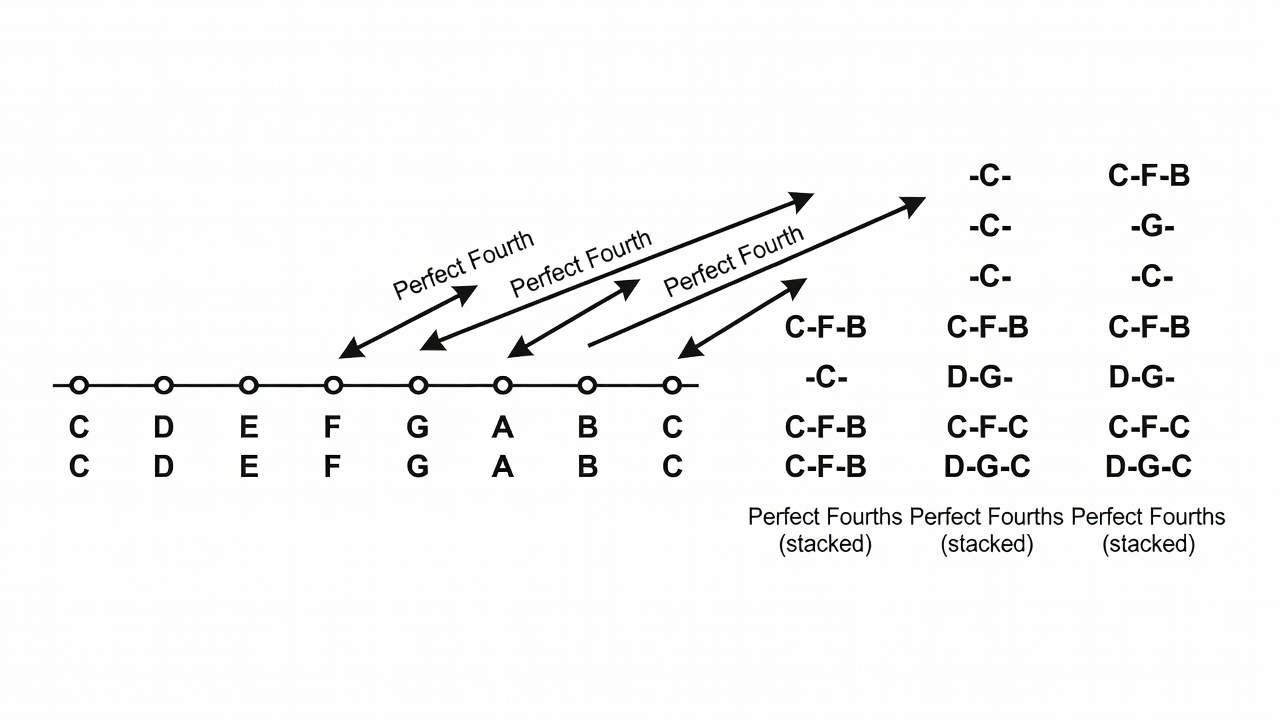
Start with the C major scale: C D E F G A B. To form a basic quartal chord, stack perfect fourths. For example, C to F is a fourth, then F to Bb creates a three-note quartal voicing: C-F-Bb. In pure scale tones without chromatic alteration, try C-F-B, though B sits a tritone away in some contexts and can introduce subtle dissonance. Extend this to four-note quartal chords by adding another fourth above, such as C-F-Bb-Eb, which works well over a C pedal point for a suspended, floating effect.
For minor scales, use the natural minor. In A minor (A B C D E F G), stack A-D-G for a quartal chord or expand to A-D-G-C. These voicings avoid the strong root-third-fifth definition of triads, giving a floating quality ideal for atmospheric song sections or introspective verses. Try the same process in D major: D-G-C-F or D-G-C-F-Bb. Experiment across modes like Dorian or Mixolydian to discover even more colorful quartal options that blend seamlessly with your melodies.
Step-by-Step Construction of Quartal Progressions
1. Choose a root note and stack two or three fourths above it within the chosen scale.
2. Resolve tension by moving voices in parallel, similar, or contrary motion by step or fourth while maintaining common tones where possible.
3. Layer over a melody by sustaining quartal chords beneath sustained notes or using them as passing harmonies on weak beats.
4. Invert the chords to keep the top voice moving smoothly and avoid large leaps that disrupt flow.
Try a simple progression in C: C-F-Bb to G-C-F, then resolve to F-Bb-Eb. This creates smooth movement while maintaining quartal color. In G major, build G-C-F-Bb followed by D-G-C-F for a pleasing cycle. Record these at a slow tempo and listen for how the ambiguity invites melodic invention above them. Adjust inversions frequently to suit vocal ranges or guitar fingerings.
Comparing Quartal Chords to Triads and Seventh Chords
Triads deliver clear major or minor identity that grounds a listener immediately, while seventh chords add richer tension through the seventh interval and guide resolution strongly toward the tonic. Quartal chords sit between these, offering ambiguity that suits modern genres without forcing a clear emotional direction. For instance, a C major triad (C-E-G) feels grounded and stable, but C-F-Bb sounds suspended and open-ended, perfect for building anticipation. In jazz contexts, quartal voicings often replace dominant seventh chords for a less predictable resolution path that keeps listeners engaged.
Voice leading in quartal harmony prioritizes common tones and stepwise motion to manage tension and release effectively. This mirrors principles found in classical counterpoint but adapts them to fourth-based intervals, resulting in a contemporary yet accessible sound. The reduced density also leaves more sonic space for melody and rhythm sections to shine.
Audio Examples in Pop, Jazz, and Indie Tracks
Listen for quartal sounds in Herbie Hancock's jazz improvisations where stacked fourths create layered textures beneath solos. Indie tracks by artists like Radiohead frequently employ quartal voicings in atmospheric verses to evoke introspection without traditional chordal weight. Pop examples appear in chord layers by Coldplay during bridge sections, adding freshness and emotional lift. These voicings add distinctive color without clashing with diatonic melodies, making them versatile across styles from folk-infused indie to electronic-infused jazz fusion.
Practical Exercises for Layering Harmony
- Take a simple melody in G major and harmonize it with quartal chords on beats 1 and 3, sustaining each for two beats while singing the tune.
- Record a two-bar loop using only stacked fourths from the C major scale, then improvise or write a new melody over it to explore melodic freedom.
- Compare your results to traditional tertian versions of the same progression to hear the textural difference and decide which fits your song's mood.
- Transpose the same quartal progression to three different keys and note how the open quality translates across registers.
- Layer a quartal chord beneath a single sustained melody note, then resolve the harmony while keeping the melody static to practice tension control.
Focus on resolution by ending phrases on a quartal chord that shares tones with the next section's tonic for seamless integration.
Understanding Tension, Resolution, and Voice Leading
Tension arises from the perfect fourth's neutral quality, which lacks the pull of a major third. It resolves by moving to a chord with more defined intervals or returning to a tertian sonority that provides closure. Effective voice leading keeps outer voices moving by step while inner voices sustain common tones, preventing abrupt jumps and maintaining musical logic. For example, in the progression C-F-Bb to G-C-F, move the top voice from Bb to C while the bottom moves from C to G in contrary motion. This technique integrates seamlessly with existing diatonic writing for hybrid progressions that feel both familiar and innovative. For deeper reference, explore resources at Wikipedia and MusicTheory.net.
Conclusion
Quartal harmony expands your songwriting palette with modern, evocative sounds that differentiate your work. Practice building from scales, apply voice leading rules consistently, and experiment across genres to discover fresh textures that stand out in a crowded musical landscape.
FAQ
What are common pitfalls when starting with quartal harmony? Overusing parallel motion can sound static; vary inversions and include occasional contrary motion instead to keep progressions dynamic.
How do I integrate quartal chords with diatonic writing? Use them as passing harmonies, color tones, or brief substitutions within a primarily tertian framework rather than replacing entire sections at once.
Can quartal harmony work in fast-tempo songs? Yes, but keep voicings to three notes or fewer and ensure clear voice leading so the ear can follow the movement at speed.
Do I need special equipment or software to practice? A keyboard, guitar, or free notation app suffices; focus on hearing the intervals rather than complex production.

No comments yet. Be the first!