 Instrumentiverse

Introduction to Symmetrical Scales in Modern Songwriting
Symmetrical scales offer songwriters powerful alternatives to traditional diatonic major and minor scales. These scales, built from repeating interval patterns, create exotic, ambiguous, or tense harmonic colors that stand out in contemporary music. Unlike standard scales with clear tonal centers, symmetrical scales like the whole-tone and diminished provide symmetry that blurs resolution, making them ideal for film scores, jazz-infused pop, and experimental tracks. Many modern producers and composers turn to these tools when standard diatonic harmony feels too predictable or emotionally limited.
This comprehensive guide explores their construction using core music theory concepts, applications in progressions and melodies, direct comparisons to major and minor scales, and step-by-step integration methods with real-world examples. You will also find expanded practical exercises, common mistakes to avoid, and answers to frequently asked questions. By mastering these scales, songwriters gain fresh options for creating tension, ambiguity, and memorable sonic landscapes.
Understanding Whole-Tone Scales: Construction and Sound
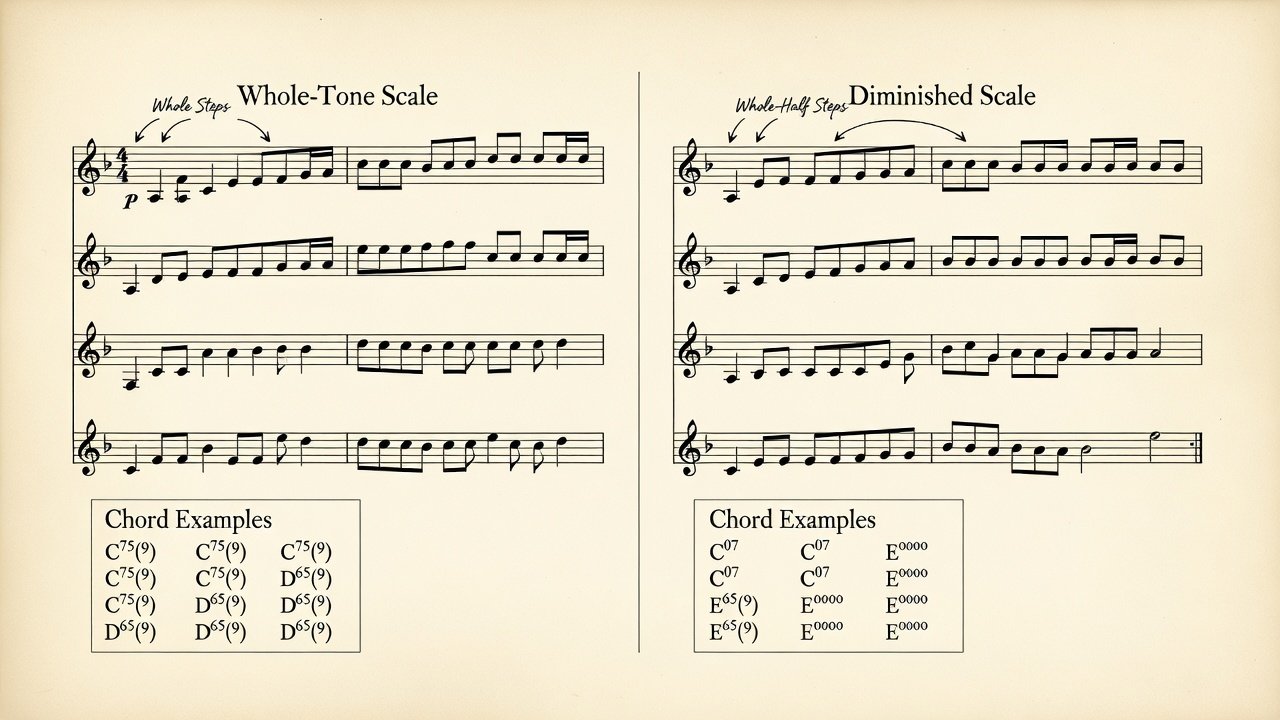
The whole-tone scale consists entirely of whole steps, resulting in six notes per octave. Starting on C, it ascends as C-D-E-F#-G#-A#-C. This even division eliminates the half-step tension found in major scales, producing a dreamy, floating quality often associated with impressionist composers such as Debussy. Its symmetry means every note can function as a potential root, creating harmonic ambiguity perfect for evoking mystery or otherworldliness in songwriting. For instance, the same scale can imply multiple tonal centers simultaneously, which is why it excels in atmospheric verses or bridge sections that need to feel unresolved.
Transposing the scale is straightforward because of its repeating pattern. Shifting the entire scale up by a whole step simply moves to the next set of six notes while preserving the identical intervallic structure. This property allows songwriters to modulate effortlessly between keys without breaking the exotic mood.
Diminished Scales: The Half-Whole and Whole-Half Variants
Diminished scales come in two forms: the half-whole diminished (alternating half and whole steps) and whole-half diminished. For example, the C half-whole diminished scale is C-Db-Eb-E-F#-G-A-Bb-C. These eight-note scales generate strong tension through their tritone intervals and diminished chords, suiting dramatic builds or unsettling verses. The whole-half version begins with a whole step and alternates thereafter, offering a slightly different flavor of dissonance that works well over dominant chords needing extra bite.
Both whole-tone and diminished scales repeat their patterns symmetrically, allowing easy transposition and modulation without losing their core character. Songwriters often combine both types within a single track to create dynamic contrast between floating dreaminess and sharp tension.
Building Progressions with Symmetrical Scales
To create progressions, stack chords derived from these scales. For whole-tone, try augmented triads moving in whole steps: C+ to D+ to E+. This produces a sense of perpetual motion without strong resolution. In practice, you might hold a C augmented chord for two bars, then shift to D augmented while maintaining a pedal tone on the low C note in the bass. The result feels like the harmony is gliding rather than progressing toward a clear tonic.
Diminished progressions often use diminished seventh chords in sequence, such as Cdim7 to Ddim7 to Edim7. These can be layered over a static bass note to heighten suspense before resolving unexpectedly into a diatonic major or minor section. A concrete example in the key of A minor would involve playing Am, then inserting a C half-whole diminished run over the dominant E7 chord to add chromatic tension before returning to Am.
Experiment further by mixing symmetrical chords with diatonic ones. Start a verse with standard minor chords and insert a whole-tone augmented chord at the end of each phrase for a sudden lift into ambiguity. Resources like Music Theory resources offer interactive chord builders that help visualize these symmetrical movements in real time.
Melodic Applications Over Chords
Melodies over symmetrical scales shine when emphasizing their unique intervals. Over a whole-tone backing, use leaps of major thirds or augmented fourths to highlight the exotic flavor. For diminished scales, incorporate chromatic passing tones that align with the half-step movements. A practical melody example in C whole-tone might begin on C, leap to E, then to G#, and resolve back to A# before returning to C, creating a circular, hypnotic line.
When writing over diminished harmony, try a descending line that follows the scale's alternating pattern, such as E to Eb to C# to C over a Cdim7 chord. This technique adds emotional depth without overwhelming listeners. Record several short phrases and transpose them symmetrically across different octaves to discover new melodic variations that fit your song's emotional arc.
Direct Comparisons to Major and Minor Scales
Major scales offer clear I-IV-V progressions with strong resolution, while minor scales introduce relative sadness through the minor third. Symmetrical scales, by contrast, avoid such predictability. A whole-tone scale lacks the leading tone of major scales, resulting in less pull toward tonic and a more suspended atmosphere. Diminished scales heighten dissonance compared to natural minor, making them suitable for modern genres seeking edge. Use them sparingly as color shifts rather than full replacements for diatonic harmony.
Side-by-side listening reveals the difference quickly. Play a standard C major scale melody, then switch to the C whole-tone version over the same chord progression. The symmetrical version immediately feels more cinematic and less grounded. Similarly, replacing a natural minor scale with half-whole diminished over the same chords introduces a jazz-fusion tension that can elevate a chorus or breakdown section.
Practical Steps to Integrate Symmetrical Scales
- Start by improvising over a drone note using one symmetrical scale for five minutes daily to internalize the intervallic sound.
- Identify chords in your existing track that feel static and replace or overlay with augmented or diminished voicings for instant color.
- Record short melodic phrases in the target scale and transpose them symmetrically to explore unexpected modulations.
- Combine with diatonic elements by playing a verse in minor, then switching to whole-tone for the chorus lift to create emotional contrast.
- Listen back critically and adjust for balance, ensuring the exotic colors enhance rather than distract from the song's core message.
- Layer symmetrical scale runs in the background of instrumental breaks while keeping vocals in a familiar key for accessibility.
- Practice voice leading exercises that smoothly connect symmetrical chords to diatonic ones, avoiding abrupt jumps.
- Collaborate with other musicians by sharing scale charts and experimenting together in a single session to spark new ideas.
Common Pitfalls and How to Avoid Them
- Overusing symmetry can lead to monotony; balance with contrasting diatonic sections to maintain listener interest.
- Ignoring voice leading may create awkward jumps, so always smooth transitions between scale tones during chord changes.
- Forgetting context: these scales work best as accents in accessible song structures rather than dominating entire arrangements.
- Neglecting rhythmic variation often makes symmetrical passages feel static; vary note lengths and syncopation to keep energy high.
- Overloading the mix with too many symmetrical layers can muddy the harmony; start with one scale at a time before combining.
Frequently Asked Questions
How do symmetrical scales differ from modes?
Modes derive from diatonic scales with shifted tonics, while symmetrical scales use fixed interval patterns independent of major/minor frameworks, resulting in greater harmonic ambiguity.
Can beginners use these scales effectively?
Yes, by starting with simple drone exercises and short phrases before attempting full progressions or complex modulations.
Where can I hear examples in popular music?
Explore impressionist influences in modern soundtracks or jazz standards that employ these scales for color and tension.
Do symmetrical scales work in all genres?
They thrive in electronic, ambient, jazz, and cinematic music but can add spice to rock or pop when used judiciously as transitional elements.
What software helps visualize these scales?
Most digital audio workstations include scale highlighting features, and online tools at authoritative music education sites make exploration easy.
Further reading is available at encyclopedic music references for deeper historical context on scale development.
Conclusion
Symmetrical scales unlock fresh harmonic possibilities for songwriters ready to move beyond standard options. With consistent practice, whole-tone and diminished scales become intuitive tools for creating tension, ambiguity, and exotic appeal in your music. Begin incorporating them gradually and let your ear guide the creative process.


No comments yet. Be the first!