 Instrumentiverse
Introduction to Counterpoint for Songwriters
Counterpoint stands as one of the most powerful yet accessible tools in music theory for songwriters who want to elevate their compositions beyond standard chord progressions and single-note melodies. At its essence, counterpoint involves weaving two or more independent melodic lines that interact harmoniously while maintaining their own identity. This creates richer textures, greater emotional depth, and a sense of movement that homophonic writing—where a primary melody rides over chordal accompaniment—often lacks. For beginners, understanding counterpoint opens doors to more dynamic songs that feel alive and layered, whether you write pop ballads, folk tunes, electronic tracks, or cinematic pieces.
The technique draws from centuries of classical tradition but translates seamlessly into modern songwriting. By focusing on voice independence and strategic use of consonance and dissonance, you can transform simple chord changes into compelling musical conversations between lines. This guide explores the fundamentals, species rules, practical integration with harmony, real-world examples, step-by-step exercises, DAW applications, pitfalls, and frequently asked questions to give you a complete foundation.
Understanding Independent Melodic Lines
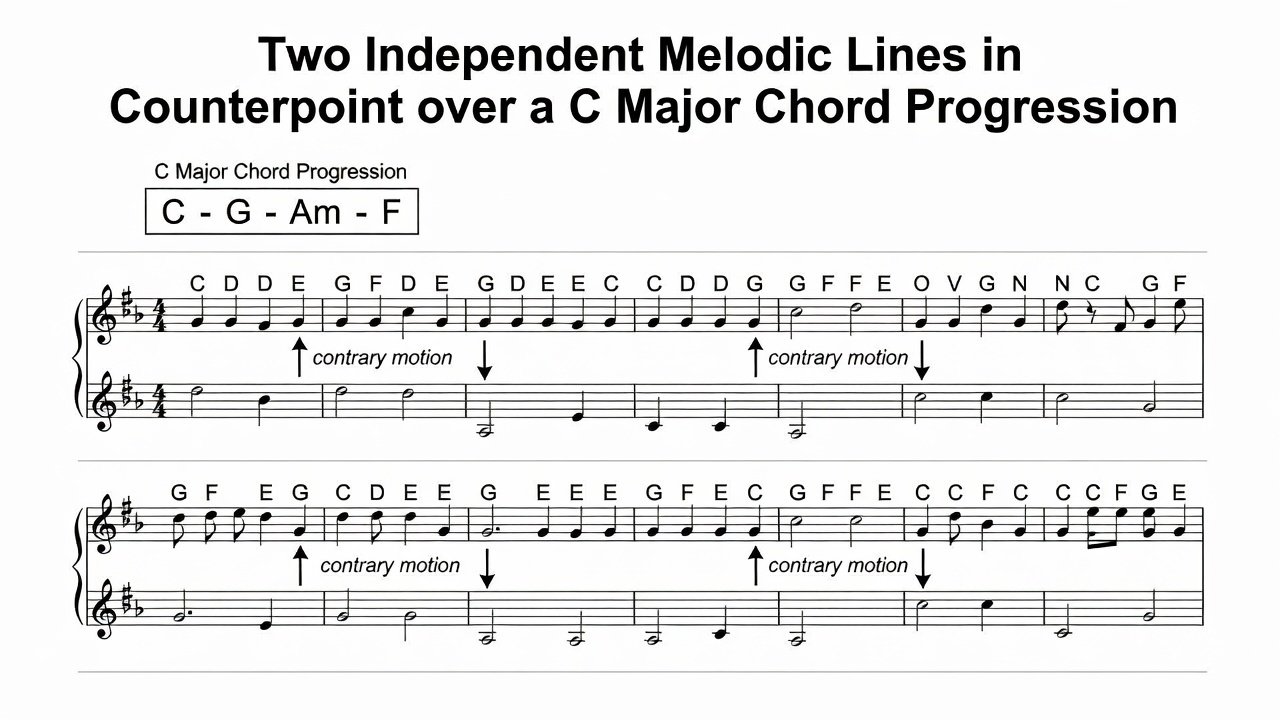
Independent melodic lines form the heart of counterpoint. Each voice must possess its own rhythmic profile, contour, and direction rather than simply doubling the main melody. Effective counterpoint relies heavily on motion types: contrary motion (lines moving in opposite directions), oblique motion (one line stays static while the other moves), and similar motion (both move in the same direction but at different intervals). Parallel motion should be used sparingly because it reduces independence and can make lines sound like a single thickened melody.
Beginners often start with a cantus firmus, a smooth, mostly stepwise melody typically written in whole notes. The second voice then responds with its own character, creating interplay that supports the underlying harmony without duplicating it. This approach teaches songwriters how to balance autonomy and cohesion, resulting in arrangements that feel both intricate and singable.
Species Counterpoint Rules Explained in Detail
Species counterpoint provides a graduated method for learning these skills. In first species, every note in the added voice aligns rhythmically with the cantus firmus, producing note-against-note writing. Only consonant intervals—unisons, octaves, perfect fifths, and thirds or sixths—are permitted on strong beats, with careful attention to avoiding parallel perfect intervals. Second species introduces two notes against one, allowing passing tones that create gentle dissonance on weak beats while resolving to consonance. Third species expands to four notes against one, incorporating more rhythmic variety and neighbor tones. Fourth species focuses on syncopation through tied notes that create suspensions, training you to handle tension and release. Fifth species combines all previous elements into florid, free counterpoint that resembles real composition.
These rules are not rigid constraints but training wheels that develop your intuition for balanced lines. Always resolve leading tones upward by step, maintain a clear tonal center, and ensure each voice could stand alone as a viable melody. Over time, internalizing these guidelines allows you to bend them creatively in original songs.
Integrating Counterpoint with Harmony Basics
Effective counterpoint never exists in isolation from harmony. Each melodic line should reinforce the chord progression while adding color through non-chord tones that resolve properly. For example, over a C major to F major progression, one voice might outline the root and third of C while the second voice moves through the fifth and seventh before resolving into the F chord tones. This creates a sense of forward motion and emotional nuance that pure block chords cannot achieve.
Pay attention to vertical intervals at key moments: strong beats favor perfect consonances for stability, while weaker beats welcome thirds and sixths for warmth. By aligning your lines with chord tones on downbeats and using passing or neighbor tones in between, you maintain harmonic clarity while enjoying melodic freedom. This integration is what gives songs their signature emotional depth, allowing listeners to feel both the structure of the harmony and the expressive conversation between voices.
Examples from Classic and Modern Songs
Classic repertoire offers clear models. Johann Sebastian Bach’s Two-Part Inventions demonstrate strict yet musical counterpoint where each hand pursues independent ideas that still outline the harmony. Ludwig van Beethoven extended these principles in his late string quartets, using counterpoint to generate dramatic tension. In popular music, The Beatles’ “Blackbird” features a solo guitar part that functions like two-voice counterpoint through alternating bass and melody lines. Contemporary artists such as Jacob Collier frequently employ dense yet transparent counterpoint in vocal arrangements, while film composers like John Williams use independent lines in orchestral scores to heighten emotional impact during pivotal scenes.
These examples illustrate how counterpoint enhances storytelling in music. Studying them reveals practical patterns you can adapt: start with a memorable cantus firmus, then craft a responsive line that echoes motifs without copying them exactly.
Step-by-Step Exercises for Creating Two-Voice Counterpoint
Practice is essential. Follow this structured sequence to build skill:
- Select a simple diatonic progression such as I–vi–IV–V in C major and play it slowly on piano or guitar.
- Compose a cantus firmus of eight to twelve notes using primarily stepwise motion and occasional leaps of a third or fourth, ending on the tonic.
- Write a second voice beginning a third or sixth above the first line, employing contrary motion wherever possible and introducing rhythmic contrast.
- Check each strong beat for consonant intervals and resolve any dissonances immediately.
- Play both lines together, then separately, ensuring each remains satisfying on its own.
- Transpose the exercise to different keys and vary the rhythmic values to develop flexibility.
- Record multiple versions and compare how small changes in motion affect the emotional character.
Repeat these exercises across several sessions. Over weeks you will notice improved ability to hear multiple lines simultaneously and greater confidence when arranging songs.
Comparing Counterpoint to Homophonic Writing
Homophonic textures prioritize a single dominant melody supported by harmonic filler, delivering immediate clarity and groove—ideal for verses or anthemic choruses. Counterpoint, by contrast, distributes melodic interest across voices, fostering complexity and intimacy. Many successful songs blend both approaches: verses remain homophonic for focus while bridges or final choruses introduce counterpoint lines that add richness and surprise. Understanding when to deploy each texture prevents overcrowding and keeps listeners engaged throughout a track.
Applying Techniques in DAWs
Digital audio workstations make experimentation effortless. In Ableton Live, create separate MIDI tracks for each voice and use the Scale MIDI effect to keep lines diatonic. Logic Pro’s chord trigger and arpeggiator tools can generate responsive counter-lines quickly, after which you edit for independence. FL Studio users benefit from the piano roll’s ghost notes feature to visualize multiple melodies simultaneously. Always assign contrasting instrument patches or synth timbres to each voice so they remain distinguishable in the mix. Export individual stems and listen on different playback systems to verify balance and clarity before finalizing arrangements.
Common Pitfalls to Avoid
- Excessive parallel motion that collapses voices into one perceived line.
- Overlooking rhythmic differentiation, resulting in two lines that feel like one rhythm doubled.
- Placing unresolved dissonances on strong beats, which creates harmonic instability.
- Neglecting dynamic contrast and articulation, making lines sound mechanical rather than expressive.
- Writing lines that are too similar in range and contour, reducing independence.
- Forgetting to check the combined texture against the intended chord progression at every cadence.
Avoiding these issues requires slow, deliberate listening during the writing process.
FAQ: Beginner Questions on Voice Independence and Consonance
How do I ensure voices remain independent?
Prioritize contrary or oblique motion and give each line distinct rhythmic patterns. A useful test is to solo each voice: if either sounds incomplete or boring alone, adjust the other line to restore balance.
What intervals create consonance in counterpoint?
Perfect intervals (unison, octave, fifth) provide stability on strong beats, while imperfect consonances (thirds and sixths) add color on weaker beats. Seconds, sevenths, and tritones function as dissonances that must resolve.
Can counterpoint work in pop or electronic music?
Yes. Many modern productions layer vocal harmonies or synth pads using counterpoint principles to create movement without cluttering the arrangement.
How long should my counterpoint lines be?
Start with phrases of four to eight bars that match the length of your chord progression, then extend or vary them as your ear develops.
Is counterpoint only for classical music?
No. It appears across genres whenever songwriters seek richer textures, from folk fingerpicking patterns to hip-hop instrumental layers.
For further exploration, consult authoritative references such as Britannica’s counterpoint overview and structured lessons at MusicTheory.net. With consistent application of these principles, your songwriting will gain new dimensions of depth and sophistication.


No comments yet. Be the first!