 Instrumentiverse

Modulation Techniques: Smooth Key Changes for Dynamic Songs
Key changes, or modulations, serve as essential devices in music composition that allow songwriters to shift the tonal center of a track. This creates emotional contrast, heightens tension, or delivers satisfying resolution. Beginners and intermediate musicians benefit greatly from learning these methods, as they turn repetitive chord progressions into compelling, memorable pieces. The following guide examines three core techniques in detail: direct modulation, pivot-chord modulation, and common-tone modulation. Each is illustrated with concrete chord examples drawn from major and minor scales, along with guidance on how these shifts interact with basic harmony principles.
Modulation works by redefining the tonic note and its accompanying scale. When executed well, it keeps the listener engaged through surprise or gradual transformation. These approaches connect directly to chord functions such as tonic, subdominant, and dominant roles, helping maintain musical logic even during transitions.
Foundational Concepts in Harmony and Scales
Successful modulation rests on understanding diatonic chords and their relationships across keys. In any major key, the scale degrees produce seven chords: three major, three minor, and one diminished. For instance, the C major scale yields C (I), Dm (ii), Em (iii), F (IV), G (V), Am (vi), and Bdim (vii°). Minor keys follow a similar pattern with adjustments for the raised leading tone. Related keys share many of these chords, making transitions smoother. Closely related keys include those a fifth apart or sharing the same key signature. Distant keys require more preparation to avoid jarring effects. Voice leading remains critical: move individual notes by step or common tones whenever possible to preserve flow.
Before applying any technique, establish the original key clearly with a cadence, such as V7-I. This sets expectations that the modulation can then fulfill or subvert. Listeners respond to these changes because they alter perceived brightness, tension, or mood without breaking overall coherence.
Direct Modulation: Creating Immediate Impact
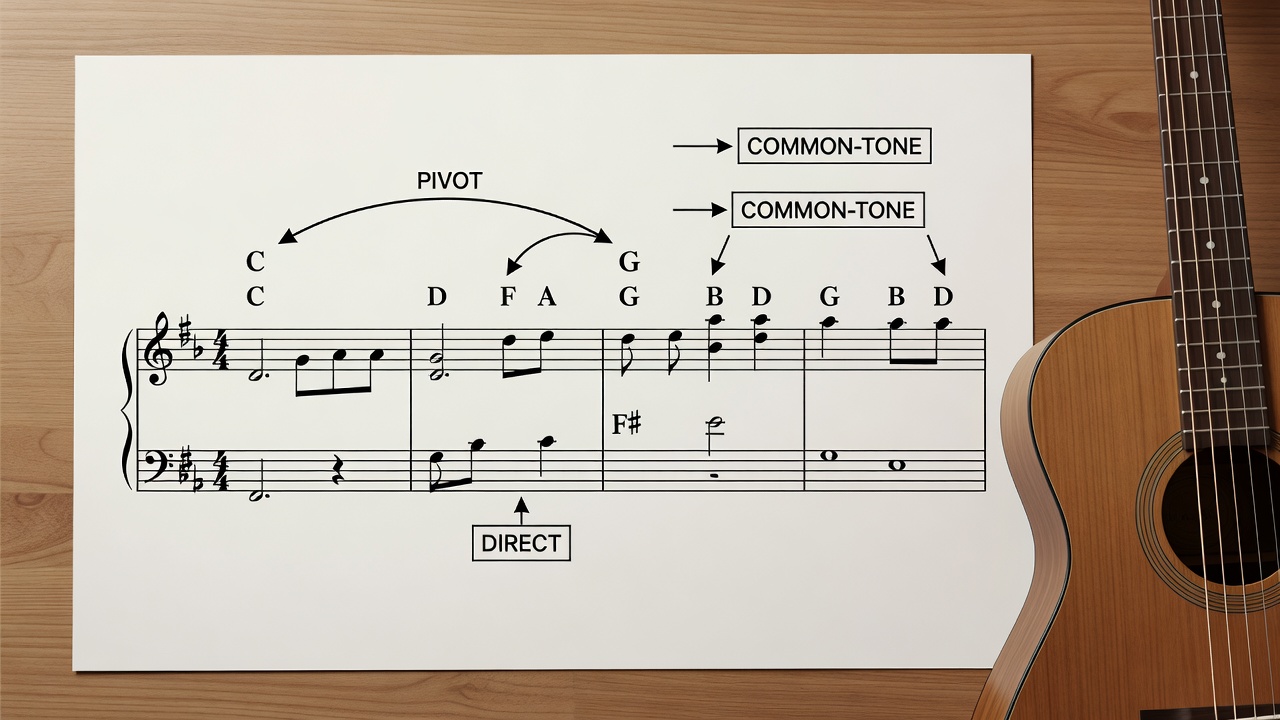
Direct modulation jumps abruptly from one key to another, often landing directly on the new tonic chord. This method suits energetic builds, such as lifting a chorus into a higher register for dramatic effect. Consider a progression in C major using C-F-G-C. After the final C, move straight to D major with D-G-A-D. The whole-step shift feels uplifting and fresh, instantly raising the song's energy.
Step-by-step application: First, confirm the starting key with a strong cadence. Second, insert the new tonic chord without intermediary harmony. Third, reinforce the new key immediately with its own dominant-to-tonic movement. This technique works especially well when moving up by a semitone or whole step, common in pop and rock for final choruses. The suddenness can surprise listeners and boost engagement, though overuse risks sounding formulaic.
Pivot-Chord Modulation: Building Logical Bridges
Pivot-chord modulation employs a single chord that belongs to both the original and target keys. This chord serves dual functions, allowing the ear to accept the shift naturally. In a move from C major to G major, the C major chord acts as I in the first key and IV in the second. Follow it with D7, the dominant of G, to solidify the arrival.
Another example involves shifting from A minor to C major using the chord F, which functions as VI in A minor and IV in C major. Practice identifying these shared chords by comparing scale-degree numbers between two keys. Pivot modulation preserves harmonic flow better than direct jumps and suits verses that evolve into pre-choruses. Songwriters often favor this method when they want emotional development without startling the audience.
Common-Tone Modulation: Achieving Subtle Fluidity
Common-tone modulation maintains one sustained pitch while the surrounding harmony changes keys. The held note provides continuity, making the transition feel seamless and introspective. From C major to A minor, the note E can link a C major chord to an A minor chord. Extend the technique by holding the common tone across two or three measures while introducing new chords from the target key.
This approach excels in ballads and cinematic scoring where gradual emotional shading is desired. It also pairs effectively with pedal points or sustained vocal lines. Compared with other methods, common-tone modulation offers the least disruption, allowing listeners to focus on melody or lyrics rather than the harmonic change itself.
Comparing the Three Techniques and Their Effects
Each modulation type influences harmonic flow and audience response differently. Direct modulation delivers high impact and excitement but can feel abrupt if unprepared. Pivot-chord modulation provides structural elegance and supports longer phrases. Common-tone modulation maximizes smoothness and works best for reflective passages. Choosing the right method depends on the desired emotional arc: use direct for climaxes, pivot for development sections, and common-tone for intimate moments. Testing each on the same chord progression reveals how listener attention shifts with the speed and subtlety of the change.
Real-World Song Examples
Numerous well-known tracks demonstrate these techniques in action. Whitney Houston's "I Will Always Love You" employs direct modulation to elevate the final chorus. The Beatles frequently used pivot chords, as heard in "Yesterday," where subtle shifts enhance the reflective tone. Common-tone examples appear in many film scores and ballads by artists such as Adele. For deeper study of these examples and interactive exercises, visit musictheory.net. Additional reference material is available at classicfm.com, which explores modulation across classical and contemporary works.
Step-by-Step Exercises for Practical Application
Apply the concepts through targeted exercises that reinforce chord and scale relationships:
- Exercise 1: Compose a four-bar verse in F major using I-IV-V-I. Apply direct modulation up a whole step to G major for the chorus, then resolve back if desired.
- Exercise 2: Create an eight-bar phrase in C major. Insert a pivot chord (Am) to modulate to F major, confirming the new key with its dominant seventh.
- Exercise 3: Write a melody over G major chords and sustain the note D while shifting to E minor via common-tone modulation; add supporting chords from the new key.
- Exercise 4: Compare all three techniques on the same starting progression and record which version best matches the intended mood.
- Exercise 5: Analyze a favorite song by identifying the modulation type and noting how it affects the overall structure.
Record your attempts and listen critically for voice-leading smoothness and emotional effectiveness. Repeat each exercise in different keys to build versatility.
Common Pitfalls and Frequently Asked Questions
Many songwriters encounter similar challenges when first experimenting with modulation. Abrupt key changes without preparation often confuse listeners; always use a cadence or pivot to anchor the transition. Over-relying on direct modulation can make a song feel disjointed. Ignoring voice leading produces awkward leaps that break immersion. Choosing distant keys without sufficient common tones increases difficulty.
Frequently asked questions include: Which keys modulate most easily? Closely related keys sharing four or more diatonic chords work best. How long should the new key last? Even two or three bars can create impact if the return to the original key is handled gracefully. Can modulation occur within a single phrase? Yes, especially with common-tone methods. What if the modulation feels forced? Simplify by returning to the original key or testing a different pivot chord.
By addressing these issues early, songwriters develop more reliable instincts for when and how to change keys effectively.
Conclusion
Mastering direct, pivot-chord, and common-tone modulations equips songwriters with versatile tools for shaping emotional journeys. Through consistent practice with scales, chords, and real examples, these techniques become intuitive additions to any creative process. Experiment freely and refine based on how each shift resonates with listeners.
No comments yet. Be the first!