 Instrumentiverse
Introduction to Extended Chords
Extended chords represent the natural progression beyond basic triads and seventh chords in music theory. For songwriters seeking richer harmonic textures, mastering 9ths, 11ths, and 13ths opens doors to more expressive progressions. These chords add layers of color and tension that triads alone cannot achieve, making them essential tools in genres from pop and jazz to indie and electronic music. This beginner-to-intermediate guide walks through every step of understanding, building, and applying these chords so you can immediately integrate them into your compositions.
Building on major and minor scales, extended chords stack additional thirds above the seventh. This guide provides clear formulas, descriptions of keyboard diagrams, and practical applications tailored for beginners to intermediates. Whether composing on piano or guitar, understanding these structures elevates your songwriting from simple to sophisticated. You will also discover how these chords compare in tension to basic triads, explore common substitutions, study real-world song examples, and complete targeted exercises that reinforce learning.
Understanding the Basics of Chord Extensions
Triads consist of three notes (root, third, fifth), while seventh chords add a seventh. Extended chords continue this pattern by including the ninth, eleventh, or thirteenth. These notes derive directly from the major or minor scale, creating intervals that introduce dissonance and resolution opportunities. The ninth is the same as the second scale degree an octave higher, the eleventh matches the fourth, and the thirteenth aligns with the sixth. This stacking creates a fuller sound that feels more complete and emotionally nuanced.
Compared to triads, extended chords heighten emotional tension. A simple C major triad feels stable and resolved, but adding extensions creates movement and intrigue. Songwriters often use this to build anticipation in verses before resolving in choruses. The added notes produce subtle clashes that resolve satisfyingly when the progression moves forward, giving listeners a sense of journey rather than static harmony.
Formulas for Building 9th, 11th, and 13th Chords
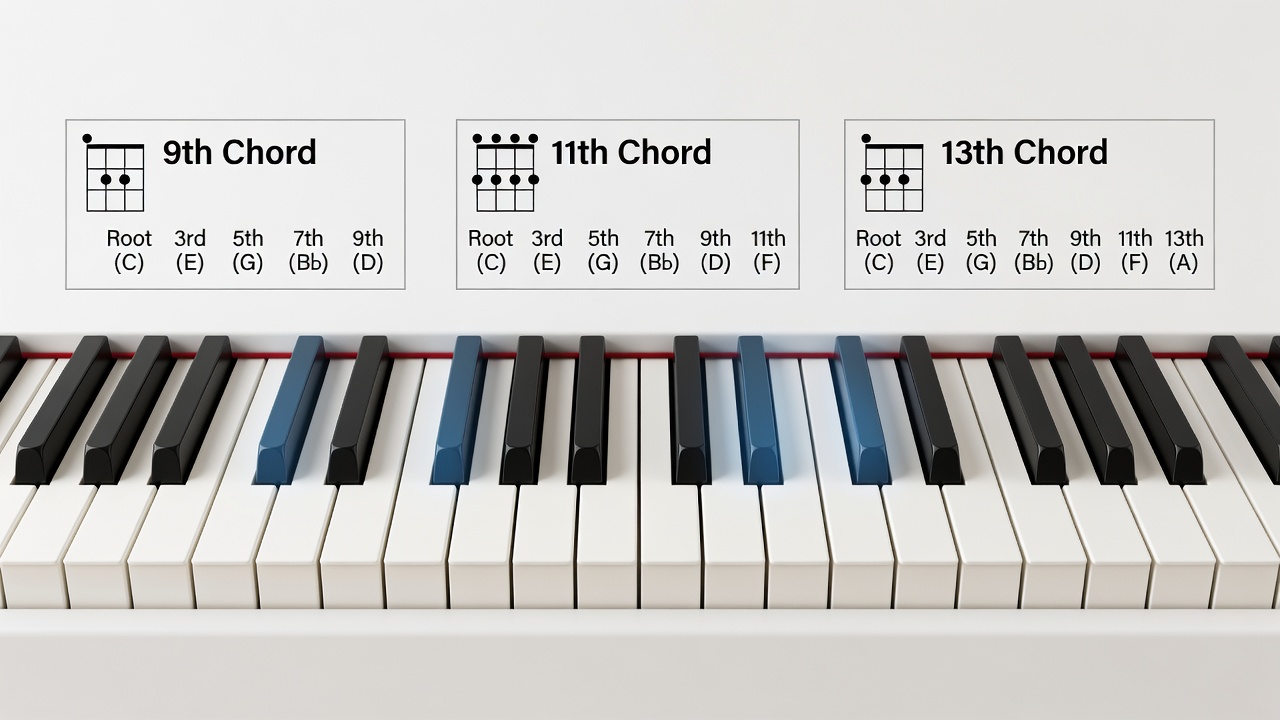
Start with the major scale. For a dominant 9th chord like C9: root (C), major third (E), perfect fifth (G), minor seventh (Bb), major ninth (D). Minor 9th follows the minor scale pattern with a minor third and minor seventh, producing a darker quality. For 11th chords, simply add the eleventh note above the ninth. In C11 this means including F, creating a suspended, floating effect. Dominant 13th chords add the thirteenth (A in C13) for maximum richness and warmth.
Always consider practical voicing choices. On most instruments you will omit the fifth or even the eleventh when space is limited, because these notes can create muddiness. Practice spelling each chord from every scale degree in both major and minor keys. For example, in the key of G major, build D9, Em11, and A13 using the same interval formulas. This repetition builds muscle memory and speeds up songwriting decisions.
Voicings for Piano and Guitar
On piano, spread extensions across both hands for clarity and balance. For C13, play the root and seventh in the left hand while placing the third, fifth, ninth, and thirteenth in the right hand. This creates an open, ringing sound that lets each extension breathe. Try inverting the chord so the ninth sits in the melody for a more vocal-friendly top line.
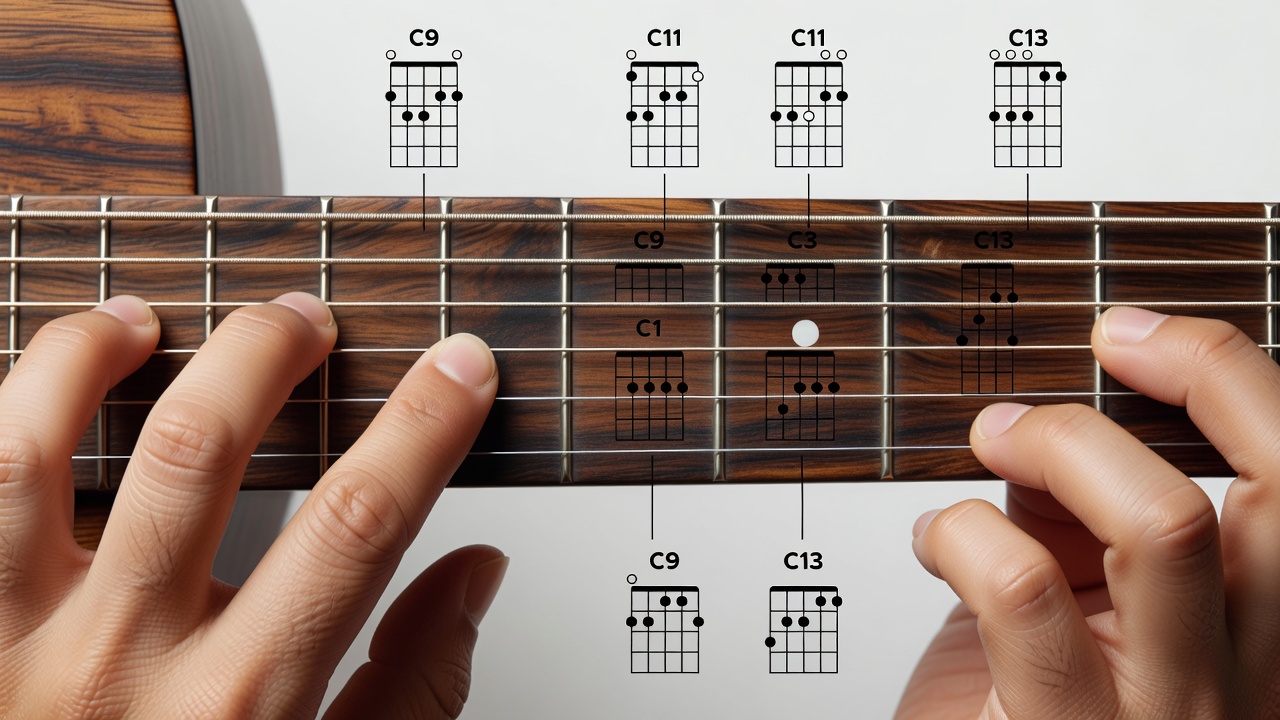
Guitar voicings require careful note selection because of the six-string limitation. Common C9 shapes place the root on the low E string, third on the A string, seventh on the D string, and ninth on the B string. Drop the fifth and eleventh when necessary to maintain playability. Experiment with partial voicings that emphasize only the most colorful extensions, such as the 9th and 13th, while letting the bass player handle the root.
Common Substitutions in Chord Progressions
Replace dominant seventh chords with their extended versions for smoother voice leading and richer color. In a classic ii-V-I progression, swap the V7 for a V9 or V13 to add sophistication without changing the fundamental root movement. The added ninth or thirteenth creates a more modern, polished resolution into the tonic chord.
Try substituting a minor 11th for a minor seventh in ballads or introspective sections. This works especially well in songs emphasizing melancholy or longing, because the eleventh introduces a suspended quality that resolves beautifully into the next chord. Another useful trick is replacing a major seventh with a major 13th in uplifting choruses to give the harmony extra lift and sparkle.
Comparing Tension Levels Versus Triads
Triads deliver immediate stability and consonance. Extended chords, by contrast, introduce controlled dissonance that increases emotional stakes. A C major triad feels grounded, while C13 feels expansive and slightly unresolved until the progression moves. This difference allows songwriters to control pacing: use triads for verses that need clarity and extended chords for bridges that demand heightened drama.
Real Song Examples from Recent Hits
Contemporary tracks demonstrate these chords effectively across radio and streaming platforms. Many 2026 productions incorporate 9ths in verse progressions to add emotional depth, then transition to 13ths in bridges for climactic tension. Listening to current releases reveals how extensions enhance storytelling through harmony without overpowering the melody. Try transcribing short sections by ear to identify where the extensions appear, then replicate the effect in your own writing.
Songwriting Exercises to Master Extensions
- Transpose a basic triad progression into extended versions across all 12 keys, noting how the mood shifts with each new extension.
- Compose a four-bar loop using only 9th and 11th chords, focusing on smooth voice leading between chords.
- Record a simple melody over a sustained 13th chord bed and observe how the added tension influences your phrasing choices.
- Compare a triad-only version of a song section against an extended-chord version to hear the precise emotional difference.
- Write a short verse-chorus form where the verse uses triads and the chorus introduces 9ths and 13ths for contrast and release.
Mistakes to Avoid When Using Extended Chords
One common pitfall is overcrowding the harmony by including every possible extension at once. Start with a single extension such as the ninth and add others gradually. Another mistake is ignoring voice leading; always check that the extensions move smoothly to the next chord rather than jumping awkwardly. On guitar, avoid low, muddy voicings of 11ths and 13ths by moving the extensions higher on the fretboard.
FAQ: Common Beginner Mistakes with Extended Chords
How do I avoid clashing notes? Omit the fifth or use inversions to prevent interval conflicts, especially on guitar where string space is limited.
Are extended chords only for jazz? No, they appear across pop, rock, soul, and film scores for added color and modern flavor.
Where can I learn more? Explore resources at MusicTheory.net for interactive lessons on chord construction and scale relationships.
What if extensions feel overwhelming? Begin with 9ths alone before adding higher extensions, and always reference the parent scale to keep your choices intentional.
Can I use extended chords in simple folk or indie songs? Absolutely. Many singer-songwriters add a single 9th or 13th in a key moment to create a memorable lift without complicating the arrangement.
Start incorporating these chords today to transform your harmonic palette and captivate listeners with nuanced, professional-sounding songwriting. With consistent practice you will soon treat 9ths, 11ths, and 13ths as naturally as basic triads.

No comments yet. Be the first!