 Instrumentiverse

Introduction to Chord Inversions
Chord inversions are a game-changer for songwriters looking to elevate their music from basic to professional. Instead of always playing chords in root position—where the root note is the lowest— inversions rearrange the notes so a different chord tone sits in the bass. This technique creates smoother transitions between chords, richer harmonic textures, and more interesting bass lines that propel your song forward.
Whether you're strumming guitar, playing piano, or producing in a DAW, understanding inversions unlocks fluid voice leading, where individual notes move logically with minimal jumps. In this guide, we'll dive deep into triad and seventh chord inversions, explore their notation, benefits for songwriting, practical examples, and exercises to integrate them into your workflow.
What Are Chord Inversions?
A chord inversion occurs when any note other than the root is the lowest pitch in the chord voicing. This is notated with a slash, like C/E for a C major chord with E in the bass.
- Root Position: Root note in bass (e.g., C major: C-E-G).
- First Inversion: Third of the chord in bass.
- Second Inversion: Fifth of the chord in bass.
For seventh chords, there's a third inversion with the seventh in the bass. Inversions don't change the chord's identity but alter its sound and function, making progressions less predictable and more sophisticated.
Check out detailed explanations on inversion basics at Wikipedia's Inversion page.
Triad Inversions: Building Blocks of Smooth Harmony
Triads—major, minor, diminished, augmented—have three inversions, but we focus on root, first, and second.
Root Position Triads
The standard voicing: root, third, fifth from bottom to top. Example: C major (C-E-G). Great for strong tonal centers but can sound blocky in sequences.
First Inversion Triads (6 Notation)
Third in bass: For C major, E-G-C (notated C6 or C/E). This creates a lighter, more open sound, ideal for passing chords.
- C major first inversion: E-G-C
- A minor first inversion: C-E-A
- G major first inversion: B-D-G
Second Inversion Triads (64 Notation)
Fifth in bass: G-C-E for C major (C/G). Often used for movement and resolution, like approaching a V-I cadence.
Visualize these on piano: Root position feels grounded; inversions float the harmony upward.
Seventh Chord Inversions: Adding Depth
Seventh chords (major7, minor7, dominant7, etc.) have four positions due to the extra note.
- Root Position (79): Root, third, fifth, seventh (e.g., Cmaj7: C-E-G-B).
- First Inversion (65 or 3/7): Third in bass (E-G-B-C).
- Second Inversion (43 or 6/5): Fifth in bass (G-B-C-E).
- Third Inversion (42 or 4/3): Seventh in bass (B-C-E-G), common for leading to root position.
These are crucial for jazz, pop, and modern songwriting. For instance, dominant7 chords in third inversion (V7/IV) smooth into subdominant resolutions.
Learn more about seventh chord symbols via MusicTheory.net's chord symbols lesson.
The Power of Voice Leading with Inversions
Voice leading is the art of moving chord tones stepwise. Inversions minimize large leaps, creating silky transitions.
Compare these progressions in C major:
- Basic roots: C (C-E-G) → F (F-A-C) → G (G-B-D). Bass jumps: C-F (4th), F-G (2nd).
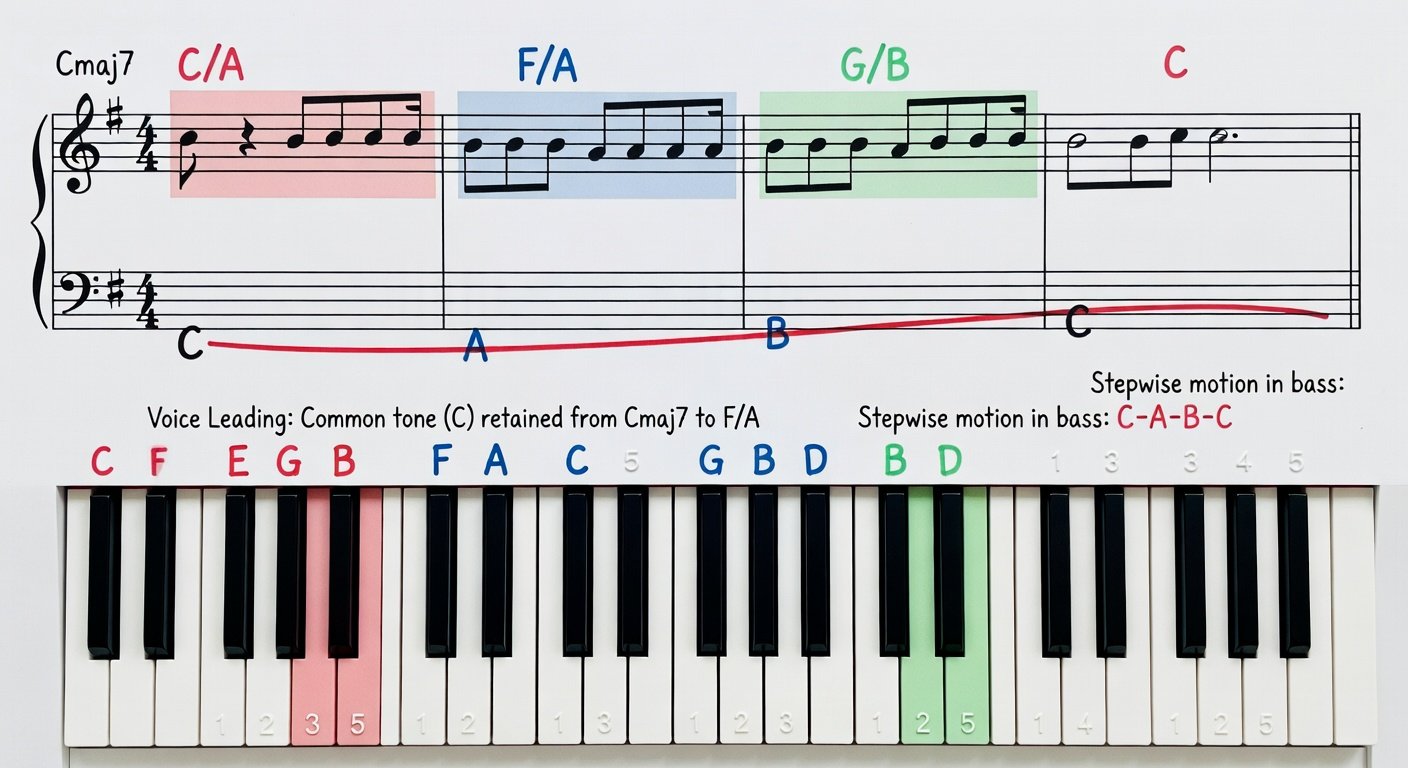
- Inverted: C (C-E-G) → F/A (A-C-F) → G/B (B-D-G). Bass: C-A (3rd down), A-B (2nd up)—much smoother!
This technique mimics classical counterpoint while fitting pop structures. Bass lines become melodic, supporting lyrics without overpowering.
Practical Songwriting Examples
Let's apply inversions to real progressions.
Classic I-IV-V-I with Inversions
C - F/A - G/B - C: Bass line C-A-B-C ascends smoothly.
C:   C E G
F/A: A C F
G/B: B D G
C:   C E G
Notes move: E to C (down 3rd), G to F (down 2nd), etc.—mostly steps.
ii-V-I Jazz Turnaround
Dm7/G - G7/B - Cmaj7/E: Inversions create contrary motion in inner voices.
Pop Ballad Progression
Em7 (E-G-B-D) → Cmaj7/G (G-B-D-E) → Am7 (A-C-E-G) → Fmaj7/E (E-G-A-C). Bass descends stepwise: E-G-A-E? Wait, adjust to Em - G/B - Am - Fmaj7 for E-B-A-F bass flow.
In songs like Adele's "Someone Like You," inversions underpin emotional piano lines.
Exercises to Master Inversions
Practice these step-by-step:
- Identify Inversions: Play C, Am, F, G. Invert each to first and second. Notation: C/E, C/G, etc.
- Voice Lead Progressions: Take I-vi-IV-V (C-Am-F-G). Write four versions: all roots, then optimize bass with inversions. Aim for <3 half-steps per note move.
- Bass Line Composition: Choose a scale (C major). Create an 8-note bass line using chord tones only, then harmonize with inversions.
- Transpose and Apply: Take a favorite song progression. Invert for guitar voicings or MIDI piano rolls.
- Ear Training: Listen to inversions blindly. Use apps or MusicTheory.net exercises for recognition.
Common Mistakes to Avoid
- Overusing Second Inversions: They weaken tonality; reserve for motion (e.g., not as I or V).
- Parallel Octaves/Fifths: Check voice leading—avoid direct 5ths or 8ves between chords.
- Ignoring Register: Place bass note low enough but not muddying mids.
- Notating Incorrectly: Use slash notation (C/E), not "first inversion" in charts.
Advanced Tips for Songwriters
Combine with pedal tones: Hold a bass note while inverting upper chords. Or use cluster voicings for tension.
In DAWs like Logic or Ableton, enable "chord trigger" modes with inversion options for quick experimentation.
Reference Wikipedia's chord progression entry for historical context in hits.
Conclusion
Chord inversions transform static harmonies into dynamic, professional soundscapes. By mastering root, first, second (and third for sevenths), you'll craft bass lines that sing and voice leading that flows effortlessly. Start with the exercises, analyze your favorite tracks, and watch your songwriting soar. Experiment today—your next hit awaits smoother harmony!

No comments yet. Be the first!