 Instrumentiverse
Introduction to Diatonic Triads
Diatonic triads are the foundational building blocks of harmony in Western music. Derived directly from the notes of a major or minor scale, these three-note chords create the harmonic framework for countless songs across genres. Whether you're a beginner songwriter strumming your first guitar progression or an aspiring composer diving into music theory, understanding diatonic triads unlocks the door to intuitive, scale-based harmony.
In this comprehensive guide, we'll explore how to construct diatonic triads from both major and minor scales, examine their roles in basic harmony, and apply them practically through examples and exercises. By the end, you'll be equipped to craft compelling chord progressions and transition toward more advanced techniques like secondary dominants and modal interchange.
Why focus on diatonic triads? They form the backbone of 90% of popular music progressions, making them essential for songwriting efficiency. Let's start with the basics.
What Are Diatonic Triads?
A triad is a chord built from three notes: the root, third, and fifth. "Diatonic" means all notes come from the parent scale without alterations. In a major scale, for example, stacking every other note from each scale degree yields seven unique triads.
These triads are classified by quality:
- Major triad: Root, major third, perfect fifth (e.g., C-E-G).
- Minor triad: Root, minor third, perfect fifth (e.g., A-C-E).
- Diminished triad: Root, minor third, diminished fifth (e.g., B-D-F).
For deeper reading on triad construction, check the Wikipedia page on triads.
Building Diatonic Triads in the Major Scale
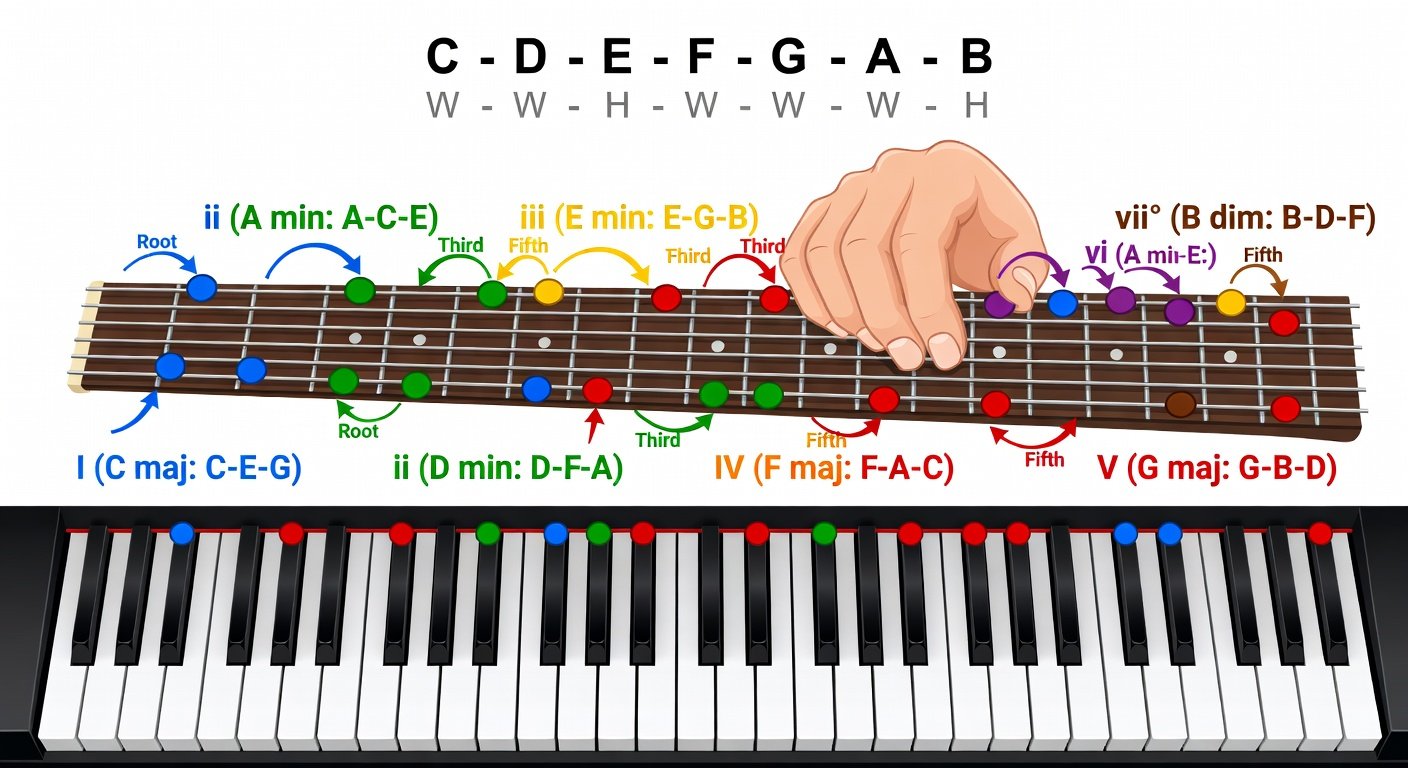
Let's use C major (no sharps or flats: C D E F G A B) as our example. To build a triad on each scale degree:
- Start with the root note of that degree.
- Skip one note to the third (major or minor interval).
- Skip another to the fifth.
Here's the full set:
- I: C major (C-E-G) – Tonic, stable home base.
- ii: D minor (D-F-A) – Supertonic, often leads to V.
- iii: E minor (E-G-B) – Mediant, adds emotional color.
- IV: F major (F-A-C) – Subdominant, builds tension.
- V: G major (G-B-D) – Dominant, strongest pull back to I.
- vi: A minor (A-C-E) – Submediant, relative minor feel.
- vii°: B diminished (B-D-F) – Leading tone, creates urgency.
Pattern: Major, minor, minor, major, major, minor, diminished (MMM mMM d).
Visualizing on Piano or Guitar
On piano, play C major scale ascending, then stack thirds for each chord. Guitarists: Use open positions like C (x32010), Dm (xx0231), Em (022000), etc. Practice arpeggiating to hear the harmony clearly.
Diatonic Triads in the Minor Scale
Minor scales have variations, but for harmony, we use the natural minor (Aeolian mode) primarily, with harmonic minor tweaks for V chord strength. Example: A minor (A B C D E F G).
- i: A minor (A-C-E) – Tonic.
- ii°: B diminished (B-D-F) – Heightens tension.
- III: C major (C-E-G) – Relative major vibe.
- iv: D minor (D-F-A) – Subdominant.
- v: E minor (E-G-B) – Or V: E major (E-G#-B) from harmonic minor.
- VI: F major (F-A-C) – Deceptive resolution.
- VII: G major (G-B-D) – Backdoor dominant.
Pattern: Minor, diminished, major, minor, minor/major, major, major. For songwriting, raise the 7th scale degree (G to G#) to make V major, enhancing resolution.
Explore more at MusicTheory.net's triad lessons.
Functions of Diatonic Triads in Harmony
Each triad has a harmonic function based on its scale degree:
- Tonic (I/i): Resolution point, like home.
- Subdominant (IV/iv): Tension builder, pre-dominant.
- Dominant (V): Pulls strongest to tonic via leading tone.
- Others: ii/ii° pre-dominant, vi/III plagal (IV substitute), iii mediant (tonic extension), vii° pre-dominant to V.
This functional harmony explains why I-IV-V (C-F-G) feels so satisfying—stable to tense to pull.
Step-by-Step Examples for Songwriting
Example 1: Classic Pop Progression in C Major
Vi-IV-I-V (Am-F-C-G): Think "Don't Stop Believin'."
- Start on vi (A minor) for melancholy intro.
- Move to IV (F) for lift.
- Land on I (C) for relief.
- End on V (G) for loop back.
Strum pattern: Down-down-up-up-down-up. Record a voice memo to test melody over it.
Example 2: Emotional Ballad in A Minor
i-VI-III-VII (Am-F-C-G): Axis of Awesome's four-chord song.
Adapt for verse: i-iv-VI-VII, chorus: i-VI-iii-VII.
Example 3: Rock Drive with vii°
In G major: I-V-vi-iii-IV-iii-VII (G-D-Em-Bm-C-Bm-F). Insert vii° (F#dim) before V for extra push.
Exercises to Identify and Use Diatonic Triads
Practice makes permanent. Try these:
- Scale to Triads: Write C major scale, build all seven triads. Play on your instrument. Time yourself under 5 minutes.
- Progression Builder: Pick a key, create 4-chord loops using only diatonic chords. E.g., ii-V-I-IV in any major key.
- Ear Training: Listen to songs (use Hooktheory's progression database). Transcribe the diatonic functions.
- Transpose Challenge: Take I-IV-V-I in C, move to D major. Use capo if guitar.
Do 15 minutes daily. Apps like Tenuto or Functional Ear Trainer accelerate this.
Common Mistakes to Avoid
- Voicing Issues: Don't play triads in root position only—experiment with inversions (e.g., C/E for smoother bass lines).
- Ignoring Context: V in minor? Use harmonic minor or it sounds weak.
- Overcomplicating: Stick to diatonic first; non-diatonic chords come later.
- Poor Resolution: Always resolve V to I, vii° to I.
Tips for Transitioning to Advanced Songwriting
Once diatonic mastery hits:
- Secondary Dominants: V/V (D major in C) borrows tension.
- Modal Interchange: Steal bVII from parallel minor (Bb in C major).
- Extended Chords: Add 7ths (e.g., G7 instead of G).
- Analyze Songs: Break down Beatles or Taylor Swift tracks.
Resources: Berklee's online theory or books like "Tonal Harmony" by Kostka/Payne.
Conclusion
Diatonic triads from major and minor scales are your harmony Swiss Army knife—simple yet endlessly versatile. By building them step-by-step, understanding functions, practicing exercises, and applying to progressions, you'll elevate your songwriting from basic to professional. Start today: Pick a scale, build the triads, jam a progression. Your next hit awaits.
Keep experimenting, and happy harmonizing!


No comments yet. Be the first!