 Instrumentiverse

What is Modal Interchange?
Modal interchange, also known as mode mixture or borrowed chords, is a music theory technique where you borrow chords from parallel modes to add emotional depth and color to your progressions. Instead of sticking to the vanilla diatonic chords of a major or minor key, you 'interchange' chords from the same key signature but different modes—like pulling from C minor while writing in C major.
This technique is a game-changer for songwriters tired of basic I-IV-V progressions. It creates tension, surprise, and sophistication, making your tracks stand out. Popular in rock, pop, jazz, and even modern EDM, modal interchange is everywhere in hits.
For example, in C major (C Dm Em F G Am Bdim), you might borrow the Eb major chord (bIII) from C minor. Suddenly, your harmony feels more cinematic and emotive.
Why Use Modal Interchange?
Borrowed chords introduce accidentals—flattened or sharpened notes not native to your key—adding grit, melancholy, or drama. They bridge major and minor worlds, perfect for evoking complex emotions without changing keys.
Common benefits:
- Expands harmonic vocabulary beyond scales.
- Creates smoother voice leading.
- Enhances modulations and resolutions.
- Makes progressions memorable, as in countless chart-toppers.
Pro tip: Start in major keys and borrow from the parallel minor (Aeolian mode) for instant impact.
Common Borrowed Chords: Notation and Examples
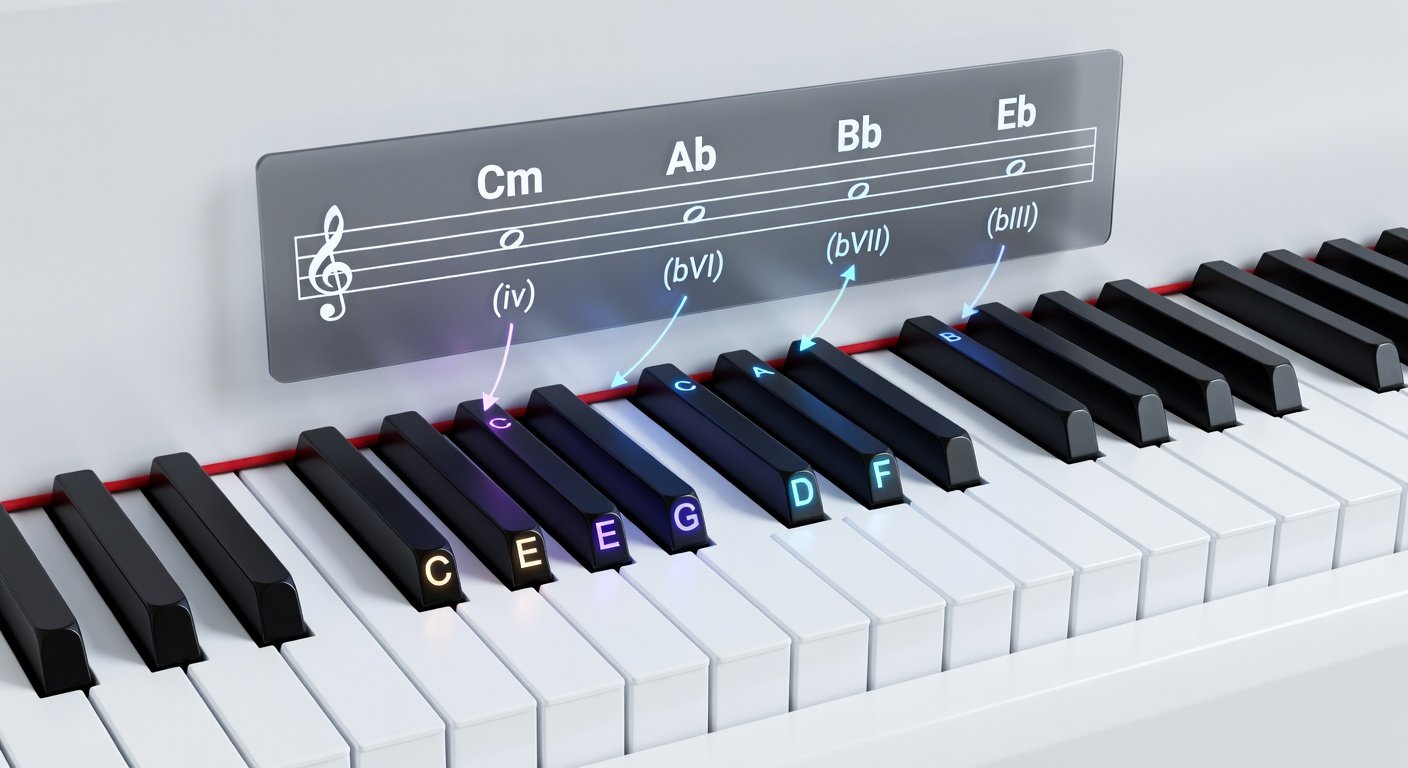
Here are the most used borrowed chords from parallel minor in major keys. We'll use C major as home base (key signature: no sharps/flats).
1. bVII Chord (Bb major in C)
The bVII is borrowed from the Mixolydian mode but shines via minor interchange. It's dominant-flavored, pulling toward the tonic.
Progression example: C - F - Bb - C (I - IV - bVII - I)
Listen for that rock 'n' roll vibe—think power chords on guitar.
2. bVI Chord (Ab major in C)
Pure minor borrow: ♭6 from Aeolian. It adds a dreamy, nostalgic haze.
Example: C - Ab - F - G (I - bVI - IV - V)
Often used in pre-choruses for buildup.
3. iv Chord (Cm in C)
The minor iv replaces IV for a subdominant minor feel—bittersweet and introspective.
Progression: C - Cm - F - G
Classic for ballads.
4. bIII Chord (Eb major in C)
Another Aeolian gem, creating a majestic lift.
Example: C - Eb - F - G
Feels epic, like a temporary minor key detour.
Real Song Examples: From Classics to 2026 Hits
Modal interchange powers timeless tracks. Let's dissect some.
"Creep" by Radiohead (C major): Verse uses bIII (Eb) and bVI (Ab)—"But I'm a creep..." hits hard with that minor infusion. Check the sheet music on Wikipedia's Borrowed Chord page for deeper theory.
"Sweet Child O' Mine" by Guns N' Roses (D major): Iconic bVII (C) in the intro riff, borrowed for that bluesy edge.
Fast-forward to 2026: Imagine hits like Aria Voss's "Echoes in Neon" (A major), borrowing iv (Dm) in the bridge for emotional peaks, or Jax Nova's "Quantum Heart" using bVI (F) over EDM drops. These tracks dominate charts by blending pop with modal spice—analyze via tools like MusicTheory.net.
Bonus: Adele's "Someone Like You" leans on iv and bVII for piano ballad mastery.
Step-by-Step Exercises to Apply Modal Interchange
Time to practice! Use your DAW, piano, or guitar. Key: G major (G A Bm C D Em F#dim).
- Basic Borrow: Add bVII (F major)
Start: G - C - D
Upgrade: G - C - F - D
Play it—feel the pull back to G. - Incorporate bVI (Eb major)
Progression: G - Eb - C - D
Record a melody over it; notice the lush tension. - Mix iv (Cm) with V (D)
G - Cm - D - G
Sing lyrics—perfect for verses. - Full Song Structure
Verse: G - Cm - C - D
Chorus: G - Eb - F - D (bVII as sub for V)
Bridge: Bm - Eb - C - G
Experiment: Transpose to your key. - Advanced: Voice Leading
Ensure smooth transitions, e.g., F chord to G shares F note. Study Berklee resources at Berklee College of Music.
Exercise goal: Write a 16-bar loop with 2+ borrows. Share on socials!
Tips for Seamless Integration
- Use borrowed chords sparingly (1-2 per progression) to avoid muddiness.
- Pair with melody adjustments—sing minor-ish lines over borrows.
- Guitarists: Power chords hide accidentals.
- Producers: Layer pads on bVI for atmosphere.
- Common pitfalls: Overuse kills diatonic flow; resolve back to I or V.
Elevate Your Songwriting Today
Modal interchange transforms basic scales into pro-level progressions. Practice these examples, dissect hits, and your songs will resonate deeper. Next: Dive into secondary dominants!

No comments yet. Be the first!