 Instrumentiverse

Whether you're a beginner strumming your first chords or a seasoned producer crafting chart-toppers, scales are the foundation of memorable melodies. In songwriting, the right scale can evoke emotion, drive hooks, and harmonize perfectly with chords. This listicle ranks the 7 essential scales by versatility for modern songwriting—from bluesy riffs to pop anthems. We'll break down each one's construction (intervals from the root), harmony applications, real-world examples from hit songs, and pro tips.
Understanding scales helps you improvise solos, write catchy choruses, and blend modes for unique flavors. For deeper theory basics, check out MusicTheory.net's lessons.
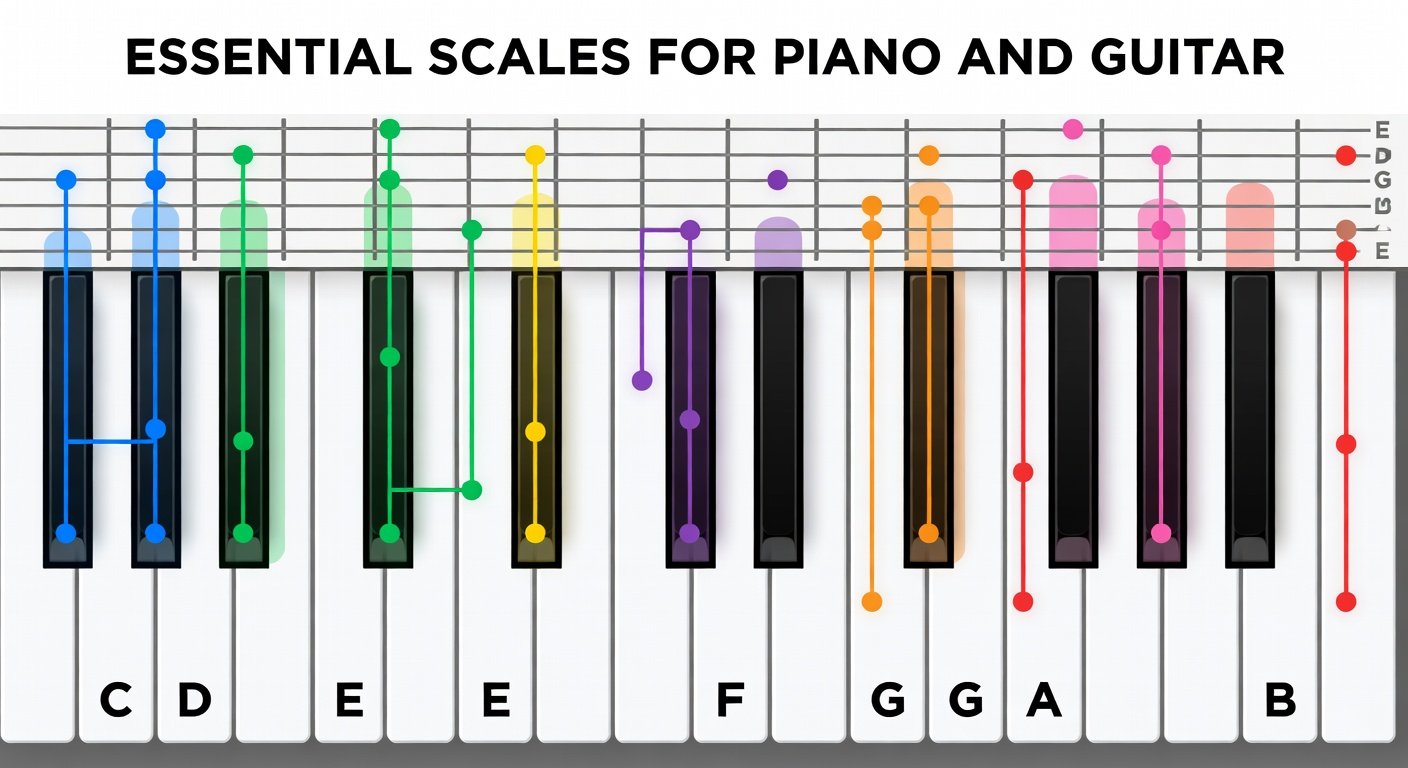
Top 7 Essential Scales for Songwriting, Ranked
-
1. Minor Pentatonic (Most Versatile for Leads)
The minor pentatonic is songwriting gold, especially for rock, blues, and pop solos. It's simple yet expressive, avoiding 'wrong' notes over minor chords.
Construction: Root (1), minor 3rd (b3), 4th (4), 5th (5), minor 7th (b7). In A minor: A C D E G.
- Intervals: W+W+b3+W+W (whole/half steps).
Harmony Applications: Fits over i, iv, v chords (e.g., Am-Dm-Em). Add bends for bluesy tension.
Real-World Examples: Guns N' Roses' "Sweet Child O' Mine" iconic solo; Led Zeppelin's "Stairway to Heaven" guitar work.
Tip: Pair with dominant 7th chords for gritty hooks.
-
2. Major Pentatonic (Pop Hook King)
Bright and uplifting, perfect for country, folk, and verse melodies.
Construction: 1, 2, 3, 5, 6. In C: C D E G A.
- Intervals: W+W+1.5W+W+1.5W.
Harmony Applications: Over I, IV, V (C-F-G). Sweetens major progressions.
Real-World Examples: Oasis' "Wonderwall" riff; Pink Floyd's "Wish You Were Here" intro.
Tip: Use in call-response with chords for singalong choruses.
-
3. Major Scale (Diatonic Foundation)
The backbone of Western music—ideal for happy, resolved song structures.
Construction: 1, 2, 3, 4, 5, 6, 7. In C: C D E F G A B.
- Intervals: W W H W W W H.
Harmony Applications: Builds all major keys' chords (I-ii-iii-IV-V-vi-vii°). Great for ballads.
Real-World Examples: The Beatles' "Let It Be"; Adele's "Someone Like You" melody.
Tip: Target chord tones (root, 3rd, 5th) for strong phrasing.
-
4. Natural Minor Scale (Emotional Depth)
Aeolian mode for melancholy verses and bridges.
Construction: 1, 2, b3, 4, 5, b6, b7. In A: A B C D E F G.
- Intervals: W H W W H W W.
Harmony Applications: Over i, v, VI (Am-Em-F). Pairs with suspended chords.
Real-World Examples: Nirvana's "Smells Like Teen Spirit"; Billie Eilish's "Bad Guy" undertones.
Tip: Emphasize b6 for haunting vibes.
-
5. Blues Scale (Soulful Grit)
Minor pentatonic + b5 'blue note' for authentic bends.
Construction: 1, b3, 4, b5, 5, b7. In A: A C D Db E G.
Harmony Applications: Dominant 7ths (E7, A7). Versatile in 12-bar blues.
Real-World Examples: B.B. King's solos; Jimi Hendrix's "Red House".
Tip: Bend the b5 to 5th over major chords for tension-release.
-
6. Dorian Mode (Jazz-Pop Fusion)
Major 6th with minor 3rd—jazzy yet accessible.
Construction: 1, 2, b3, 4, 5, 6, b7. In D: D E F G A B C.
- Intervals: W H W W W H W (2nd mode of major).
Harmony Applications: i-IV (Dm-G). Minor with hopeful lift.
Real-World Examples: Eagles' "Hotel California" solo; Santana's "Oye Como Va".
Tip: Use over sus4 chords for funky grooves. For more on modes, see Wikipedia's Musical Mode page.
-
7. Mixolydian Mode (Rock Anthem Power)
Dominant flavor with flat 7th—blues-rock staple.
Construction: 1, 2, 3, 4, 5, 6, b7. In G: G A B C D E F.
- Intervals: W W H W W H W (5th mode).
Harmony Applications: Over V7 chords (G7). Drives I-IV-V.
Real-World Examples: Deep Purple's "Smoke on the Water" riff; AC/DC's "Back in Black".
Tip: Flat 7th adds edge to major pentatonic riffs.
Tips for Blending Scales with Chords in Songwriting
To create catchy melodies, treat scales as 'note pools' over chord progressions. Here's how:
- Outline Chords: Start melodies on chord roots/3rds (e.g., E or G# over E major).
- Scale Switching: Verse in minor pentatonic, chorus in major for contrast (like in Ed Sheeran's hits).
- Passing Notes: Borrow from parallel scales (e.g., blues b5 over pentatonic).
- Rhythm First: Short motifs repeated with scale variations stick in ears.
- Record & Iterate: Loop chords, noodle scales, refine hooks.
Practice daily: Pick a progression like Am-F-C-G, cycle scales. For advanced harmony, explore Berklee College of Music resources. Experiment—these 7 scales cover 90% of hits!
Master them, and your songwriting will level up. What's your favorite scale? Share in comments!


No comments yet. Be the first!