 Instrumentiverse

Introduction to Chord Progressions and Harmony Basics
Chord progressions are the backbone of most music, creating emotional flow and structure in songs. They form the foundation of harmony, where chords built from scales interact to evoke tension and resolution. Common progressions like I-IV-V (think blues and rock) and ii-V-I (jazz staple) are everywhere because they're simple yet powerful.
In this guide, we'll break down how to construct these using basic major and minor scales. You'll get step-by-step instructions, real song examples, audio practice tips, and exercises to create your own songs. No advanced theory needed—just a keyboard, guitar, or app.
Understanding Scales and Roman Numeral Notation
Start with the major scale, like C major: C-D-E-F-G-A-B-C. Chords are built by stacking every other note (thirds):
- I: C major (C-E-G)
- ii: D minor (D-F-A)
- iii: E minor (E-G-B)
- IV: F major (F-A-C)
- V: G major (G-B-D)
- vi: A minor (A-C-E)
- vii°: B diminished (B-D-F)
Roman numerals show function: uppercase for major, lowercase for minor. This works in any key—transpose by shifting the root.
For more on scale degrees and chords, check the interactive lessons at MusicTheory.net.
Step-by-Step: Building the I-IV-V Progression
The I-IV-V is the king of rock, blues, and pop. It builds tension (V wants to resolve to I) and feels satisfying.
- Choose your key: Let's use C major for simplicity. I = C, IV = F, V = G.
- Play the chords: Strum or arpeggiate: C (4 beats), F (4 beats), G (4 beats). Loop it.
- Add rhythm: In 4/4 time, try quarter-note strums or shuffle for blues feel.
- Extend it: I-IV-I-V or I-V-IV-I for variety.
This progression dominates because it's diatonic—all chords from the scale—and resolves strongly.
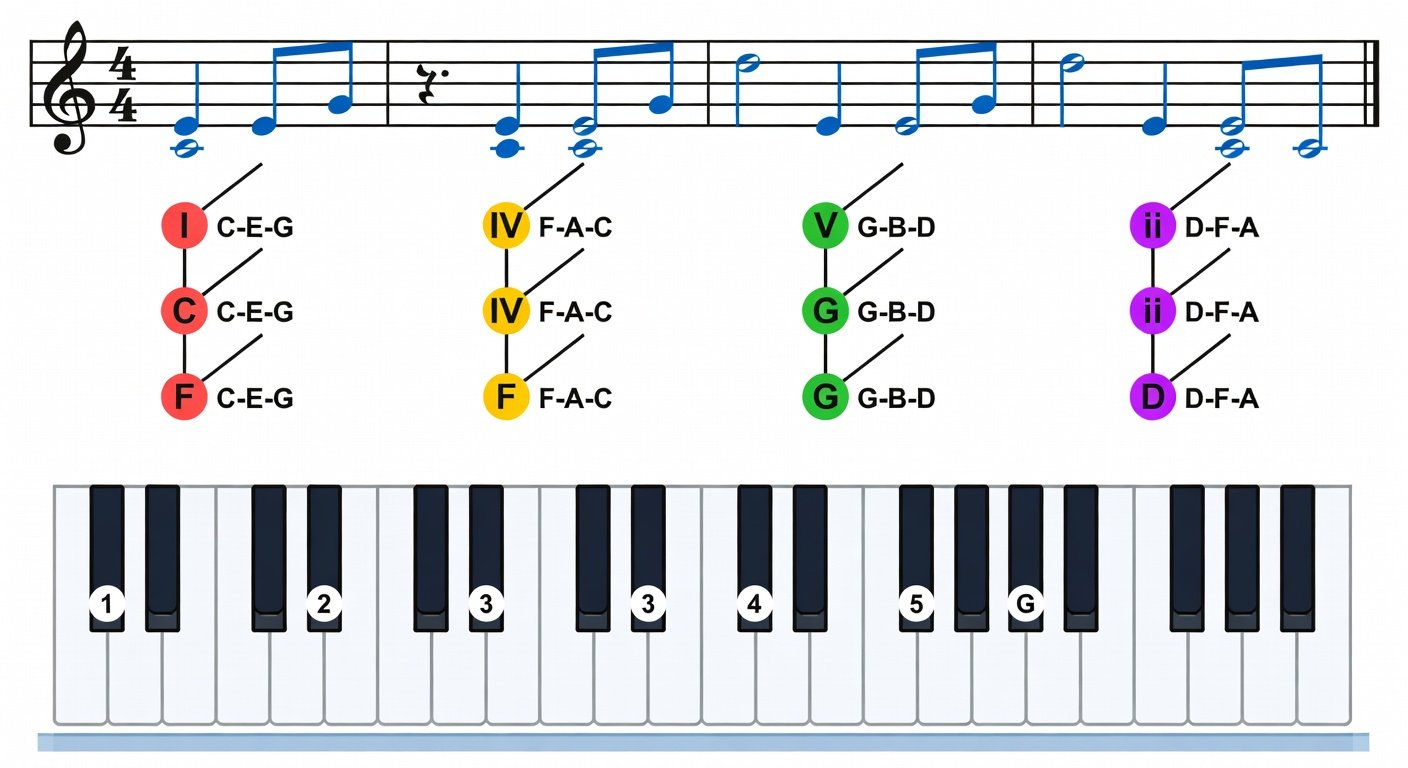
Step-by-Step: Constructing the ii-V-I Progression
ii-V-I is smoother, common in jazz, standards, and modern pop. The ii (minor) leads to V (dominant), pulling to I.
- Select key: C major: ii = Dm, V = G, I = C.
- Build chords: Dm (ii: supertonic), G (V: dominant with leading tone B), C (tonic resolution).
- Voice them: On piano, right hand: Dm (D-F-A), G (G-B-D), C (C-E-G). Add 7ths for jazz: Dm7-G7-Cmaj7.
- Practice cycle: Play slowly, then up-tempo. Feel the pull from ii to V to I.
Read more about its history on Wikipedia's Chord Progression page.
The Role of These Progressions in Harmony Basics
Harmony is about chord relationships. I is home (tonic), IV subdominant (builds away), V dominant (tension). ii acts like a pre-subdominant, softer than IV.
I-IV-V creates raw energy—perfect for anthems. ii-V-I offers sophistication, with the minor ii adding color before V's push. Both exemplify functional harmony: tonic → subdominant → dominant → tonic.
In songwriting, they provide predictability for melodies to shine. Vary with inversions, extensions (7ths, 9ths), or borrowing from parallel minor.
Songwriting Examples with Audio Practice Tips
I-IV-V in Action
"Sweet Home Alabama" by Lynyrd Skynyrd: D-A-G (I-IV-V in D). "Wild Thing" by The Troggs: A-D-E. Blues like "Boom Boom" by John Lee Hooker.
Audio tip: Use YouTube—search "I-IV-V backing track C major." Play along on guitar: capo for keys. Apps like GarageBand or iReal Pro generate loops. Record yourself improvising melodies over it; slow to 60 BPM first.
ii-V-I Classics
"Fly Me to the Moon": |Dm7 G7| Cmaj7. "Autumn Leaves" intro. Pop: End of choruses in many Ed Sheeran tunes.
Audio tip: Hooktheory or YouTube jazz standards play-alongs. Ear train: Hum melody over ii-V-I loop. Transcribe by pausing songs, noting changes. Use metronome apps like Tempo—start at 80 BPM, add swing.
Experiment: Write a verse with I-IV-V, chorus ii-V-I. Melodies fit naturally on scale degrees 1-3-5.
Exercises to Apply in Original Songs
Put theory to practice:
- Basic loop: Pick key (G major). Play I-IV-V 8x. Improvise melody using scale. Record 1 min.
- ii-V-I chain: Four keys: C (Dm7-G7-C), F (Gm7-C7-F), etc. Cycle 5 mins daily.
- Song sketch: Verse: I-IV-V-I. Chorus: ii-V-I-vi. Add lyrics on resolution beats.
- Transpose challenge: Write I-IV-V in three keys. Play on instrument.
- Hybrid: I-vi-IV-V (Amigos progression twist). Analyze favorite song's changes.
Track progress in a journal. Share on SoundCloud for feedback. Over weeks, these will feel intuitive for songwriting.
Final Tips for Mastery
Practice daily 15-30 mins. Use free tools: Ultimate Guitar tabs, Chordify for analysis. Listen actively—spot progressions in playlists. Soon, you'll craft hits from scales alone.

No comments yet. Be the first!