 Instrumentiverse
Introduction to Music Theory for Multiple Instruments
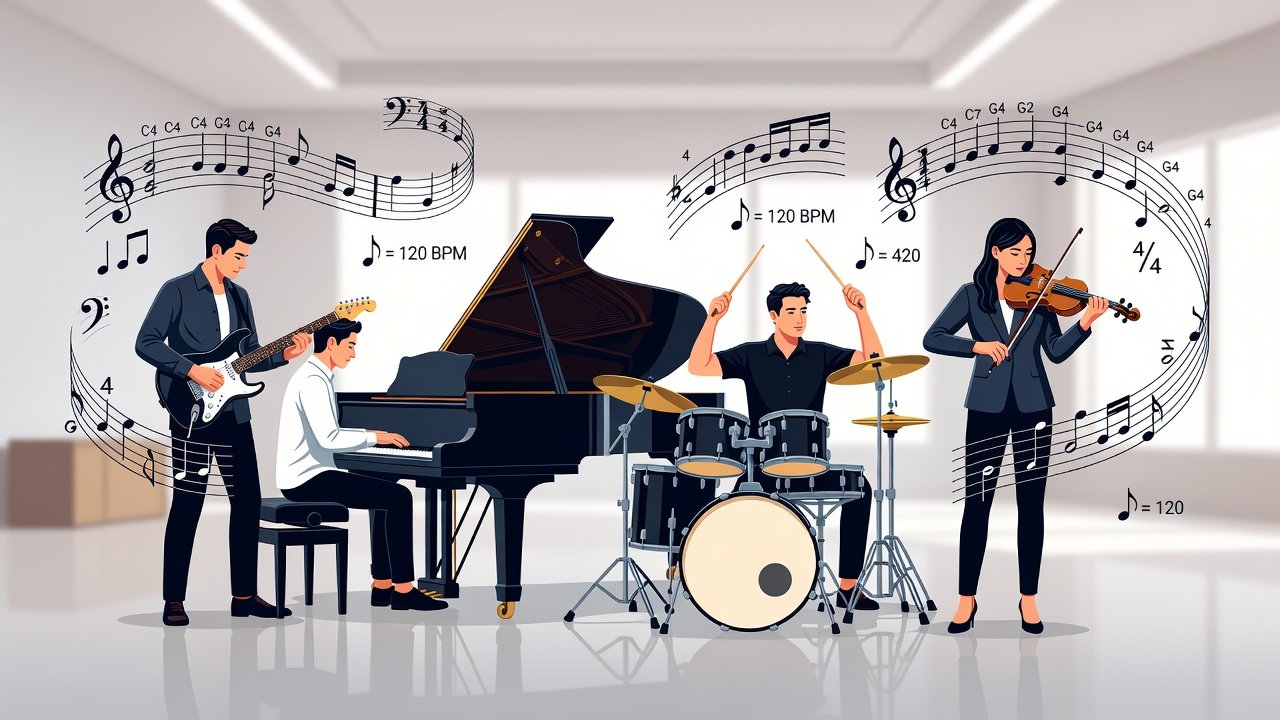
Understanding music theory provides a strong foundation for learning guitar, piano, drums, and violin. In 2026, beginners can accelerate their progress by focusing on note identification, basic scales, rhythm notation, and interval recognition. These concepts apply universally yet adapt uniquely to each instrument, helping players move beyond rote memorization toward true musical comprehension. Whether you are picking up an instrument for the first time or refreshing fundamentals, this guide delivers practical, step-by-step exercises and side-by-side comparisons to help you apply theory directly on your chosen instrument. Real-world examples like simple melodies demonstrate how theory translates into playable music, building confidence and speed in your practice sessions.
Note Identification Across Instruments
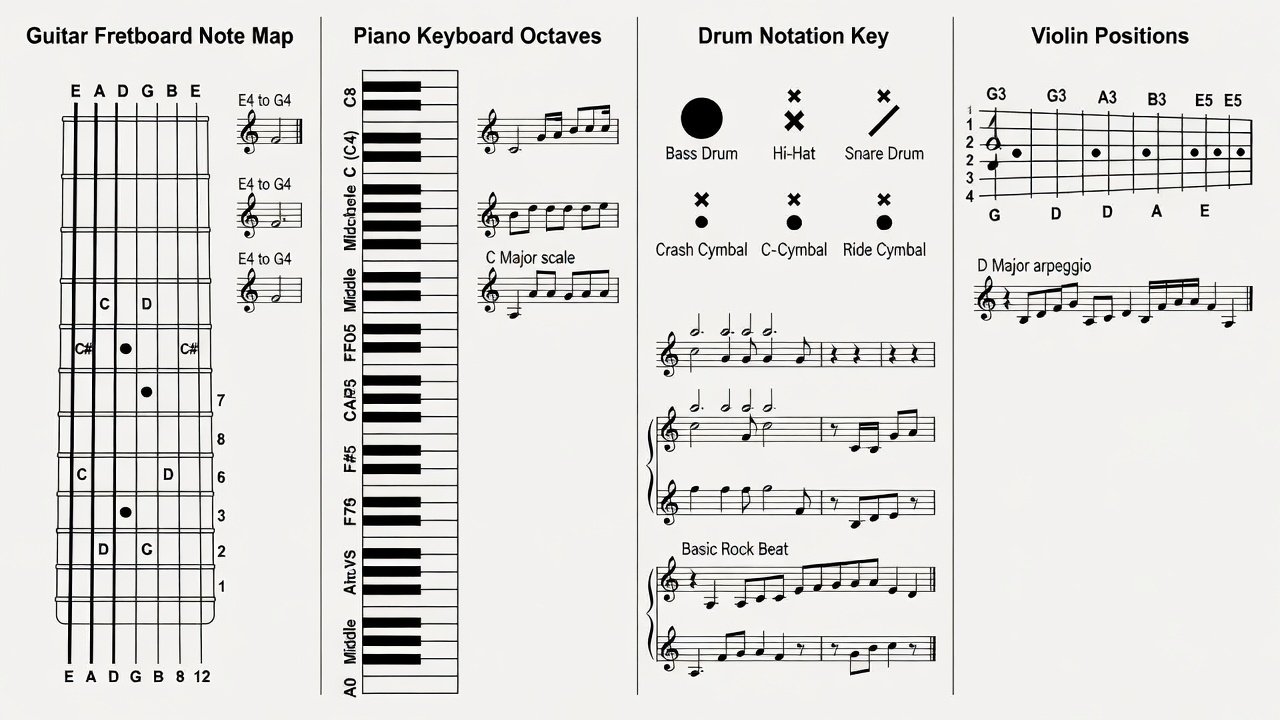
Notes form the building blocks of music. On piano, notes appear as white and black keys in repeating octaves, with middle C positioned near the center of the keyboard. Guitar uses frets and strings, with standard tuning E-A-D-G-B-E allowing players to locate any pitch by counting frets and moving across strings. Drums rely on notation for different kit pieces rather than pitched notes, using specific symbols for snare, bass drum, hi-hat, and cymbals. Violin uses four strings tuned G-D-A-E with finger placements on the fingerboard that correspond to specific pitches in first position and beyond.
Exercise: Play middle C on piano using your right thumb, locate the same pitch on guitar at the 8th fret of the 6th string, strike a matching rhythmic hit on the snare drum, and find the equivalent tone on violin’s A string by placing your second finger. Repeat this cross-instrument drill daily for five minutes to strengthen auditory recognition and muscle memory. Expand the exercise by moving to other notes such as G and D, ensuring you can name and play each pitch on every instrument you study.
Basic Scales for Beginners
The C major scale (C-D-E-F-G-A-B-C) serves as an ideal starting point because it contains no sharps or flats. Piano players use all white keys in sequence. Guitarists practice it across two octaves using alternate picking and position shifts. Drummers apply rhythmic patterns to scale-like phrases by assigning different limbs to represent ascending and descending movement. Violinists shift positions smoothly between notes while maintaining accurate intonation through careful finger placement.
Side-by-side comparison: Piano offers immediate visual clarity of whole and half steps, guitar builds muscle memory through repeatable scale shapes that transfer to many keys, drums emphasize timing and coordination within scale-derived rhythms, and violin develops precise intonation and shifting technique. Practice the G major scale next by adding one sharp (F#) and notice how fingerings change slightly on each instrument. A simple melody example is “Mary Had a Little Lamb,” which uses only five notes from the C major scale and can be played slowly on piano with single notes, strummed on guitar using open strings where possible, tapped as a rhythm on drums, or bowed on violin with detached strokes.
Rhythm Notation Fundamentals
Rhythm notation includes whole notes, half notes, quarter notes, and eighth notes, each representing specific durations relative to a steady beat. Piano and violin read standard five-line staff notation with time signatures such as 4/4 or 3/4 indicating beats per measure. Guitar often combines tablature with staff notation to show both rhythm and fret positions. Drums use a percussion staff with unique symbols for each component of the kit, allowing drummers to read complex patterns at a glance.
Step-by-step exercise: Begin by counting out loud while clapping steady quarter notes in 4/4 time. Progress to playing those quarter notes on your instrument while maintaining a metronome click at 60 beats per minute. Advance to eighth-note patterns by subdividing each beat into two equal parts, first clapping then transferring the rhythm to guitar strums, piano chords, drum grooves, or violin bow strokes. Practice a short four-bar phrase that mixes quarter and eighth notes, then transpose the same rhythm to a different instrument to reinforce understanding.
Interval Recognition and Applications
Intervals measure the distance between two notes and form the basis of melody and harmony. A perfect fifth spans seven semitones and appears frequently in classical and popular music. On guitar this interval is played by moving two frets up and two strings down. Piano players count seven keys apart, including both white and black. Violin requires accurate finger spacing to produce clean intonation. Drummers translate intervals into rhythmic gaps between hits, creating space that mirrors melodic movement.
Practical example: Recognize the opening perfect fifth interval in “Twinkle Twinkle Little Star” and replicate it across all four instruments. Start on C and move to G, then explore the major third interval (four semitones) by playing E after C. Record yourself playing these intervals slowly on one instrument and identify them by ear on another to develop relative pitch skills. Over several weeks, expand to minor thirds, perfect fourths, and octaves, always practicing both ascending and descending forms.
Instrument-Specific Practice Tips and Comparisons
Effective practice integrates theory into daily routines rather than treating it as separate study. Guitarists should combine scales with basic chord changes, such as moving from C to G7 while keeping time. Pianists benefit from focusing on hand coordination and reading intervals in both treble and bass clefs simultaneously. Drummers can layer simple rhythms over melodic concepts learned from other instruments, turning scale degrees into sticking patterns. Violinists must emphasize bowing technique and vibrato development alongside pitch accuracy to achieve expressive tone.
- Guitar: Use scale shapes as movable templates that work in every key once the root note is identified.
- Piano: Visualize intervals on the keyboard layout to speed up sight-reading of new pieces.
- Drums: Apply rhythmic subdivisions learned from melody to create more musical fills and grooves.
- Violin: Match open strings to piano or guitar pitches for reliable tuning before practicing intervals.
Common mistakes to avoid include rushing through scales without listening for even tone, neglecting rhythm when focusing on pitch, and failing to transfer concepts between instruments. Instead, dedicate at least ten minutes per session to each core area while recording short clips to track improvement.
Integrating Theory into Real-World Playing
Apply these essentials consistently by learning one short piece per month that incorporates the concepts covered. For instance, arrange a simple folk melody for your instrument using only notes from the C major scale, then notate the rhythm yourself before checking against published versions. Resources such as MusicTheory.net offer free interactive tools for drilling intervals and scales, while Teoria provides structured ear-training exercises suitable for all four instruments. Over time, theory becomes second nature, allowing faster learning of new songs and more creative improvisation.
FAQ
How long until I see results from daily theory practice? Consistent daily sessions of twenty to thirty minutes yield noticeable improvement in note recognition and rhythmic accuracy within four to six weeks.
Can I learn multiple instruments at once using the same theory foundation? Yes, but begin with one primary instrument to build solid habits before transferring knowledge to a second instrument.
What if I struggle with rhythm notation while playing? Use a metronome app set at slow tempos and practice clapping or tapping rhythms separately before combining them with pitch reading.
Are there specific exercises that work equally well on guitar, piano, drums, and violin? Interval drills and simple scale-based melodies adapt easily to every instrument when adjusted for range and technique.
Apply these music theory essentials consistently to build lasting skills and enjoyment on guitar, piano, drums, or violin throughout 2026 and beyond.

No comments yet. Be the first!