 Instrumentiverse

Introduction to Voice Leading for Songwriters
Voice leading stands as one of the most practical tools in music theory for songwriters seeking to elevate their chord progressions. Rather than jumping between chords in disconnected blocks, voice leading focuses on the smooth movement of individual notes, known as voices, from one harmony to the next. This technique creates a sense of continuity and emotional depth that resonates with listeners across genres. For beginners writing original songs, mastering voice leading means transforming basic three-chord songs into polished, flowing compositions that feel intentional and professional.
Many aspiring songwriters rely on simple triads played in root position, which often results in noticeable leaps that disrupt the musical narrative. Voice leading addresses this by encouraging minimal motion between notes, typically favoring steps over leaps and preserving shared tones. Whether you compose on piano, guitar, ukulele, or within a digital workstation, these principles apply universally. The following sections break down the concept thoroughly, providing concrete rules, multiple worked examples, instrument-specific advice, and targeted exercises so you can immediately implement smoother transitions in your own music.
What Is Voice Leading?
At its core, voice leading describes the horizontal path each note takes when chords change. In a four-voice texture, you have soprano, alto, tenor, and bass lines moving independently yet cohesively. The emphasis lies on contrary or oblique motion rather than all voices shifting rigidly together. This approach originates from centuries of contrapuntal practice yet proves invaluable in contemporary songwriting where chord changes drive the harmonic rhythm.
Think of each chord as a vertical stack of pitches. When moving to the next chord, you decide how high or low each pitch travels. Effective voice leading keeps most movements to adjacent scale degrees, creating a melodic quality even within the harmony. Poor voice leading, by contrast, produces jarring leaps that can make a progression feel amateurish or unsettled. Understanding this distinction helps songwriters craft verses and choruses that maintain listener interest through subtle, logical connections rather than dramatic jumps.
Core Voice Leading Rules Explained with Examples
Several guiding principles govern successful voice leading. First, prioritize stepwise motion: move each voice by a half step or whole step whenever feasible. Second, retain common tones that appear in both the current and following chord; these notes act as anchors that glue the progression together. Third, avoid parallel perfect fifths and octaves, as they reduce the independence of voices and create an unintended hollow effect. Fourth, resolve active tones properly, such as raising the leading tone to the tonic or descending the seventh of a dominant chord.
Consider a simple C major to A minor transition. In root position without voice leading, the notes leap noticeably. With proper leading, the E remains common, the C moves down a step to B, and the G moves down a step to E, producing a gentle, connected sound. These rules are elaborated in established references such as MusicTheory.net. Applying them consistently builds muscle memory for more complex sequences.
Step-by-Step Application to Common Chord Sequences
Begin with the classic I–IV–V–I in C major: C–F–G–C. Start with C-E-G in the right hand. Moving to F major (F-A-C), retain C as the common tone, shift E up to F, and G up to A. This yields only two small steps. From F to G major (G-B-D), move C down to B, A down to G, and F up to G. Returning to C, the voices resolve naturally with minimal displacement.
Now examine a ii–V–I in jazz-influenced pop: Dm–G–C. Dm (D-F-A) to G (G-B-D) keeps D as common tone while F rises to G and A rises to B. Then G to C resolves the leading tone B to C and the seventh F down to E. These movements feel organic and support vocal melodies effectively.
For minor keys, try i–VI–III–VII in A minor: Am–F–C–G. Careful voice leading prevents the parallel motion that can flatten emotional impact. Retain the A across Am and F, move C up to D? No—adjust to E for smoothness while preserving the minor color through careful alto and tenor placement. 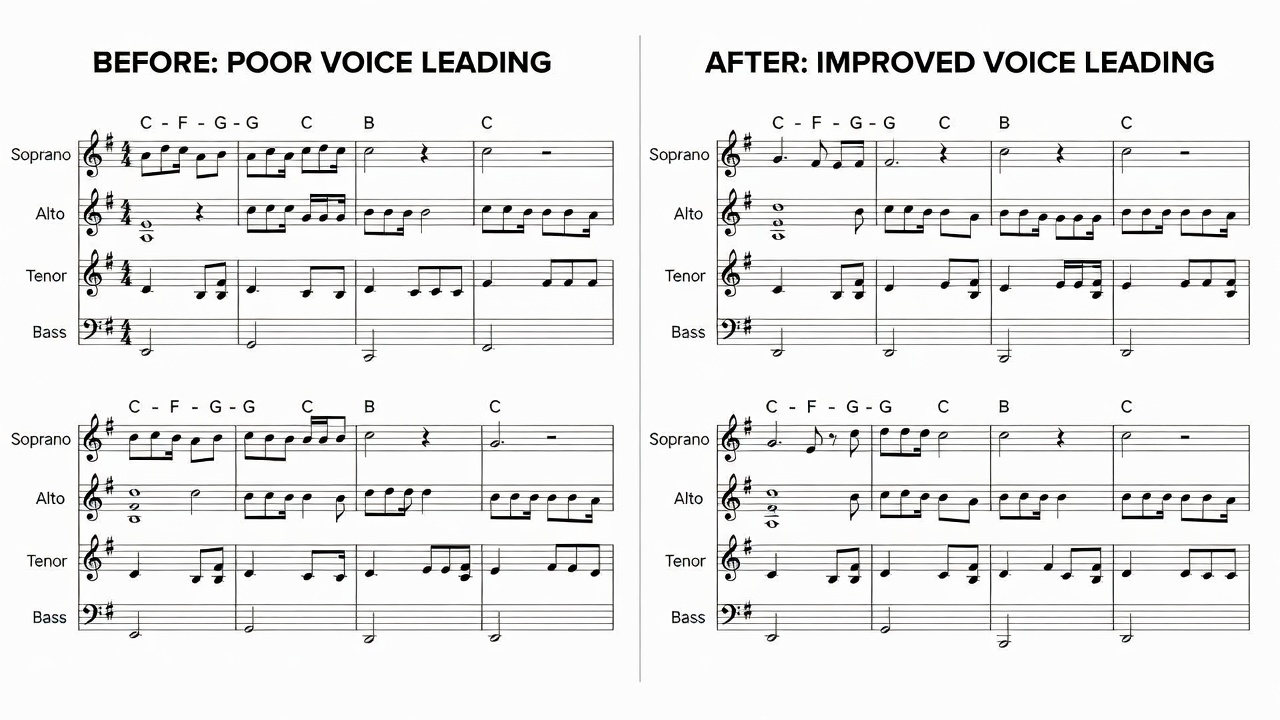
Before-and-After Examples and Parallel Motion Pitfalls
Audio examples reveal the difference dramatically. A I–vi–IV–V loop without voice leading sounds blocky and segmented. The same loop with stepwise adjustments flows continuously, supporting lyrics more naturally. Parallel motion, where every voice travels in the same direction by identical intervals, often produces a thick, organ-like texture suitable for certain rock anthems but fatiguing in intimate ballads. Counter this by inverting one chord or staggering the inner voices slightly.
Voice Leading Across Instruments and Genres
On piano, voice leading is straightforward because all notes are visible. Guitarists achieve similar results through inversions and open-string drones that function as common tones. In electronic production, MIDI editing lets you nudge individual notes by semitones. Across pop, folk, and indie genres, these techniques enhance emotional delivery without requiring advanced theory knowledge.
Common Mistakes to Avoid
- Overusing root-position triads that force large leaps between chords.
- Ignoring the leading tone resolution in dominant chords.
- Allowing voices to cross unnecessarily, which muddies the texture.
- Neglecting range limits, causing the melody to become unsingable.
Recognizing these pitfalls early saves hours of revision later.
Practical Exercises for Songwriters
- Compose a two-chord vamp and rewrite it three times, each version using only stepwise motion in the upper voices.
- Select a verse from an existing song and insert common tones between every chord change; record both versions for comparison.
- Apply voice leading to a 12-bar blues progression, focusing on the I–IV and V–I turnarounds.
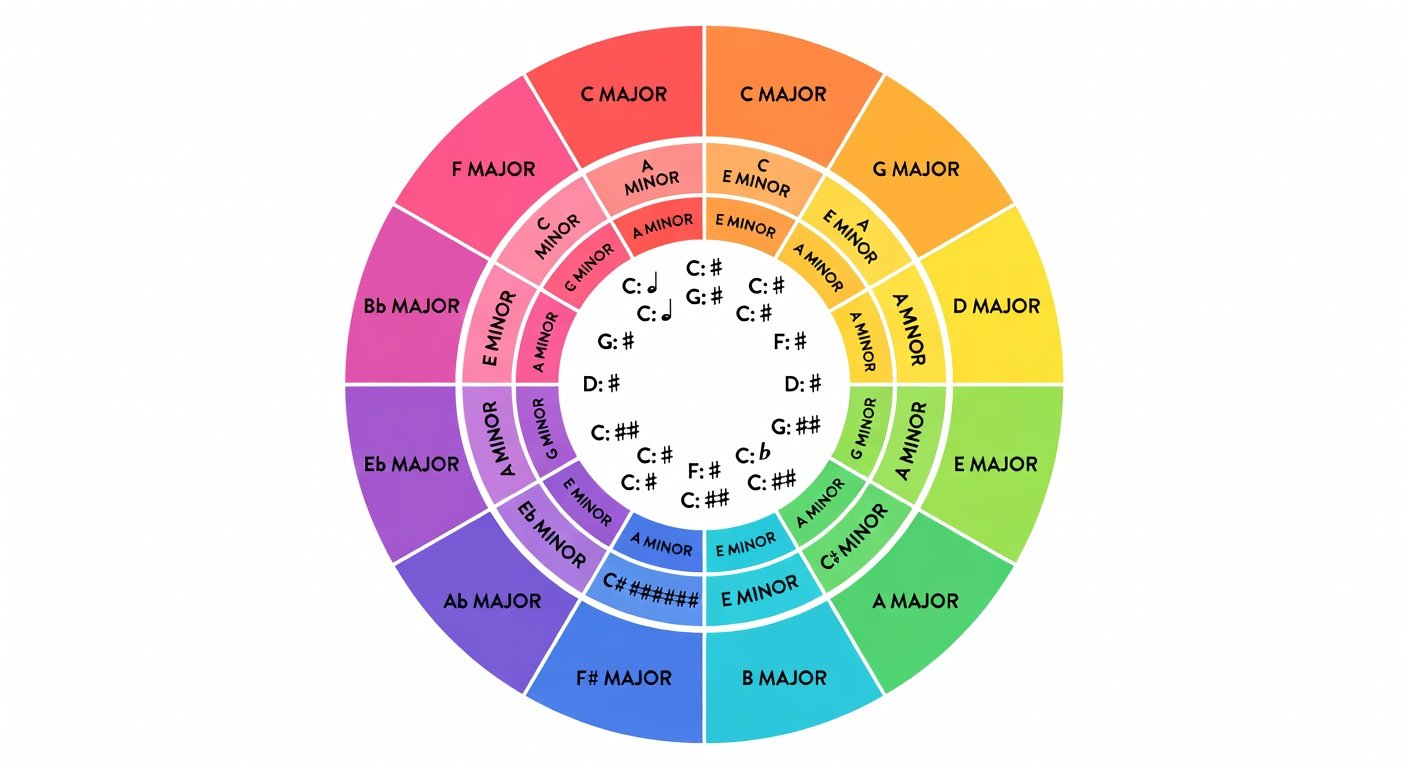
- Transpose the same exercise into three different keys to internalize patterns across the circle of fifths.
- Collaborate with a vocalist: sing the top voice while playing the supporting voices to ensure singability.
Consistent practice over two weeks yields noticeable improvement in your song drafts.
Frequently Asked Questions
How wide should the spacing between voices be?
Keep inner voices within an octave of each other and the outer voices within two octaves to maintain clarity and performability.
Can voice leading conflict with a strong melody?
Yes. Treat the melody as the fixed soprano line and adjust the supporting voices underneath to follow the rules as closely as possible without sacrificing the tune.
Does voice leading apply to seventh chords?
Absolutely. Resolve the seventh downward by step and treat the third as the leading tone when it functions as such.
Is voice leading only for classical music?
No. Modern songwriters in every genre benefit; the same principles improve chord flow in electronic, country, and alternative tracks.
What if my chord progression includes borrowed chords?
Apply the same rules while watching for chromatic movement; small half-step adjustments often create beautiful color without disrupting smoothness.
Conclusion
Voice leading transforms ordinary chord changes into compelling musical stories. Through stepwise motion, common tones, and careful resolution, songwriters gain a reliable method for crafting professional-sounding harmony. The examples, exercises, and instrument adaptations provided here offer a complete starting point. Begin incorporating these techniques into your next song and experience the immediate improvement in flow and emotional impact.

No comments yet. Be the first!