 Instrumentiverse

Introduction to Cadences in Music Theory
Cadences form the foundation of harmonic resolution in songwriting, providing listeners with a sense of arrival or tension at key moments. For beginners exploring practical applications, understanding cadences unlocks the ability to shape emotional responses through chord progressions. This guide focuses exclusively on the four primary cadence types—perfect, plagal, imperfect, and deceptive—and their direct use in creating memorable song endings using basic major and minor scales. Cadences serve as musical punctuation marks, signaling the end of a phrase, section, or entire piece much like periods and commas guide readers through text. Without effective cadences, even the most compelling melodies can feel incomplete or directionless. Songwriters who master these tools gain precise control over how audiences experience closure or anticipation, directly influencing the emotional arc of a track.
Each cadence relies on specific scale degree movements, typically involving the tonic (I or i), dominant (V or v), subdominant (IV or iv), and other functions. By mastering these, songwriters can control whether an ending feels conclusive, reflective, open, or surprising. The principles apply equally to acoustic guitar ballads, electronic productions, and orchestral arrangements, making cadences a universal skill for any composer working in contemporary styles.
Understanding Scale Degree Functions in Cadences
Scale degrees assign roles to each note within a key. In C major, for example, C is the tonic (degree 1), G is the dominant (degree 5), and F is the subdominant (degree 4). Cadences exploit the natural pull between these degrees. The leading tone (degree 7) often resolves upward to the tonic, creating tension release. These functions remain consistent across keys, allowing transposition without changing emotional impact. In minor keys the same framework applies but with adjusted chord qualities, such as the minor tonic (i) and major dominant (V) that still contains the leading tone for strong resolution. Recognizing these relationships helps songwriters choose chords that reinforce or subvert listener expectations at critical ending points.
The Four Main Cadence Types Explained
Perfect Cadence (V-I)
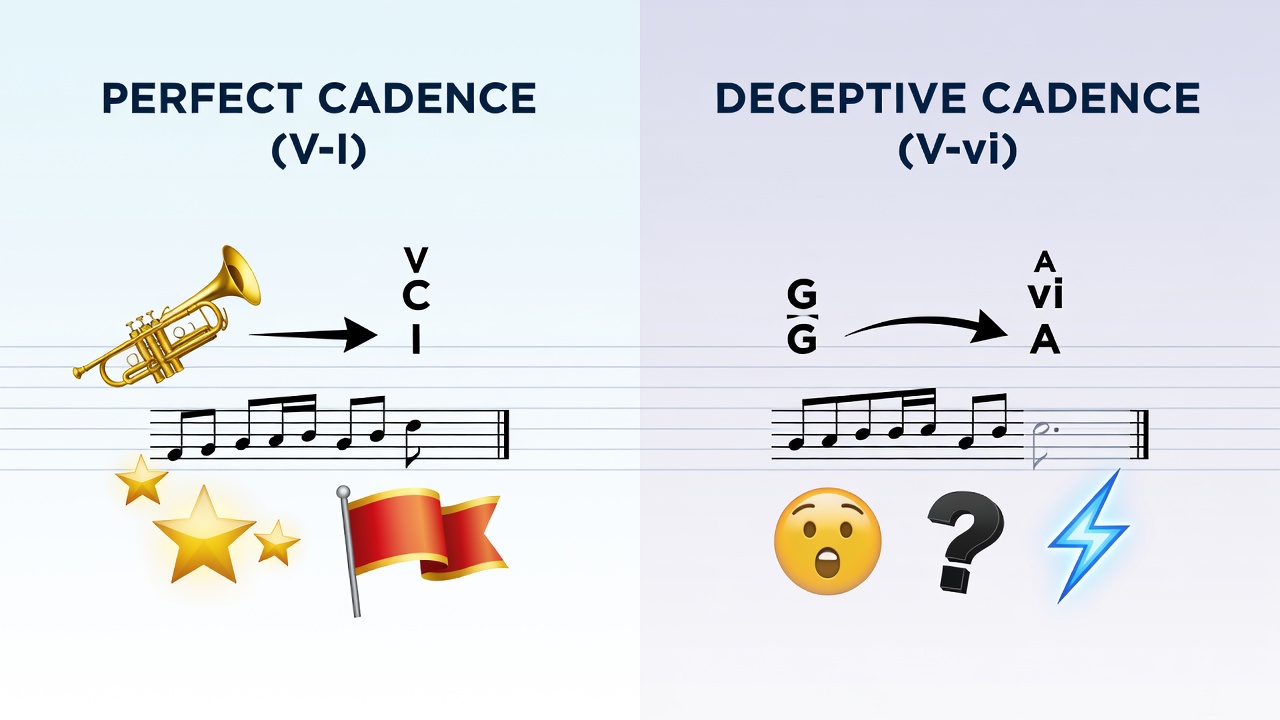
The perfect cadence delivers the strongest sense of finality. It moves from the dominant chord (V) to the tonic (I). In C major this appears as G major to C major. This progression satisfies harmonic expectations because the dominant contains the leading tone that resolves to the tonic root. In minor keys the equivalent is V-i, such as G major to C minor. The perfect cadence works across genres because its root motion of a perfect fifth downward creates maximum stability. Songwriters often place it at the conclusion of a chorus or the final bar of a track to leave audiences with a feeling of complete satisfaction.
Plagal Cadence (IV-I)
Also known as the "Amen" cadence, the plagal cadence uses the subdominant (IV) resolving to the tonic (I). In C major this is F major to C major. It produces a gentle, hymn-like warmth often associated with resolution in gospel and pop ballads. The motion here is a fourth downward rather than a fifth, resulting in a softer landing that avoids the dramatic tension of the dominant chord. In minor keys the plagal cadence appears as iv-i, offering an even more introspective quality suitable for emotional ballads or reflective verses.
Imperfect Cadence (I-V or ii-V)
An imperfect cadence ends on the dominant, leaving the phrase open. Common forms include tonic to dominant (I-V) or supertonic to dominant (ii-V). This creates anticipation, ideal for verse endings that lead into a chorus. The imperfect cadence functions as a musical comma, inviting continuation rather than signaling completion. In practice, songwriters use it to build momentum across sections, ensuring the listener remains engaged until the eventual arrival of a stronger resolution later in the arrangement.
Deceptive Cadence (V-vi)
The deceptive cadence replaces the expected tonic with the relative minor (vi). In C major this is G major to A minor. It surprises the ear and can extend a section or pivot to a new key. Because the ear anticipates the tonic after hearing the dominant, the shift to the minor chord creates an immediate emotional twist. This technique appears frequently in modern songwriting to delay resolution or introduce unexpected harmonic color without abandoning the established key.
Real-World Chord Examples from Popular Songs
Perfect cadences appear at the close of The Beatles' "Hey Jude" where the final V-I reinforces emotional closure. Plagal cadences feature prominently in many traditional hymns and in Adele's "Someone Like You," where IV-I lends a bittersweet quality. Imperfect cadences drive tension in Ed Sheeran's verse structures, while deceptive cadences create memorable twists in songs like Radiohead's "Creep." Additional examples include the perfect cadence ending in Taylor Swift's "Love Story" and the plagal cadence in Coldplay's "Fix You," both demonstrating how these resolutions translate across decades of popular music. Studying these tracks note by note reveals how subtle inversions and voice leading enhance the core cadence effect.
Side-by-Side Comparison of Emotional Effects
- Perfect: Complete, triumphant, satisfying—best for final choruses and album closers.
- Plagal: Warm, reflective, comforting—suited to gospel, folk, and heartfelt ballads.
- Imperfect: Expectant, unresolved, forward-moving—ideal for building into bridges or pre-choruses.
- Deceptive: Surprising, melancholic, intriguing—effective for extending sections or creating emotional depth.
Step-by-Step Methods to Compose Stronger Endings
- Choose your key and identify the tonic, dominant, and subdominant chords on your instrument or in notation software.
- Write a short phrase ending on the dominant chord to build tension, ensuring the melody approaches the leading tone.
- Resolve using one of the four cadences based on the desired emotion, testing both root position and first inversion options.
- Layer melody notes that emphasize resolution tones such as the tonic or third of the final chord for added clarity.
- Record a quick demo and listen back, noting whether the ending feels abrupt or appropriately paced.
- Adjust by changing chord inversions, adding suspensions, or extending the dominant for greater drama before resolution.
- Repeat the process across multiple sections of the song to maintain consistency while varying emotional impact.
Common Mistakes and How to Avoid Them
Many beginners overuse perfect cadences, resulting in predictable endings. Instead, alternate with plagal or deceptive options for variety. Another frequent error is ignoring voice leading; always move the leading tone upward by step. Finally, avoid placing cadences only at the very end—experiment with them at phrase midpoints for better flow. Additional pitfalls include failing to consider the preceding harmony, which can weaken the resolution, and neglecting to match the cadence to the song's overall mood and tempo.
FAQ on Cadences in Songwriting
How do cadences differ from chord progressions? Cadences are specific two-chord resolutions, while progressions can be longer sequences that may or may not include a cadence at their conclusion.
Can cadences be used in minor keys? Yes, the same patterns apply with appropriate chord qualities (e.g., V-i for perfect in minor).
Which cadence works best for upbeat pop songs? Perfect cadences generally provide the energetic close listeners expect.
How can I practice identifying cadences? Play common songs on piano or guitar and pause before the final two chords to predict the resolution type.
Do cadences work in non-diatonic music? They remain effective even when borrowed chords are introduced, though the emotional effect may shift slightly.
For further foundational reading, explore resources at MusicTheory.net and Britannica.
No comments yet. Be the first!