 Instrumentiverse
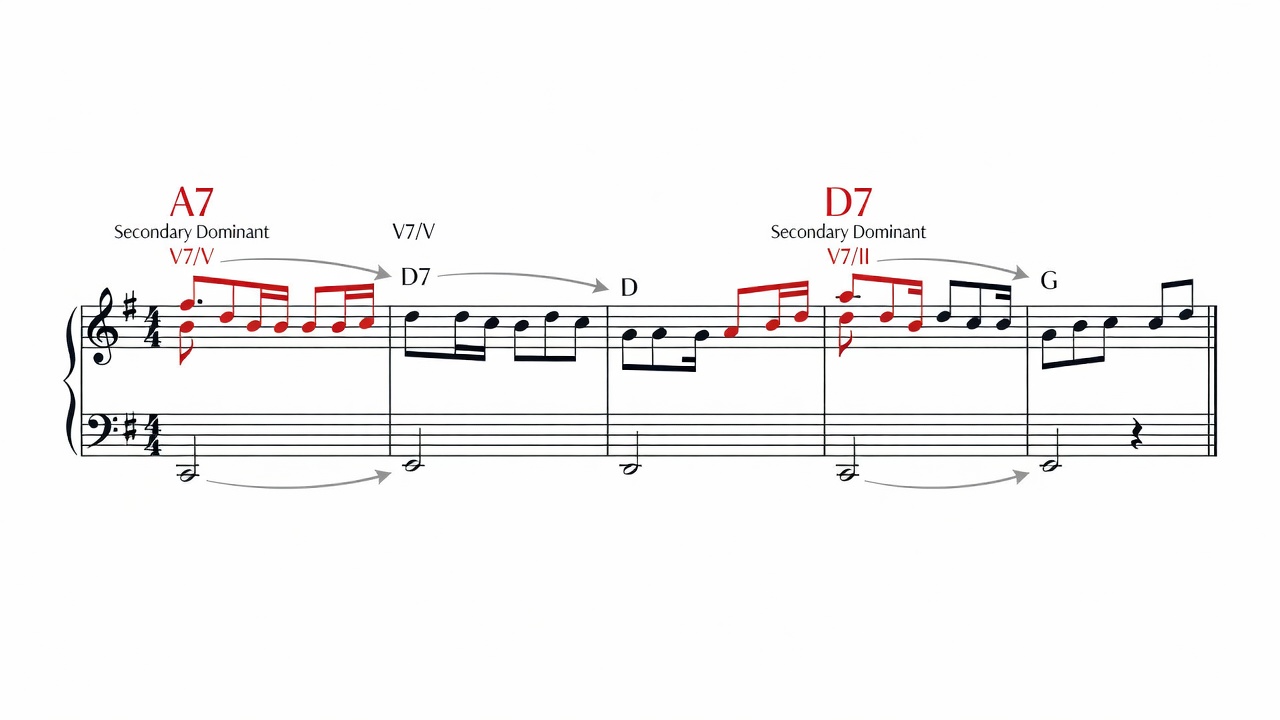
Introduction to Secondary Dominants
Songwriters who have mastered basic diatonic progressions such as I-IV-V often seek ways to introduce greater emotional depth and forward momentum in their music. Secondary dominants provide exactly that capability by functioning as temporary dominant chords that target non-tonic scale degrees. These chords generate a powerful sense of tension and resolution, pulling the listener through the harmony in a more compelling manner than standard diatonic movement alone. This comprehensive how-to guide explores the mechanics of secondary dominants within major and minor scales, details their role in creating emotional pull, and supplies practical construction methods, real-world song examples, integration strategies, and targeted exercises for original compositions.
By incorporating secondary dominants, composers can expand their harmonic vocabulary while remaining firmly rooted in the home key. The technique introduces chromatic notes that heighten drama without requiring a full modulation, making it invaluable for intermediate-level songwriters working across pop, rock, folk, jazz, and classical styles.
What Are Secondary Dominants and How Do They Function Within Scales?
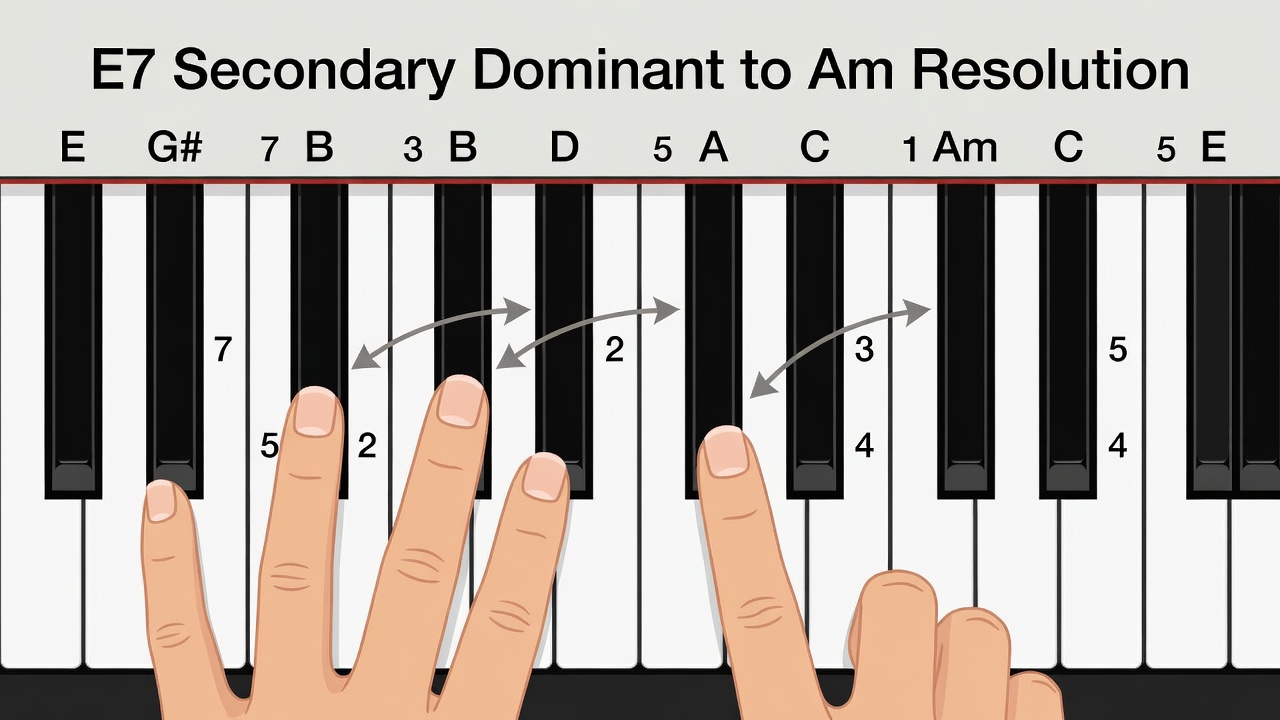
A secondary dominant is defined as the dominant or dominant-seventh chord built on the fifth scale degree of any diatonic chord other than the tonic. In the key of C major, the primary dominant is G7, which resolves strongly back to C. Secondary examples include A7 targeting D minor (the ii chord), D7 targeting G major (the V chord), or E7 targeting A minor (the vi chord). Each creates a brief tonicization that mimics the authentic cadence but applies it locally to another degree of the scale.
Within major scales, secondary dominants borrow the leading-tone function from related keys, raising the fourth scale degree of the target chord to form the major third of the dominant seventh. This chromatic alteration produces the characteristic tension. In minor keys the process is similar, though the raised sixth and seventh degrees already present in the harmonic minor scale often facilitate smoother voice leading. The result is increased harmonic color and a stronger sense of arrival when the target chord resolves.
These chords operate by temporarily reorienting the listener’s ear toward a non-tonic harmony, then releasing that tension upon resolution. The effect adds narrative drive to chord progressions and helps shape song sections with distinct emotional arcs.
Step-by-Step Construction of V7 Chords Targeting Non-Tonic Degrees
Constructing secondary dominants follows a reliable four-step process that can be applied in any key:
- Identify the target diatonic chord (any chord except the tonic I).
- Locate the root a perfect fifth above that target.
- Build a dominant-seventh chord on the new root: a major triad plus a minor seventh.
- Apply proper voice leading so the seventh descends by step and the leading tone ascends to the target chord’s root.
In C major, targeting the ii chord (D minor) yields A7 resolving to Dm. Targeting the IV chord (F major) yields C7 resolving to F. Targeting the vi chord (A minor) yields E7 resolving to Am. In the key of G major, targeting the iii chord (B minor) produces F#7 resolving to Bm. Practicing these constructions in multiple keys builds fluency and reveals how the same pattern adapts across different tonal centers.
Real-World Examples from Classic and Modern Tracks
Secondary dominants appear throughout recorded music. The Beatles’ “Yesterday” employs an A7 secondary dominant before the Dm chord in the verse, intensifying the reflective mood. In “I Will Always Love You,” Dolly Parton and later Whitney Houston use E7 to approach A major within the key of A, creating a soaring emotional lift. Taylor Swift’s “Love Story” features D7 resolving to G in the key of G major during the pre-chorus, adding urgency before the chorus release. Jazz standards such as “Autumn Leaves” chain multiple secondary dominants (E7–Am, A7–Dm, D7–G7) to produce sophisticated forward motion. Classic rock tracks like “Sweet Caroline” by Neil Diamond insert A7 before Dm to heighten the sing-along climax. Analyzing these progressions reveals how the chromatic notes introduced by secondary dominants consistently amplify emotional impact.
Comparing Secondary Dominants to Standard I-IV-V Movement
The familiar I-IV-V progression offers stability, simplicity, and immediate recognition, making it ideal for verses that require a grounded feel. Secondary dominants, by contrast, introduce chromatic tension and stronger resolution tendencies. While I-IV-V remains entirely diatonic, secondary dominants add raised or lowered notes that create momentary key centers. Songwriters can reserve I-IV-V for verses and deploy secondary dominants in pre-choruses or bridges to generate contrast and heightened anticipation. The choice depends on the desired emotional trajectory of each section.
Integration Tips for Song Sections
Place secondary dominants strategically to maximize their effect. In verses, use a single secondary dominant before the vi or ii chord to add subtle color without overwhelming the narrative. Pre-choruses benefit from chains of two secondary dominants that accelerate harmonic rhythm and build anticipation for the chorus. Bridges can feature extended chains or inversions of secondary dominants to provide harmonic contrast before returning to the tonic. Always consider voice leading: inversions of the dominant seventh can smooth connections between chords and maintain melodic flow. Limit usage to two or three instances per section to preserve their dramatic power.
Practical Exercises for Applying Secondary Dominants in Original Compositions
Complete these exercises to develop fluency:
- Start with a basic I-vi-IV-V loop and substitute the final V with a secondary dominant targeting the vi chord.
- Write an eight-bar phrase that incorporates a secondary-dominant chain such as V7/vi–vi–V7/ii–ii.
- Transpose the same progression through three different keys while maintaining correct voice leading.
- Analyze a favorite song, identify existing secondary dominants, and rewrite a section replacing them with diatonic chords to hear the loss of tension.
- Record a short verse–chorus form and experiment with adding one secondary dominant only in the chorus for comparative listening.
Daily practice on piano or guitar reinforces the sound and feel of proper resolutions.
Common Mistakes to Avoid
Beginners frequently resolve the secondary dominant to the wrong chord or omit the seventh entirely, weakening the dominant function. Another pitfall is overusing the device throughout an entire song, which can make the harmony feel restless. Poor voice leading—such as parallel fifths or unresolved leading tones—also diminishes effectiveness. Finally, placing secondary dominants on weak beats reduces their impact; always align the resolution with a strong metrical accent.
Frequently Asked Questions
How do I avoid resolution errors with secondary dominants?
Ensure the seventh of the dominant seventh descends by step and the leading tone rises to the root of the target chord. Resolve on a strong beat and confirm the target is diatonic within the home key.
Can secondary dominants be used in minor keys?
Yes. They function similarly and often target the relative major or other diatonic chords, adding expressive color while respecting the minor tonality.
What common pitfalls should beginners watch for?
Over-application, incomplete seventh chords, and ignoring voice-leading rules are the most frequent issues. Begin with one secondary dominant per phrase and study model songs for natural placement.
Do secondary dominants always resolve immediately?
Most do resolve directly, but occasional deceptive resolutions or chains can extend tension when used purposefully.
Are secondary dominants limited to seventh chords?
While dominant sevenths are most common, plain dominant triads can also function as secondary dominants, though they provide slightly less tension.
Conclusion
Mastering secondary dominants equips songwriters with a versatile tool for shaping emotional arcs through harmony. By following the construction steps, studying concrete examples, practicing the exercises, and avoiding common pitfalls, you can integrate these chords seamlessly into original work. For additional music-theory resources, explore musictheory.net, Wikipedia’s music theory overview, and Britannica’s guide to musical scales.

No comments yet. Be the first!