 Instrumentiverse
Introduction to the Circle of Fifths for Songwriters
The circle of fifths stands as one of the most powerful and enduring tools in music theory, empowering songwriters to navigate keys, chords, and fluid transitions with precision and creativity. In 2026, its relevance continues to grow as composers blend traditional harmony with modern production techniques. Whether you are building intimate acoustic ballads or crafting expansive electronic tracks, the circle provides a visual roadmap that reveals how keys interconnect. This diagram helps you identify which chords and scales will sound harmonious together, allowing for key changes that feel intentional and emotionally resonant rather than random or jarring.
This comprehensive guide covers every essential aspect of the circle, from basic reading skills to advanced modulation strategies. You will explore practical song examples from well-known hits, follow detailed step-by-step exercises for mapping chords and scales, compare major and minor applications, and learn to sidestep frequent beginner errors. Additional sections address integration with core harmony concepts, downloadable practice resources, and answers to common questions that arise during the songwriting process. By the conclusion, you will possess actionable knowledge to elevate your compositions immediately.
How to Read the Circle of Fifths
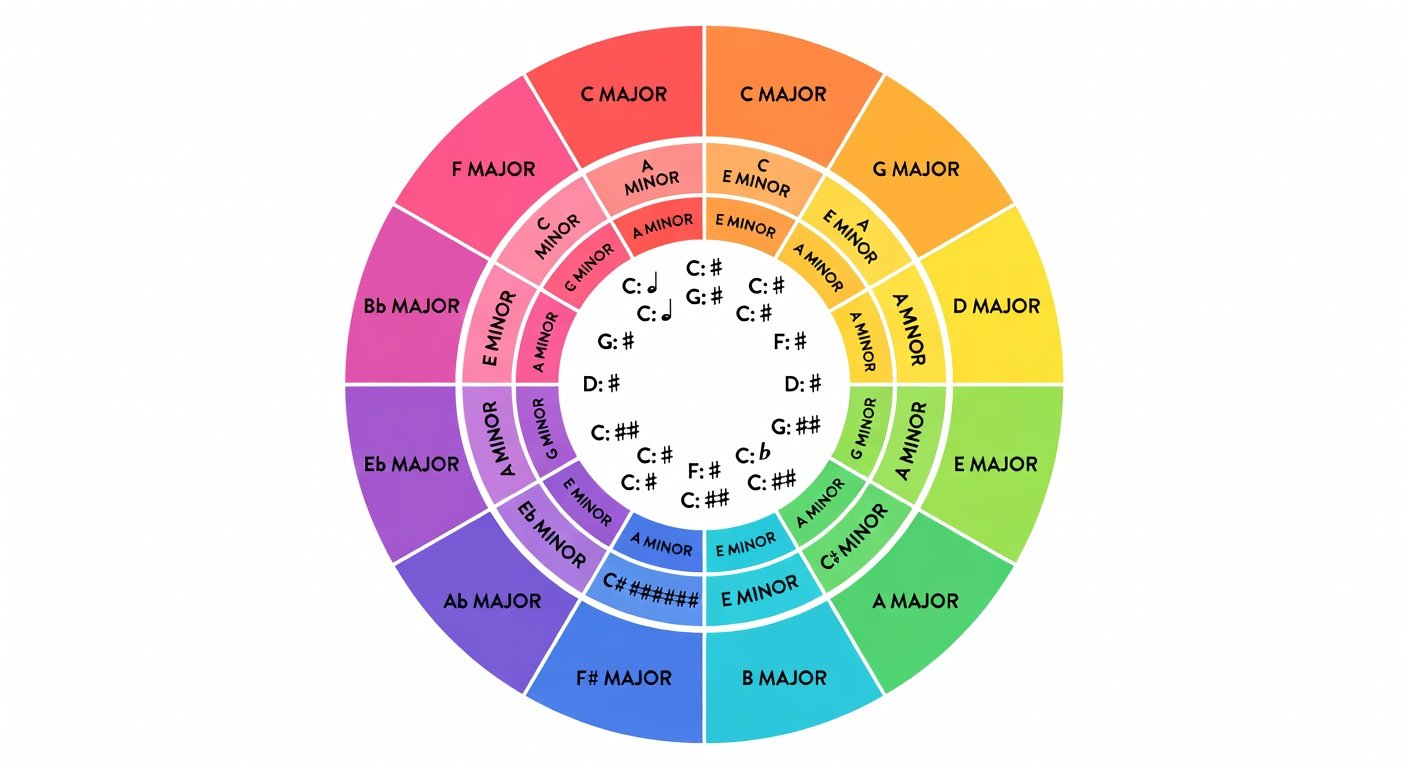
Visualize the circle as a clock face divided into twelve segments, each representing a unique key. Starting at the top with C major, which contains no sharps or flats, movement clockwise introduces one additional sharp per step. The sequence proceeds through G major, D major, A major, E major, B major, F-sharp major, and C-sharp major. Counterclockwise travel adds flats instead: F major, B-flat major, E-flat major, A-flat major, D-flat major, G-flat major, and C-flat major. Each adjacent key differs by exactly one note, making the transition between them musically logical and pleasing to the ear.
Minor keys occupy positions directly inside or parallel to their relative majors. For instance, A minor shares the zero-accidental signature of C major, while E minor aligns with G major. This dual-ring structure immediately highlights parallel relationships that songwriters exploit for emotional contrast within a single piece. Understanding these positions eliminates guesswork when choosing the next chord or planning a modulation.
Key Signature Quick Reference
- Clockwise majors: C, G, D, A, E, B, F♯, C♯
- Counterclockwise majors: C, F, B♭, E♭, A♭, D♭, G♭, C♭
- Relative minors positioned three steps counterclockwise from each major
- Enharmonic equivalents appear at the bottom where keys overlap in sound but differ in spelling
Identifying Related Keys for Smooth Progressions
Keys positioned next to each other on the circle share the greatest number of common tones, creating natural chord progressions that require minimal adjustment. A distance of one or two steps produces gentle movement suitable for verses, while three or four steps introduce more color without losing cohesion. Opposite keys, separated by six steps, generate dramatic tension ideal for bridges or final choruses. Songwriters routinely use these distances to map entire song structures before writing a single lyric.
For practical application, begin in C major and move clockwise to G major. The shared chords C, G, and their diatonic relatives provide seamless continuity while the new tonic note introduces brightness. This principle scales across all keys once the visual pattern is memorized.
Major versus Minor Circle Usage
The outer ring emphasizes major keys that typically convey optimism and resolution, whereas the inner ring spotlights their relative minors for introspective or melancholic passages. Because relative minor keys inherit identical key signatures, songwriters can borrow chords or entire phrases without altering notation. Parallel minors, located three steps clockwise from the major, offer even richer borrowing opportunities through the harmonic minor scale.
Comparing the two rings side by side reveals perfect symmetry. A minor sits opposite its parallel major in emotional impact yet remains closely connected through shared notes. This duality allows rapid mood shifts within verses and choruses, a technique frequently heard in contemporary singer-songwriter material.
Practical Examples of Key Changes in Popular Songs
Numerous chart-topping tracks demonstrate circle-based modulations in action. Journey’s “Don’t Stop Believin’” employs a pivot chord to shift from E major into related territory, heightening the anthemic quality of the final chorus. The Beatles often modulated up a fifth or minor third in songs such as “Penny Lane,” creating an uplifting lift that mirrors lyrical themes of discovery. Modern artists continue this tradition; many current pop productions modulate clockwise by one or two positions during the final chorus to maximize emotional payoff.
Analyze these examples by plotting the keys on your own circle diagram. Notice how the pivot chords always belong to both the original and destination keys, ensuring the listener perceives continuity rather than disruption.
MusicTheory.net provides interactive visualizations that let you replay these exact modulations in real time.
Step-by-Step Exercises for Mapping Chords and Scales
Consistent practice transforms the circle from a static diagram into an intuitive songwriting aid. Complete these exercises daily for best results:
- Reproduce the full circle from memory, labeling every major key and its relative minor.
- Select any starting key, such as D major, and list its primary triads (I, IV, V) plus the three primary chords from its relative minor.
- Write a simple four-chord loop in the starting key, then modulate to the dominant key using a shared chord as the pivot.
- Transpose the same loop into the parallel minor and compare the emotional difference.
- Map a complete verse-chorus-bridge structure that travels through three adjacent keys.
- Practice singing or playing the major scale and its relative minor scale over the same chord progression to internalize note relationships.
- Experiment with secondary dominants by inserting the V chord of the upcoming key one measure early.
Printable templates available from reputable theory resources allow you to repeat these drills without starting from a blank page each session. Over time, the patterns become automatic during live composition sessions.
Building Modulations and Progressions
Effective modulations rely on pivot chords, common tones, or sequential movement along the circle. Begin by identifying one chord that exists in both keys. Extend that chord across two measures while the melody hints at the new tonic, then resolve firmly to the destination key’s I chord. This method works equally well for short lifts or full key changes spanning an entire section.
Try chaining three keys in sequence: start in C major, move to G major, then to D major. Each step reinforces the fifths relationship while gradually raising the overall energy. Record yourself playing these progressions to evaluate how the circle translates into audible results.

Common Pitfalls to Avoid
- Modulating too early, which can make the song feel unsettled before the main theme develops.
- Neglecting the relative minor when seeking emotional variety within the same key signature.
- Forgetting to adjust melodic accidentals after a key change, resulting in dissonant clashes.
- Over-relying on the circle without testing progressions by ear; always play and listen.
- Choosing distant keys without sufficient pivot material, creating abrupt and unmusical jumps.
- Ignoring enharmonic spellings when working with flat or sharp keys near the bottom of the circle.
- Applying the circle only to major keys and overlooking minor-key songwriting opportunities.
Integrating the Circle with Harmony Basics: FAQ
How does the circle relate to basic triads and seventh chords?
Primary triads cluster together on the circle, while seventh chords extend naturally from the same positions, enabling richer harmonic movement.
Can the circle assist with modal writing?
Yes. Each mode shares its parent major or minor key on the circle, allowing quick identification of characteristic notes and chords.
Is software or an app necessary to use the circle effectively?
No. Paper diagrams and mental visualization suffice, though digital tools can accelerate learning for visual learners.
How long does it typically take to internalize the circle?
Most beginners achieve functional fluency within two to three weeks of daily ten-minute exercises.
Does the circle apply to genres outside pop and rock?
Absolutely. Jazz, classical, and many world music traditions rely on the same fifths relationships for modulation and progression.
Conclusion
The circle of fifths equips songwriters with a reliable framework for crafting compelling key changes and harmonic progressions. Through repeated mapping exercises, careful study of real song examples, and mindful avoidance of common pitfalls, this tool becomes second nature. Begin incorporating one new modulation technique per writing session and observe how your music gains both sophistication and emotional depth. The circle is not merely a theoretical construct; it is a practical partner in the ongoing creative process.


No comments yet. Be the first!