 Instrumentiverse

Introduction to 7th Chords in Songwriting
Intermediate songwriters often discover that basic triads alone cannot convey the full spectrum of human emotion in their compositions. While major and minor triads provide solid foundations, seventh chords introduce an essential layer of tension, color, and resolution that transforms ordinary progressions into compelling musical narratives. By mastering the construction and application of seventh chords drawn from major and minor scales, you can infuse your songs with greater depth, making verses feel more introspective and choruses more impactful. This comprehensive guide walks through every major type of seventh chord, offers step-by-step building exercises suitable for piano or keyboard practice, and demonstrates practical songwriting techniques including triad substitutions, voice leading strategies, and real-world examples inspired by 2026 releases such as Taylor Swift's latest tracks.
Understanding the Foundation: Triads Versus Seventh Chords
Triads consist of three notes stacked in thirds and serve as the primary building blocks of harmony in most popular music. However, they often produce a relatively static sound that lacks forward momentum. Seventh chords expand this structure by adding a fourth note, typically a seventh interval above the root. This addition creates inherent dissonance that demands resolution, mirroring emotional arcs in storytelling. For instance, a simple C major triad (C-E-G) feels complete and stable, yet replacing it with C major seventh (C-E-G-B) adds a dreamy, unresolved quality that invites melodic development. The contrast becomes especially evident in progressions where seventh chords heighten anticipation before resolving back to triads or other stable harmonies. Songwriters who compare the two side by side quickly recognize how seventh chords expand expressive possibilities without complicating the overall harmonic framework.
Step-by-Step Construction of Seventh Chords
Begin by selecting a root note from either the major or minor scale. Build each chord by stacking thirds while carefully adjusting interval qualities according to the desired chord type. A piano or keyboard provides the clearest visual reference for these intervals, allowing you to hear and see the relationships simultaneously. Practice ascending and descending through all twelve keys to internalize the patterns.
Major Seventh Chords
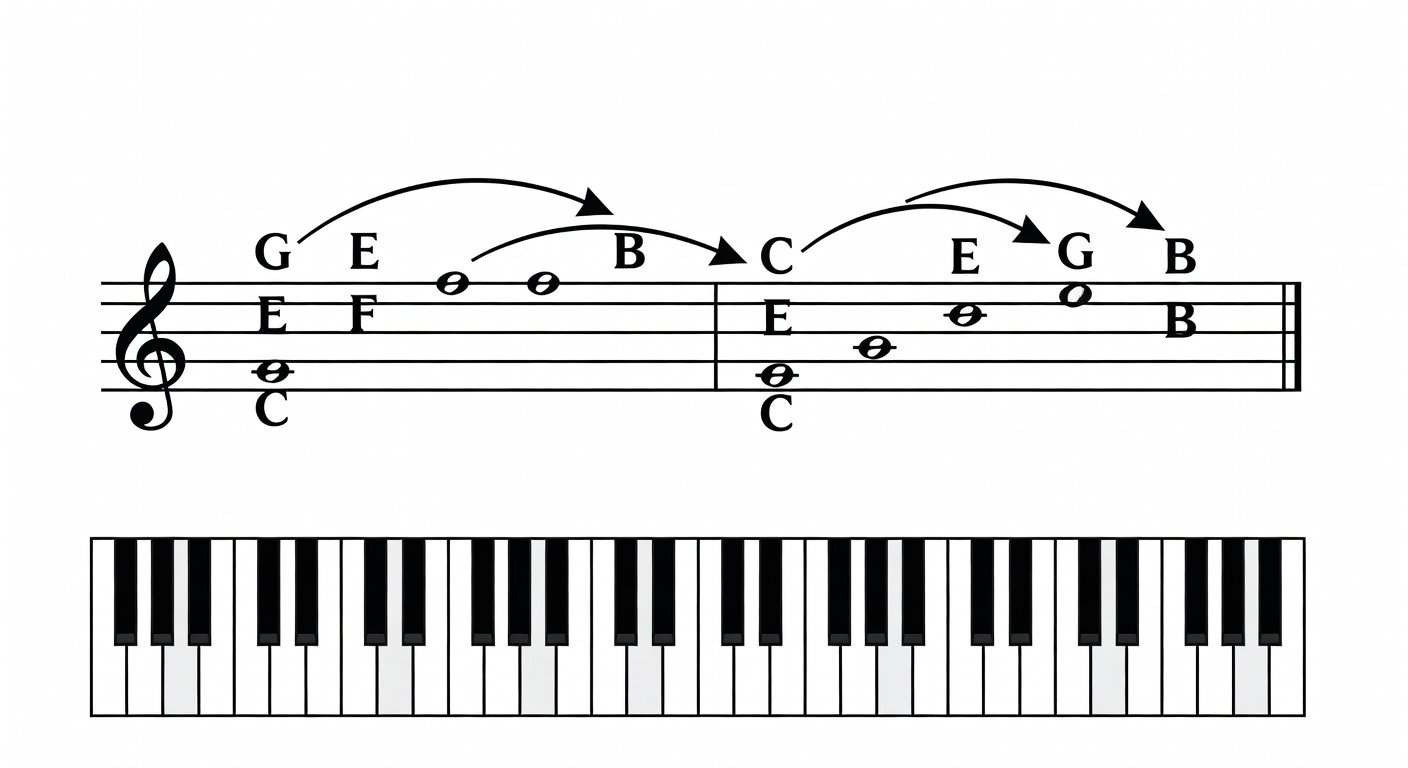
Construct a major seventh chord by combining a major triad with a major seventh interval. Starting on C, play C-E-G and then add B natural. The resulting chord, Cmaj7, evokes warmth and sophistication often heard in jazz-influenced pop ballads. Repeat the process in G major to form Gmaj7 (G-B-D-F#) and listen for the consistent emotional lift provided by the major seventh.
Dominant Seventh Chords
Dominant seventh chords introduce a minor seventh above a major triad, generating strong tension that resolves naturally to the tonic. In C, the chord becomes C7 (C-E-G-Bb). This type appears frequently in blues, rock, and contemporary pop turnarounds. Practice moving from C7 to F major to experience the satisfying release of the tritone interval resolving.
Minor Seventh Chords
Form minor seventh chords from a minor triad plus a minor seventh: C-Eb-G-Bb yields Cm7. These chords convey melancholy or contemplation and work beautifully in minor-key verses. Try building Dm7 in the key of C major for a ii7 chord that smoothly leads toward a dominant.
Half-Diminished and Fully Diminished Chords
Half-diminished chords, also known as minor seven flat five, combine a diminished triad with a minor seventh (C-Eb-Gb-Bb = Cm7b5). Fully diminished chords stack three minor thirds to create maximum instability (C-Eb-Gb-Bbb = C°7). Use half-diminished chords as passing harmonies and fully diminished chords for dramatic modulations or climactic moments.
Voice Leading for Smooth Transitions
Effective voice leading ensures that chord changes feel fluid rather than jarring. Keep common tones in the same voice when possible and move the remaining notes by step or half step. For example, when progressing from Cmaj7 to Dm7, retain the G and move C up to D while E moves to F. This approach minimizes leaps and preserves melodic continuity across the progression. Experiment with inversions to further refine transitions, placing the seventh in the bass for a descending bass line that adds sophistication to your arrangements.
Practical Songwriting Applications and Substitutions
One powerful technique involves substituting seventh chords for basic triads within familiar progressions. Replace the I chord in a I-vi-IV-V sequence with Imaj7 to create a more reflective opening. In recent 2026 hits, including several tracks from Taylor Swift's latest album, songwriters employ dominant seventh chords to inject bluesy energy into otherwise straightforward pop structures. Another approach layers seventh chords beneath vocal melodies that emphasize the added seventh note, allowing the harmony to support lyrical themes of longing or uncertainty. Record short four-bar loops using these substitutions and improvise melodies over them to discover unexpected emotional resonances.
Common Progressions and Exercises
Practice the following progressions in multiple keys: I7-vi7-ii7-V7, ii7-V7-Imaj7, and i7-iv7-v7 in minor keys. For each progression, write a short melodic fragment that highlights the seventh of each chord. This exercise strengthens both your harmonic awareness and melodic intuition. Additionally, transpose the same progression to distant keys to explore modulation possibilities using diminished seventh chords as pivot points.
Comparing Tension and Resolution
Seventh chords generate more pronounced tension than triads because the added seventh creates intervals such as the tritone or minor second that crave resolution. A dominant seventh chord, for instance, contains a tritone that resolves outward or inward depending on voice leading choices. In contrast, triads remain relatively stable and can sometimes feel emotionally flat when overused. By alternating between triads and seventh chords within a single section, you control the pacing of emotional intensity throughout your song.
Frequently Asked Questions and Mistakes to Avoid
- What is the most common mistake beginners make? Confusing the quality of the seventh interval and applying a major seventh where a minor seventh is required.
- How should I practice chord inversions? Start with root position, then move the third to the bass, followed by the fifth and seventh in the bass to hear each unique color.
- Can seventh chords work in simple folk or indie styles? Absolutely; many modern indie tracks use major seventh chords sparingly for atmospheric effect without overwhelming the arrangement.
- What if the chord clashes with my melody? Adjust the melody to emphasize chord tones or use non-chord tones as passing notes that resolve into the seventh.
Seventh Chord Reference Chart
| Chord Type | Interval Formula | Example in C | Emotional Character |
|---|---|---|---|
| Major 7th | 1-3-5-7 | Cmaj7 | Warm, dreamy |
| Dominant 7th | 1-3-5-b7 | C7 | Tense, driving |
| Minor 7th | 1-b3-5-b7 | Cm7 | Melancholy, soulful |
| Half-Diminished | 1-b3-b5-b7 | Cm7b5 | Unsettled, mysterious |
| Fully Diminished | 1-b3-b5-bb7 | C°7 | Dramatic, unstable |
Continue exploring music theory concepts at MusicTheory.net and review detailed references on Wikipedia. With consistent practice, seventh chords will become an indispensable tool in your songwriting toolkit, helping you craft music that resonates on a deeper emotional level.

No comments yet. Be the first!