 Instrumentiverse

Introduction to Suspended Chords
Suspended chords, often called sus chords, offer songwriters a simple yet powerful way to introduce harmonic color without diving into complex theory. Unlike traditional major and minor triads, suspended chords replace the third with either a second or a fourth, creating an open, ambiguous sound that builds tension and emotional depth. This beginner-friendly guide explores sus2 and sus4 chords drawn directly from major and minor scales, their role in progressions, voice leading techniques, and real-world applications to help you integrate them immediately into your songwriting. Whether you are composing on piano, guitar, or digital audio workstation, understanding suspended chords unlocks fresh harmonic possibilities that keep listeners engaged.
What Are Suspended Chords?
A suspended chord is built by taking a root note and adding either the second or fourth scale degree instead of the third. This omission of the third removes the major or minor quality, resulting in a neutral, floating harmony. Sus2 chords use the root, second, and fifth, while sus4 chords use the root, fourth, and fifth. These chords are staples in rock, pop, folk, and jazz because they resolve beautifully to triads or create movement within a progression. The suspended sound evokes a sense of waiting or suspension, which is why they are named as such, and they function as excellent tools for songwriters seeking to avoid predictable harmonic patterns.
Building Sus2 and Sus4 Chords from Scales
To construct these chords, start with any major or minor scale. For example, in the C major scale (C-D-E-F-G-A-B), a Csus2 is C-D-G and a Csus4 is C-F-G. The same process applies in minor keys: in A minor (A-B-C-D-E-F-G), Asus2 is A-B-E and Asus4 is A-D-E. In G major, Gsus2 becomes G-A-D and Gsus4 becomes G-C-D. Practicing in multiple keys helps solidify the concept. The same method works across all 12 keys and helps songwriters quickly transpose ideas when moving between songs or modulating within a piece. Always verify the fifth remains constant while swapping the third for the appropriate suspended note.
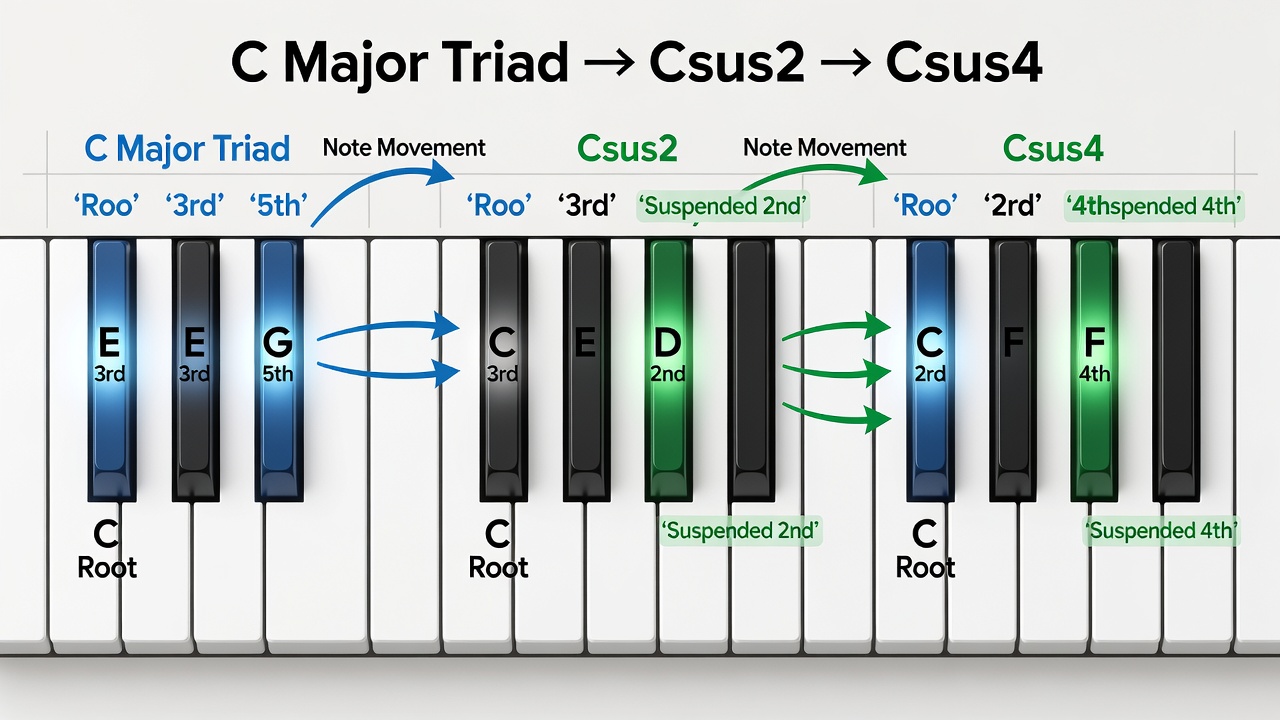
Compare this to standard triads: a C major triad is C-E-G, while Csus2 replaces E with D and Csus4 replaces E with F. Seventh chords add further layers, such as a dominant seventh (C7 = C-E-G-Bb), but suspended versions like Csus4(7) introduce even richer tension by combining the suspended fourth with the flattened seventh for dramatic effect before resolution.
Comparing Sus Chords to Triads and Seventh Chords
Triads provide clear emotional direction—major for brightness, minor for melancholy. Suspended chords sit in between, offering ambiguity that songwriters exploit for drama. Seventh chords extend triads with added color, yet sus chords can substitute or enhance them. For instance, replacing the third in a dominant seventh creates a sus4(7) that heightens resolution when it moves to the tonic. This flexibility allows sus chords to serve as transitional elements that bridge sections without abrupt changes.
The Tension-Building Role in Progressions
Suspended chords excel at creating anticipation. Common moves include Csus4 resolving to C major or Csus2 leading into G major. In a I-IV-V progression in C, try C - Csus4 - F - G - Csus2 for added lift. Extend this idea further by inserting Csus4 between F and G to prolong the build-up. In minor keys, try Am - Asus2 - Dm - Esus4 for a haunting quality. These substitutions prevent static harmony and guide the listener’s ear toward resolution, making verses feel more dynamic and choruses more impactful.
Music Theory Net offers interactive tools to visualize these movements across keys.
Smooth Voice Leading Techniques
Effective voice leading keeps common tones and moves other notes by step. When shifting from C major (C-E-G) to Csus4 (C-F-G), simply raise E to F. From Csus4 back to C, lower F to E. For sus2, move the third down a whole step to the second. Practice these minimal movements on piano or guitar to maintain smooth transitions and avoid awkward leaps. In a progression such as C - Csus2 - G, keep the C and G common while the E slides down to D then resolves upward to the B in G major. This technique ensures the harmony flows naturally and supports melodic lines without clashing.
Real Song Examples
Classic tracks demonstrate sus chords in action. The opening of “Don’t Stop Believin’” by Journey uses E major with sus4 touches for uplift. In folk, “Wild World” by Cat Stevens leans on sus2 and sus4 for emotional nuance. Modern pop songs frequently insert Csus4 before the chorus to heighten impact. Listen to “Wonderwall” by Oasis for repeated sus4 shapes that define the riff, or “Hey Jude” by The Beatles where suspended chords add warmth during the coda. Analyze these examples by ear to internalize the sound and experiment with similar placements in your own work.
Step-by-Step Application Exercises
- Choose a simple progression like C - G - Am - F and replace the C with Csus4, then resolve back to C major.
- Write a two-bar phrase using only sus2 and sus4 chords before landing on a major triad for contrast.
- Transpose the same idea to three different keys, focusing on voice leading consistency.
- Record yourself playing a verse with sus chords and note the emotional shift compared to plain triads.
- Layer a sus2 chord under a vocal melody that emphasizes the second degree for added tension.
- Combine sus4 with a seventh chord in the left hand while keeping the right hand melodic.
These drills build muscle memory and help you hear how suspended harmony affects mood over extended sections.
Emotional Impact and Practical Tips
Suspended chords can evoke longing, hope, or uncertainty depending on context and resolution speed. Use sus2 for gentle, reflective moments and sus4 for stronger, more urgent tension. A practical tip is to place a sus chord on the last beat of a phrase to lead naturally into the next section. Another tip involves doubling the root or fifth in the bass for fuller sound on guitar or keyboard. Always test your ideas at different tempos, as slower ballads benefit from longer suspensions while upbeat tracks need quicker resolutions.
Common Pitfalls to Avoid
- Overusing sus chords without resolution can leave listeners unsettled and the music feeling incomplete.
- Ignoring voice leading often produces choppy transitions that disrupt the flow of a song.
- Confusing sus2 with add2 chords—remember sus2 omits the third entirely while add2 includes it.
- Forgetting to check the key signature when building chords from minor scales leads to incorrect notes.
- Placing sus chords too frequently in fast passages may clutter the arrangement instead of enhancing it.
Frequently Asked Questions
Can suspended chords be used in minor keys?
Yes, they work equally well and often heighten the introspective quality of minor progressions, creating beautiful ambiguity.
How do sus chords differ from power chords?
Power chords omit the third like sus chords but lack the second or fourth, resulting in a more aggressive, less colorful sound suited to rock riffs.
Should beginners start with sus2 or sus4?
Start with both—sus4 tends to resolve more dramatically, while sus2 offers gentler color that suits acoustic styles.
Do suspended chords work with extended harmonies?
Absolutely; adding ninths or elevenths to sus chords creates lush textures popular in jazz-influenced songwriting.
Conclusion
Suspended chords are an accessible entry point into richer harmony for any songwriter. By mastering their construction from scales, applying them in progressions, and refining voice leading, you can add fresh emotional layers to your music right away. Experiment daily with the exercises above and listen closely to how these chords transform familiar progressions into more compelling musical stories.
No comments yet. Be the first!