 Instrumentiverse
Introduction to Song Form Analysis
Song form analysis is a foundational skill for any aspiring songwriter or composer looking to elevate their work beyond simple chord progressions and basic scales. By applying core music theory principles, creators can understand how different sections of a song interact to create emotional arcs, maintain listener engagement, and deliver memorable hooks. This beginner-friendly guide explores common structures such as verse-chorus-bridge and AABA forms, while connecting them directly to harmony choices and scale selections that amplify emotional impact. Through detailed breakdowns of real song examples, comparisons between pop and jazz approaches, and step-by-step guidance on mapping progressions, you will gain practical tools to build more compelling tracks.
At its core, song form refers to the organizational blueprint of a composition. It dictates where repetition occurs, when contrast is introduced, and how tension and release are managed across the entire piece. Without thoughtful form, even the strongest melodies and lyrics can feel disjointed or monotonous. Aspiring creators often start with basic loops but quickly discover that intentional structure transforms raw ideas into professional-sounding songs that resonate with audiences.
Core Song Structures Explained in Depth
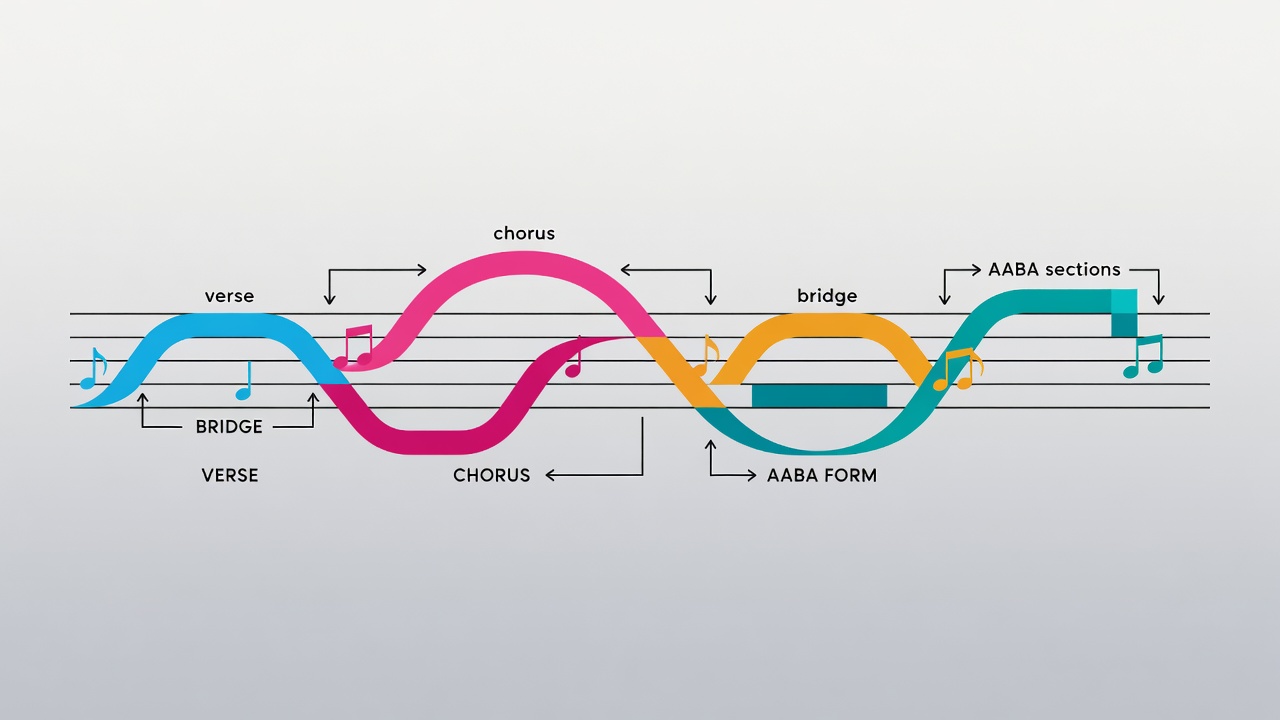
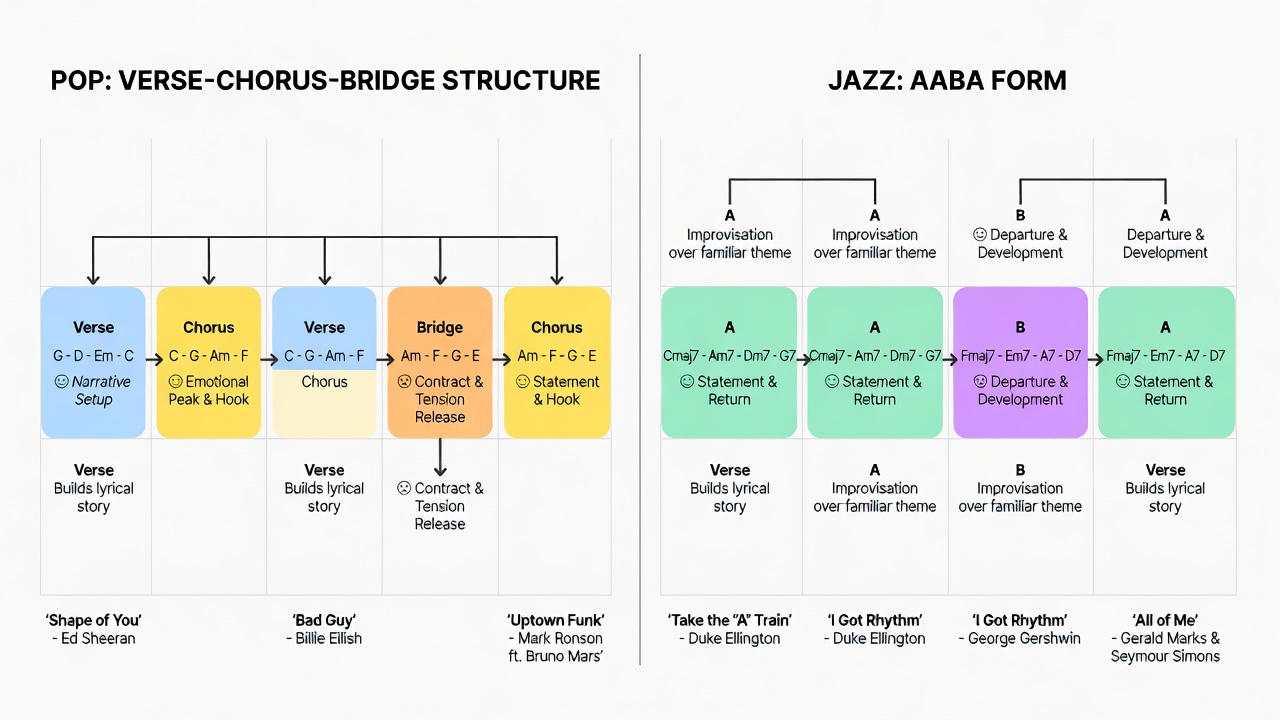
The verse-chorus-bridge structure remains the most prevalent form in contemporary popular music. Verses typically advance the narrative with changing lyrics over a consistent harmonic foundation, allowing the story to unfold gradually. The chorus then serves as the emotional centerpiece, featuring repeated lyrics, a catchy melody, and often the song's title hook. The bridge provides essential contrast by shifting the harmonic landscape, introducing new melodic material, or altering the rhythmic feel to prevent listener fatigue before returning to the chorus for a satisfying resolution.
In contrast, AABA form, which originated in early 20th-century Tin Pan Alley and became a staple of jazz standards, consists of two statements of the main theme (A sections), a contrasting middle section (B), and a final return to the theme (A). This structure emphasizes thematic development and works exceptionally well for ballads or instrumental pieces where melodic variation takes center stage. Each A section is usually 8 or 16 bars, while the B section often modulates to a related key to heighten drama.
Breaking Down Real Song Examples with Theory Application
Analyzing hit songs reveals how these forms operate in practice. "Hey Jude" by The Beatles extends the traditional verse-chorus pattern into a lengthy coda that functions as an extended improvisational bridge, building intensity through repeated "na-na-na" vocals and harmonic layering. The form allows the emotional payoff to unfold over several minutes without losing coherence. Similarly, "Don't Stop Believin'" by Journey uses verse-chorus with a pre-chorus buildup and a powerful bridge that modulates upward for the final chorus, creating an anthemic lift.
For AABA, consider "Take the 'A' Train" by Duke Ellington. The A sections establish the swinging main melody in a major key, while the B section introduces chromatic movement and a brief key change that spotlights soloists. Mapping the chords shows how the form supports improvisation: A sections stay diatonic, but the B section employs secondary dominants to create forward momentum. Another example is "Over the Rainbow" by Harold Arlen, where the AABA structure lets the soaring melody develop emotional depth through strategic harmonic shifts.
Harmony Basics and Scale Choices for Emotional Impact
Harmony is the engine that drives emotional response within any song form. Diatonic progressions in major keys tend to feel bright and resolved, while minor keys introduce melancholy or introspection. Borrowed chords from parallel modes—such as using a flattened seventh degree in a major key—can inject unexpected tension, particularly effective in bridges or final choruses. Scale choices further color the mood: the Ionian mode supports uplifting choruses, whereas the Aeolian or Dorian modes lend a reflective quality to verses.
In practice, songwriters can map scale choices to section functions. A verse in a minor pentatonic scale might convey vulnerability, then shift to the major scale for the chorus to signal hope or triumph. Jazz forms often incorporate the Mixolydian mode over dominant chords in the B section to facilitate smooth solo transitions. Experimenting with these choices prevents sections from blending together and strengthens the overall narrative arc.
Explore foundational concepts of musical form at Britannica. Additional guidance on harmony can be found at MusicTheory.net.
Pop Versus Jazz Forms: Detailed Side-by-Side Comparison
Pop and jazz approaches to form differ significantly in priorities and execution. Pop structures like verse-chorus-bridge prioritize immediate accessibility and repetition of hooks, with sections usually lasting 8 to 16 bars to suit radio formats. Energy builds through dynamic contrast and lyrical repetition rather than harmonic complexity. Jazz forms such as AABA or 12-bar blues, however, emphasize improvisation and harmonic exploration. The B section frequently features key changes or extended dominant chords that open space for solos, while the overall form remains flexible for live variation.
- Pop favors concise, memorable choruses that listeners can sing along to immediately.
- Jazz highlights the B section as a vehicle for melodic and harmonic invention.
- Both can benefit from hybrid approaches, such as inserting a jazz bridge into a pop song for unexpected depth.
Understanding these distinctions helps songwriters choose the right form based on genre goals and audience expectations.
Practical Steps for Mapping Out Progressions Within Sections
- Listen actively to identify section boundaries by noting changes in energy, lyrics, or instrumentation.
- Label each section clearly (Verse, Chorus, Bridge) and count the bar lengths to understand proportions.
- Transcribe the chord progression for each section using Roman numeral analysis to reveal functional relationships.
- Identify opportunities for substitutions, such as replacing a IV chord with a ii7 for smoother voice leading or adding a secondary dominant before the bridge.
- Test emotional impact by playing the same progression with different scale modes and noting listener responses.
- Iterate by rearranging sections or extending certain parts to improve pacing and avoid predictability.
Simple Worksheet Template and How to Use It Effectively
A practical worksheet template accelerates learning. Create columns for Section, Key/Scale, Chord Progression (Roman numerals), Emotional Goal, and Notes on Contrast. Begin by filling it out for three favorite songs, then apply the same process to your own drafts. This exercise highlights patterns, such as how bridges often introduce the first borrowed chord, and reveals areas where your song needs more dynamic contrast. Over time, the template becomes a personal reference for consistent form decisions.
Common Mistakes to Avoid When Analyzing or Building Forms
Many beginners repeat the same four-chord loop across every section, leading to monotony. Another frequent error is neglecting the bridge entirely or making it too similar to the verse. Overly long sections without internal development can also lose momentum. To avoid these pitfalls, always introduce at least one harmonic or melodic variation per section and ensure the bridge provides genuine contrast in key, rhythm, or texture.
FAQ on Avoiding Repetitive Structures
How can I keep my songs from sounding repetitive? Introduce subtle variations such as changing the bridge instrumentation, adding a pre-chorus build, or modulating the final chorus up a half step for renewed energy.
What if my chosen form feels too predictable? Experiment with extended or hybrid forms, including post-chorus sections or an instrumental break that functions like a jazz B section.
Should beginners attempt complex forms right away? Start with verse-chorus-bridge, master its emotional flow, then gradually incorporate elements from AABA or blues structures as your harmonic vocabulary grows.
How does music theory help prevent repetition? Theory provides tools like modal interchange and secondary dominants that naturally create contrast without guesswork.
Conclusion
Song form analysis, when combined with practical music theory application, equips songwriters with the ability to craft engaging, emotionally resonant music. By studying established structures, dissecting real examples, comparing genre approaches, and using worksheets to map progressions, you can move beyond basic ideas into fully realized compositions. Begin applying these principles to your next song today and notice how intentional form transforms your creative output.


No comments yet. Be the first!