 Instrumentiverse
Introduction to Augmented Chords in Modern Songwriting
Augmented chords offer songwriters a powerful way to inject drama and unexpected harmonic colors into their music. Unlike standard major and minor triads, these symmetrical structures create tension that demands resolution, making them ideal for emotional peaks in progressions. This guide dives deep into their construction, functions, and practical applications for intermediate creators looking to expand beyond basic harmony. By understanding how these chords function outside diatonic frameworks, you can craft progressions that surprise listeners while maintaining musical coherence. Augmented chords bridge the gap between familiar triads and more complex extensions, providing a fresh palette without requiring advanced jazz theory knowledge.
Constructing Augmented Triads from Scales
An augmented triad consists of a root, a major third, and an augmented fifth. Starting from any note in a major or minor scale, raise the fifth by a half step. For example, a C augmented chord (Caug or C+) uses C, E, and G#. These chords appear naturally in harmonic minor scales and can be derived from whole-tone scales for a floating, unresolved feel. In the key of C major, the augmented chord on the tonic emerges when you sharpen the fifth degree. Try building one on every scale degree to hear the unique symmetry. In D major, the augmented triad is D, F#, A#. Notice how the interval structure remains consistent regardless of root: each note is separated by a major third. This symmetry allows the chord to invert seamlessly, with any note functioning as the root. Practice spelling these in all twelve keys to internalize the pattern. Reference materials at musictheory.net can reinforce scale derivations.
Voice Leading Techniques
Smooth voice leading is essential when using augmented chords. Move the augmented fifth up or down by half steps to resolve tension. Keep common tones static while shifting the other voices to create seamless transitions in your progressions. For instance, in a C to Caug movement, hold the C and E while raising G to G#. Then resolve the G# upward to A in the next chord. Experiment with contrary motion between outer voices to heighten drama. Avoid parallel fifths by staggering the movement of inner voices. These techniques prevent the chord from sounding abrupt and instead integrate it organically into melodic lines.
Function in Chord Progressions
Augmented chords often serve as passing or pivot chords. They heighten drama before resolving to major or minor tonics. In a I - I+ - IV progression, the augmented chord adds a surprising lift that feels cinematic. Common resolutions include moving the augmented fifth chromatically to the next chord's root or third. This creates satisfying tension-and-release moments that elevate song sections like bridges or choruses. Consider the progression C - Caug - F - G7 in C major: the Caug acts as a chromatic connector that pulls the ear forward. You can also substitute an augmented chord for a dominant seventh in turnaround sections for added color. Multiple examples across keys reveal how the same shape functions differently depending on context, such as acting as a secondary dominant or a neighbor chord.
Further reading on chord functions is available through Wikipedia music theory resources.
Comparisons to Diminished Chords for Emotional Contrast
While diminished chords evoke unease and instability with their minor thirds and diminished fifths, augmented chords produce a brighter yet equally tense quality due to their major thirds and raised fifths. Use diminished for darker, more ominous passages and augmented for dramatic, uplifting builds. The emotional contrast becomes clear in parallel progressions: replace a diminished chord with an augmented one and observe the shift from minor-key tension to major-key anticipation. Diminished chords often resolve downward, whereas augmented chords favor upward chromatic motion. This distinction helps songwriters choose the right tool for specific lyrical moods.
- Diminished: Often leads to dominant chords in minor keys.
- Augmented: Frequently substitutes for dominant or acts as a chromatic passing tone.
- Both: Create symmetrical movement but differ in brightness and resolution direction.
Step-by-Step Exercises for Songwriters
Practice these exercises at your instrument: 1. Build Caug, then resolve it to F or Am. 2. Experiment with voice leading in a four-bar loop. 3. Transpose the same pattern to different keys. Record your attempts to hear how the drama unfolds. Extend the exercise by writing a short verse using only augmented chords followed by diatonic resolution. Try layering melodies over these progressions to test compatibility. Spend time daily on one key before moving to the next to build muscle memory and intuitive usage.
Real Song Examples and Genre Applications
Augmented chords appear in classic tracks like The Beatles' "Oh! Darling" and jazz standards. In pop and rock, they add cinematic flair, while in film scoring they heighten suspense. Explore applications in electronic music for evolving pads and in folk for unexpected turns. In country ballads, they punctuate emotional choruses, and in R&B they support smooth modulations. Analyze these placements to see how producers use the chord's symmetry for seamless key changes or builds. 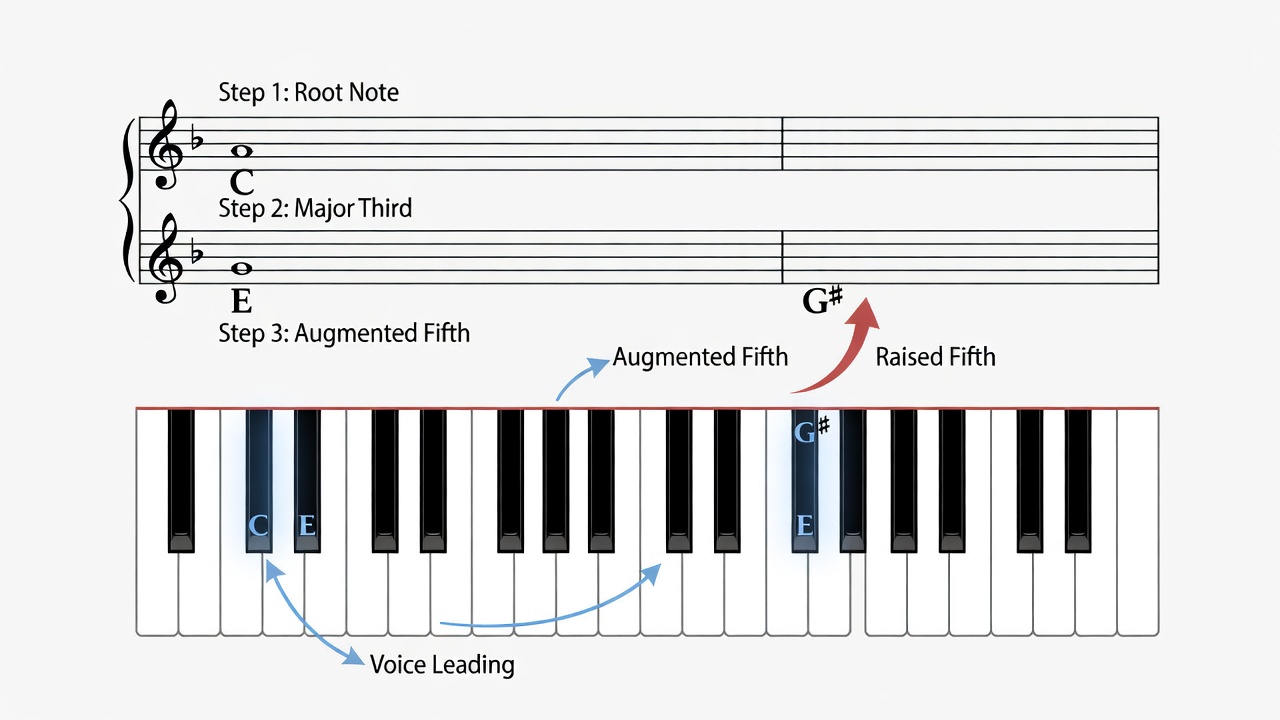
Common Mistakes to Avoid
Overusing augmented chords can dilute their impact. Always ensure clear resolution paths, and avoid clashing with the melody. Test progressions in context with your full arrangement. Another pitfall is neglecting inversions; explore all three inversions of the chord to discover varied bass lines. Finally, do not force the chord into every progression—reserve it for moments where tension serves the song's narrative arc.
Short FAQ on Usage and Notation
How are augmented chords notated?
Common symbols include Caug, C+, or C(#5). In lead sheets, they appear as passing chords between diatonic options.
Can beginners use them effectively?
Start simple by inserting one augmented chord per section and focus on its resolution for immediate dramatic effect.
What keys work best for initial practice?
Begin with C, G, and F major to leverage familiar white-key positions before advancing to sharps and flats.
Conclusion
Augmented chords unlock fresh harmonic palettes that transform ordinary progressions into memorable experiences. Experiment consistently, and you'll discover endless ways to add drama to your songwriting.
No comments yet. Be the first!