 Instrumentiverse

Introduction to Extended Chords for Songwriters
Extended chords like 9ths, 11ths, and 13ths add rich color and emotional depth to music without complicating progressions. These chords build on basic triads and seventh chords by stacking additional notes from the scale. For songwriters, they offer powerful tools to enhance melody flow and create memorable hooks in genres from pop to jazz and R&B. Many modern tracks rely on these sounds to stand out in playlists, moving beyond simple major and minor chords to evoke specific feelings like longing, tension, or resolution.
Understanding their application starts with recognizing how they function in context. In this guide, we break down popular tracks and provide concrete voicings tailored for practical use. Whether you work on piano, guitar, or digital audio workstations, these concepts translate directly into your writing process. Extended chords do not require advanced theory knowledge to begin experimenting; they reward careful listening and incremental practice.
Breaking Down 9th Chords in Modern Tracks
The 9th chord extends a seventh chord by adding the ninth scale degree. It creates a lush, open sound ideal for verses or bridges. Consider Stevie Wonder's "Isn't She Lovely," where dominant 9ths drive the groove and support the vocal melody. Another strong example appears in D'Angelo's "Untitled (How Does It Feel)," where 9ths add warmth and soulful texture to the chord progression.
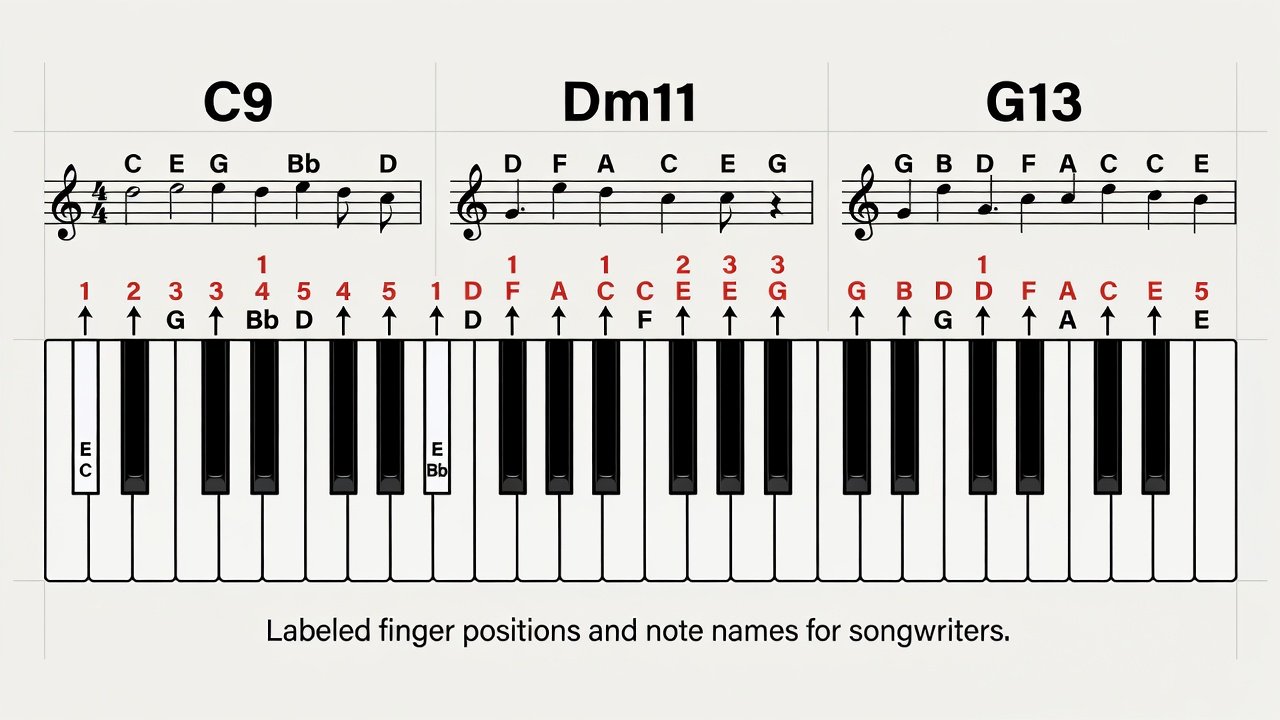
Step-by-step voicing on piano: Start with C7 (C-E-G-Bb), then add D for C9. Play it in root position or invert for smoother transitions. On guitar, try a common shape with the root on the sixth string and the ninth voiced on the second string. This substitution works well over dominant chords in major keys, replacing plain 7ths to heighten tension before resolution. Compare the effect: a plain C7 feels direct and bluesy, while C9 introduces a brighter, more hopeful quality that can lift a chorus.
Songwriters often use 9ths in turnaround progressions. Try replacing the final V7 in a 12-bar blues with a V9 to create a more contemporary feel. Listen to how the extra note interacts with the melody; the ninth frequently doubles or harmonizes with a vocal line for added richness.
Applying 11th Chords for Depth
11th chords layer the eleventh on top, often suspended for a dreamy effect. In The Beatles' "The Long and Winding Road," 11ths contribute to the melancholic atmosphere. Songwriters can substitute an 11th for a minor seventh to soften emotional peaks. Modern examples include tracks by artists like Bon Iver, where 11ths create atmospheric layers in indie-folk arrangements.
Voicing example: For Dm11, play D-F-A-C-E-G. Focus on the top three notes for guitar or keyboard to keep progressions accessible. Compare this to a standard Dm7—the added E and G create more space for melody to breathe. On guitar, omit the root if a bass player handles it, allowing the upper extensions to shine. This approach keeps the chord light and prevents muddiness in dense mixes.
13th Chords and Emotional Impact
13th chords complete the extension with the thirteenth note, delivering sophisticated tension. Tracks like Herbie Hancock's "Maiden Voyage" showcase 13ths in jazz contexts, but they translate to pop ballads too. Use them sparingly as substitutions to avoid cluttering simple I-IV-V progressions. In contemporary music, artists such as Snarky Puppy incorporate 13ths to add funky, layered harmonies that support extended improvisations.
Side-by-side comparison: A C13 voicing (C-E-G-Bb-D-F-A) versus C7 feels fuller yet resolves cleanly. Practice moving between these to see effects on melody flow—13ths often support descending lines beautifully. The thirteenth note can act as a passing tone or a sustained color note that enriches the harmonic palette without overpowering the lead vocal.
Substitutions That Enhance Emotional Impact
Substitutions let you swap basic chords for extended versions while preserving the underlying harmony. For instance, replace a minor seventh with a minor 11th in a verse to introduce subtle melancholy. In major progressions, swap a dominant seventh for a 13th during the final phrase to heighten resolution. These changes maintain accessibility because the root movement stays the same; only the upper voices expand.
Always test substitutions against your melody. If the ninth or eleventh clashes, lower it an octave or choose a different inversion. This method keeps progressions familiar yet more expressive, helping your songs connect emotionally with listeners.
Targeted Exercises for Integration
Integrate extended chords into your scales with these exercises:
- Take a basic C major scale and build 9ths, 11ths, and 13ths on each degree, playing them in both root position and first inversion.
- Substitute one extended chord per progression in an existing song sketch, then record the result to evaluate emotional shifts.
- Record yourself playing a loop and layer melody over different voicings to compare emotional results; note which extensions support ascending versus descending lines.
- Practice voice leading by moving only the upper notes between chords while keeping the bass steady.
- Apply the same exercise across minor keys to understand how extensions behave differently in darker tonalities.
These build familiarity while keeping harmony basics intact. Repeat daily for two weeks to internalize the sounds.
Comparing Voicings Side-by-Side and Their Effects on Melody Flow
Different voicings of the same extended chord produce distinct results. A close-position C9 on piano sounds compact and intimate, whereas a spread voicing across two octaves feels open and cinematic. On guitar, cluster voicings with the ninth and seventh adjacent create tension suitable for verses, while wider shapes suit choruses.
Melody flow improves when extensions align with vocal notes. If your melody lands on the ninth, emphasize that note in the chord to reinforce the line. Avoid stacking too many extensions in the same octave range, as this can blur the harmonic identity and make the melody harder to follow.
Common Pitfalls and FAQs
Many songwriters overuse extensions, muddying the mix. Always check voicing spread—keep notes within two octaves. Another pitfall is ignoring voice leading; smooth movement between chords preserves flow. Beginners sometimes add every available extension at once, resulting in overly dense chords that fight the melody.
FAQ: How do I start adding these without theory overload? Begin with one 9th per section and expand gradually. What if my melody clashes? Adjust the ninth or eleventh to fit the vocal line or choose an inversion that places the clashing note higher. Can extended chords work in simple pop structures? Yes, many hit songs use one or two per section for color. How do guitar and piano voicings differ? Guitar benefits from omitting the root or fifth, while piano can sustain all notes clearly. For more foundational reading, explore Music Theory resources and Extended chord concepts. Additional guidance is available at Berklee College of Music.
Conclusion
Extended chords transform ordinary progressions into expressive tools. By studying song examples, practicing voicings, and experimenting with substitutions, songwriters gain accessible ways to elevate their craft. Start small, listen critically, and let these harmonies inspire new ideas. Consistent application across your catalog will develop a distinctive sonic signature that resonates with audiences.

No comments yet. Be the first!