 Instrumentiverse
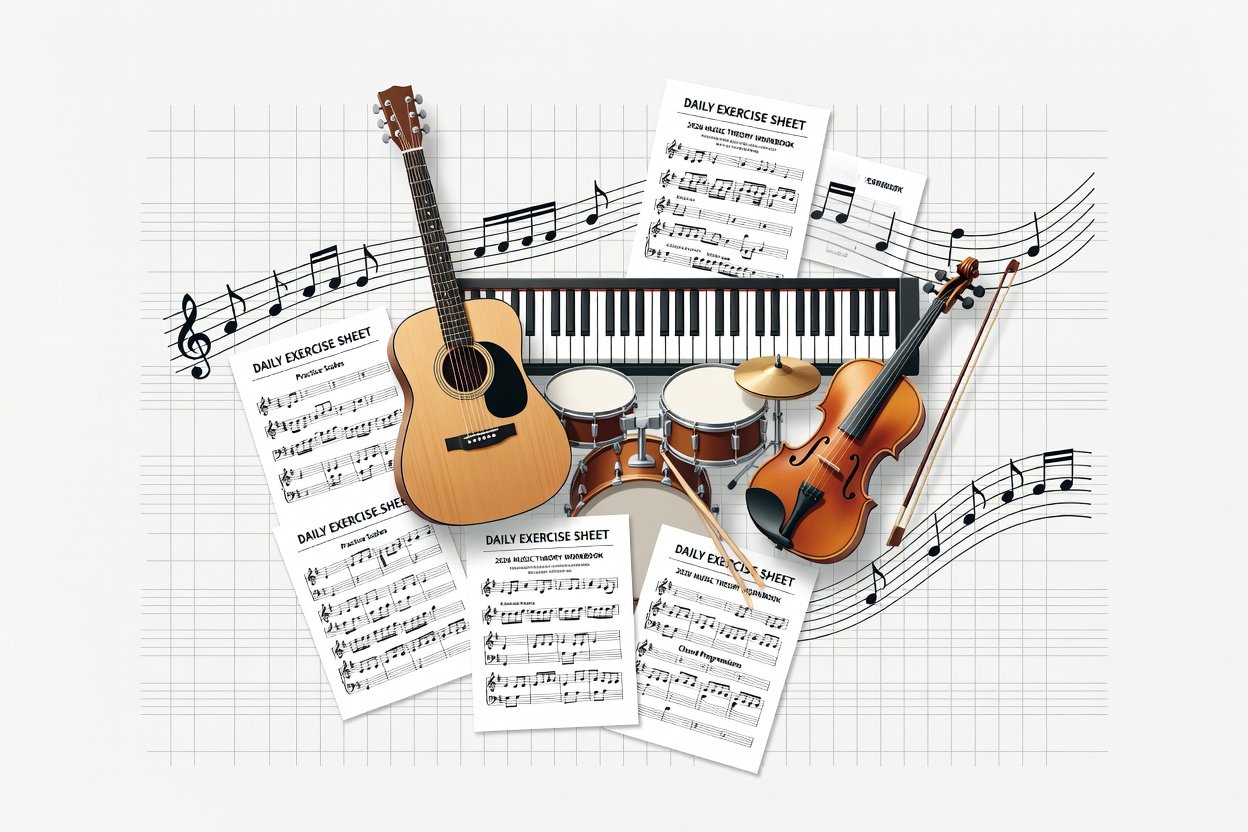
Introduction to the 2026 Music Theory Workbook
Building a strong foundation in music theory transforms how beginners approach their instruments. This 2026 workbook delivers practical daily exercises specifically designed for guitar, piano, drums, and violin players. The focus remains on applied practice rather than theory lectures, helping users develop immediate skills through targeted repetition, instrument-specific examples, and built-in self-checks.
Absolute beginners often struggle with translating concepts into playing. Here, every section breaks down core elements like note identification, scale construction, rhythm accuracy, and interval recognition into manageable drills. Each instrument receives tailored guidance because fingerings, techniques, and physical demands differ greatly between strings, keys, percussion, and bowed instruments. By committing to short daily sessions, musicians can expect measurable progress within weeks, building confidence that carries into real performances and ensemble playing.
Understanding Notes: Daily Drills Across Instruments
Notes form the alphabet of music. Begin each practice with five to ten minutes of note location drills. On piano, start at middle C and move chromatically, naming every key aloud while playing. Guitarists should master the open strings E-A-D-G-B-E then locate the same notes at different frets, starting on the low E string. Violin players focus on the G-D-A-E strings, practicing first-position notes with correct finger placement to develop muscle memory. Drummers translate staff notes into corresponding drum or cymbal strikes on a practice pad, learning that quarter notes land on beats one through four.
Printable-style exercise: Draw a treble clef staff and fill in the notes of the C major scale for your primary instrument. Repeat the exercise in bass clef if applicable. Practice naming notes randomly chosen from flash cards for another five minutes. This builds instant recognition essential for sight-reading later.
Instrument-Specific Note Examples
For guitar, try finding every C on the fretboard within one minute. Piano players can label all white keys in one octave. Violin drills emphasize spacing between first and third fingers on each string. Drummers practice reading basic note heads on a five-line staff mapped to snare, bass drum, and hi-hat.
Mastering Scales with Step-by-Step Progressions
Scales unlock melody and harmony. Begin exclusively with the C major scale because it contains only natural notes. On piano, use the right-hand fingering 1-2-3-1-2-3-4-5 ascending. Guitarists play the scale across two octaves using alternate picking on the appropriate frets. Violinists employ smooth détaché bowing while maintaining even tone. Drummers convert the scale into rhythmic patterns such as single-stroke rolls that follow the note sequence in timing.
Step-by-step progression: Week one covers only C major ascending and descending at 60 BPM. Week two adds the G major scale with one sharp. By week three introduce A minor, the relative minor of C major. Always warm up with slow practice before increasing speed. Record yourself weekly to hear improvements in evenness and intonation.

Common Scale Pitfalls and Corrections
Many players skip the descending portion or rush the thumb tuck on piano. Guitarists often mute strings accidentally during position shifts. Violin bow changes can create unwanted accents. Drummers lose subdivision consistency. Correct these by practicing in front of a mirror or with a metronome click on every subdivision.
Rhythm Reading Exercises and Instrument Applications
Rhythm connects all instruments. Use a metronome set between 50 and 80 BPM. Start with quarter notes counted aloud as “1-2-3-4.” Progress to eighth notes by saying “1-and-2-and.” Piano and guitar players play these rhythms on single notes or open strings. Violinists combine rhythm with sustained tones. Drummers layer the rhythms onto a basic rock or jazz beat pattern.
- Exercise 1: Clap the rhythm while tapping your foot on the pulse.
- Exercise 2: Play the same rhythm using only one pitch on your instrument.
- Exercise 3: Combine the rhythm with the C major scale in quarter notes.
- Exercise 4: Introduce rests and practice silent counting during those beats.
Self-assessment quiz: Write out a four-bar rhythm containing two quarter rests and six eighth notes, then perform it at 72 BPM without stopping. Check accuracy by recording and counting along.
Intervals: Practical Drills and Self-Assessment Quizzes
Intervals measure the distance between two notes and appear in every melody. Practice major seconds, major thirds, perfect fourths, and perfect fifths daily. On guitar, play intervals on adjacent strings. Piano players use both hands to sound the interval simultaneously. Violin finger spacing must match the interval size exactly. Drummers map interval distances to timing gaps between strikes.
Daily drill example: Play C to D (major second), C to E (major third), then C to F (perfect fourth) ten times each. Quiz yourself by hearing an interval played and naming it before checking the answer. Retention improves dramatically when you combine ear training with physical playing.
Common Pitfalls to Avoid
Skipping warm-ups leads to tension and sloppy technique on violin and guitar. Piano players frequently ignore left-hand independence. Drummers overlook dynamics and play everything at one volume. Another frequent mistake is practicing too fast too soon, which ingrains errors. Always begin at half tempo and only accelerate after clean execution. Review recordings of your sessions to identify recurring problems such as rushing or uneven tone.
4-Week Sample Schedule
- Week 1: 15 minutes notes, 10 minutes C major scale, 5 minutes basic rhythm clapping. Total 30 minutes daily.
- Week 2: Add G major scale and eighth-note rhythms. Include one self-quiz per session.
- Week 3: Introduce A minor scale and simple intervals. Practice cross-instrument comparisons for 10 minutes.
- Week 4: Full integration with mixed drills, tempo increases, and a complete four-bar composition using learned elements.
Adjust duration based on available time while maintaining consistency.
FAQ on Adapting Exercises to Different Skill Levels
How should absolute beginners modify the schedule? Shorten sessions to 15 minutes and focus on one concept per day. Intermediate players can double the tempo targets and add articulation variations. Can the exercises be adapted for left-handed players? Yes, simply mirror all fingerings and string orders. What if I play multiple instruments? Rotate focus daily to prevent overload while still covering all four. Khan Academy supplies supplementary video explanations for any concept that remains unclear. For broader historical context on why these fundamentals matter, consult Britannica.
Conclusion
Daily application of these music theory exercises will produce noticeable gains in note reading, scale fluency, rhythmic precision, and interval awareness across guitar, piano, drums, and violin. Stay consistent, track your progress, and revisit quizzes regularly. By the end of four weeks you will possess a practical foundation ready for more advanced 2026 repertoire and ensemble work.


No comments yet. Be the first!