 Instrumentiverse
Introduction to Major Music Genres
Understanding music genres provides a foundation for appreciating how different styles evolved and what makes each unique. This comprehensive beginner guide breaks down the foundational traits of rock, hip hop, jazz, and electronic music using clear definitions, historical timelines, and concrete audio examples. Readers seeking an accessible overview will learn the essential elements without venturing into advanced fusion techniques or current trends. By examining roots, rhythmic patterns, improvisational approaches, and synthetic production methods, you gain practical skills for identifying these genres in everyday listening.
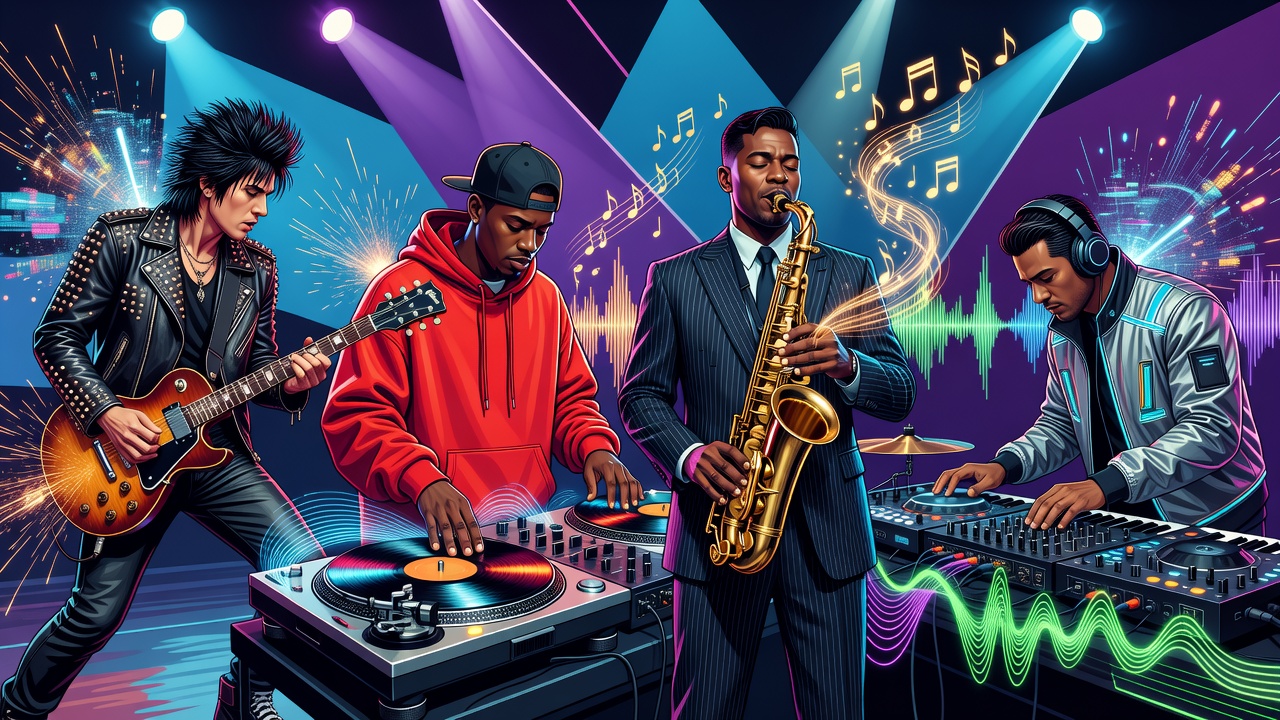
Music genres serve as categories that help organize vast libraries of recordings. They reflect cultural movements, technological advances, and artistic innovations. Rock draws from mid-20th-century American sounds, while hip hop emerged from urban communities emphasizing beats and spoken-word delivery. Jazz highlights spontaneous creation, and electronic music showcases technology-driven textures. Each section below includes timelines, key artists, and structural breakdowns to build recognition skills.
Rock History and Foundational Traits
Rock music traces its roots to the 1950s, blending rhythm and blues with country influences. Pioneers such as Chuck Berry and Elvis Presley popularized the energetic guitar-driven sound that defined early hits like “Rock Around the Clock.” By the 1960s, British bands including The Beatles and The Rolling Stones expanded the palette with electric guitars, bass, and powerful drum kits. Typical rock structures follow verse-chorus-verse patterns with tempos between 120 and 140 beats per minute, often featuring guitar solos as emotional peaks.
Key instrumentation centers on amplified electric guitars for riffs, bass guitar locking with drums for groove, and vocals delivering narrative lyrics. Subgenres like hard rock added heavier distortion while folk-rock incorporated acoustic elements. Listening examples include The Who’s “My Generation” for its rebellious energy and Led Zeppelin’s “Stairway to Heaven” for dynamic builds. Rock’s timeline shows steady evolution through the 1970s punk movement and 1980s hair metal, always retaining a focus on live performance energy and memorable hooks.
Rhythmic Foundations in Hip Hop
Hip hop emerged in the 1970s Bronx block parties where DJs like Kool Herc extended drum breaks from funk records. Its rhythmic backbone relies on sampled breakbeats looped to create hypnotic foundations. MCs layer rhymes emphasizing syncopation, internal rhymes, and storytelling over bass-heavy kicks produced by drum machines such as the Roland TR-808. Song structures often include short intros, multiple 16-bar verses, and catchy hooks rather than traditional repeating choruses.
Core elements include turntablism for scratching effects, sampling from soul and jazz records, and beatboxing as vocal percussion. Classic tracks like “Rapper’s Delight” by The Sugarhill Gang illustrate early party-focused flows, while later works demonstrate intricate lyricism. Hip hop production values low-end frequencies and crisp hi-hats. Modern listeners can identify the genre by its emphasis on groove, spoken or chanted vocals, and creative use of silence between beats. This foundation later influenced global styles while staying rooted in community expression and innovation.
Improvisational Hallmarks of Jazz
Jazz developed in early 20th-century New Orleans from African American musical traditions blending blues, ragtime, and marching band music. Improvisation defines the genre, allowing musicians to create melodies spontaneously over repeating chord progressions. Swing rhythms featuring uneven eighth notes produce its signature lilting feel. Common instruments include saxophone for expressive solos, trumpet for bright leads, upright bass for walking lines, piano for harmonic support, and drums maintaining steady swing time.
Historical eras progress from Dixieland collective improvisation to bebop’s fast tempos in the 1940s, cool jazz’s relaxed approach, and fusion experiments later. Iconic recordings such as Miles Davis’ “So What” demonstrate modal improvisation where players explore scales rather than strict chord changes. Jazz standards provide the head-solo-head format: state the melody, explore variations, then restate the theme. Listeners learn to recognize jazz through its conversational interplay among players and rich harmonic language that rewards repeated hearings.
Synthetic Textures in Electronic Music
Electronic music gained prominence in the 1970s and 1980s through affordable synthesizers and drum machines. Genres like techno, house, and trance rely on repetitive four-on-the-floor kick patterns at 120-130 BPM alongside evolving synth pads and arpeggios. Sound design focuses on textures created through oscillators, filters, envelopes, and effects processors rather than traditional acoustic instruments. Early milestones include Donna Summer’s “I Feel Love,” showcasing analog synthesis for hypnotic atmospheres.
Production techniques involve sequencing patterns, layering atmospheric sounds, and building tension through risers before explosive drops. Artists manipulate white noise, resonance sweeps, and sidechain compression to achieve pumping effects. Structure follows extended intros, main grooves, breakdowns, and outros designed for dance floors. Electronic music encourages experimentation with timbre and space, making it accessible via software yet capable of vast sonic variety. Recognition comes from identifying synthetic timbres and mechanical precision absent in live acoustic recordings.
Side-by-Side Comparisons of Instrumentation and Structure
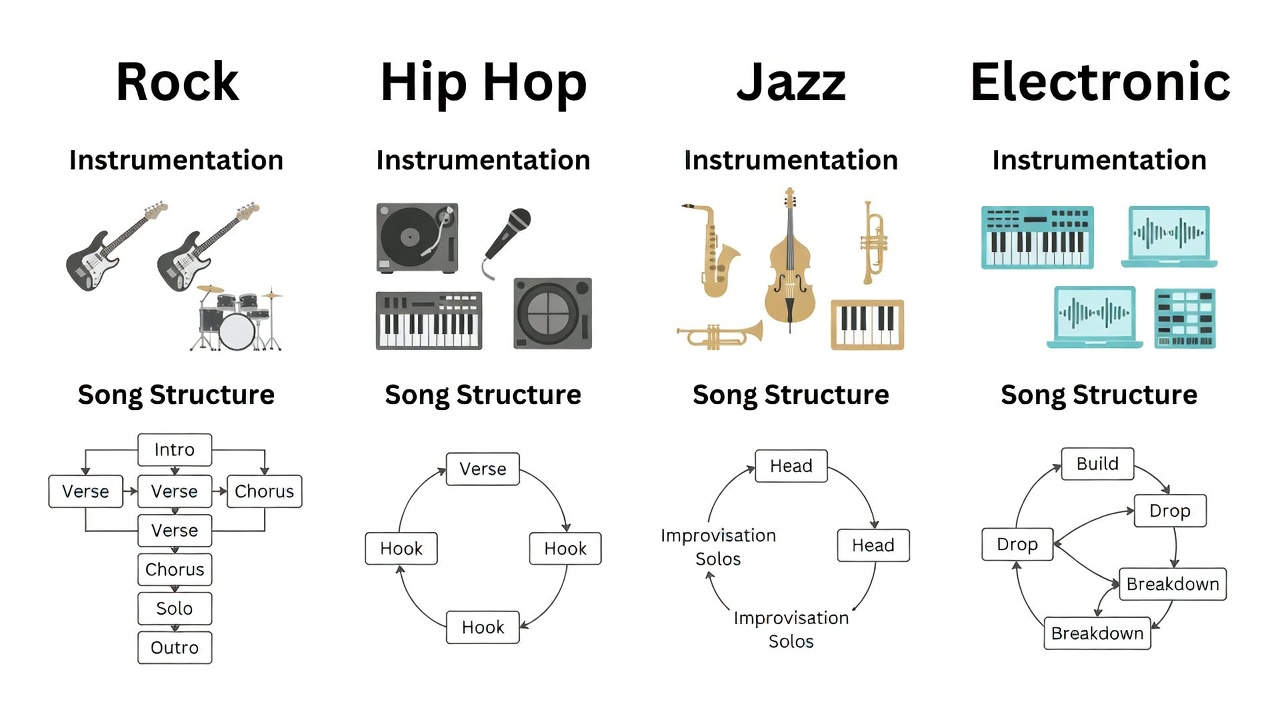
- Rock: Electric guitar leads, bass guitar, acoustic or electronic drums; verse-chorus form with bridge and extended guitar solos for climactic moments.
- Hip Hop: Drum machines or samplers, 808 bass, turntables; loop-based beats with 8- or 16-bar verses, minimal harmonic movement, heavy focus on rhythm and lyrics.
- Jazz: Saxophone, trumpet, piano, upright bass, ride cymbal; head-solo-head format allowing extended improvisation sections over changing chords.
- Electronic: Hardware or software synthesizers, sequencers, drum machines; build-ups, breakdowns, and drops organized in 8- or 16-bar phrases with evolving textures.
These comparisons highlight how rock emphasizes live band interplay, hip hop prioritizes sampled rhythms, jazz celebrates spontaneity, and electronic music explores sound design possibilities.
FAQ on Common Misconceptions
Is rock only loud guitar music? No. Subgenres range from acoustic-driven folk-rock to ambient post-rock and everything between, proving the genre’s flexibility.
Does hip hop require rapping? No. Instrumental hip hop tracks thrive on beat craftsmanship alone, and many producers release acclaimed non-vocal albums.
Is all jazz fully improvised? No. Standards begin with composed melodies before solos begin, and big-band arrangements often feature written sections.
Is electronic music just computer-generated noise? No. Careful arrangement, sound selection, and human performance nuances create emotional depth comparable to any acoustic genre.
Practical Listening Exercises
Begin with focused track analysis. Play Chuck Berry’s “Johnny B. Goode” and count the backbeat emphasis on beats two and four. Next, listen to “Rapper’s Delight” and isolate the looped bassline and drum break. Move to Miles Davis’ “So What” and note how the rhythm section supports soloists without overpowering them. Finally, experience “I Feel Love” to identify the steady kick pattern and evolving synthesizer lines.
Advance to comparison exercises by finding cover versions of the same song performed in different genres. Note how instrumentation and structure shift while core melody remains. Create genre-specific playlists and label each track with observed traits such as “swing rhythm present” or “four-on-the-floor confirmed.” Repeat sessions weekly to strengthen identification speed. Over time these exercises develop an intuitive ear for genre markers across any recording.
For deeper exploration of music history and genre development, consult authoritative resources such as Britannica and Grammy resources. Additional context appears at Library of Congress music collections. Consistent practice with these methods transforms passive listening into active genre recognition.
Conclusion
Mastering the basics of rock, hip hop, jazz, and electronic music enriches every listening experience. By understanding timelines, rhythmic foundations, improvisational freedom, and synthetic textures, you develop lasting appreciation and sharper analytical skills. Apply the comparisons, FAQs, and exercises regularly to internalize these distinctions and enjoy music with greater insight.
No comments yet. Be the first!