 Instrumentiverse
Introduction to Music Theory for Guitar and Piano Beginners
Starting guitar or piano in 2026 can feel overwhelming when music theory enters the picture. Yet grasping the fundamentals accelerates your progress dramatically, turning random notes into meaningful music. This guide breaks down core concepts including the musical alphabet, clefs, staff notation, and instrument-specific note locations with clear explanations and practice steps. Beginners often struggle because theory seems abstract at first, but connecting it directly to your instrument makes everything click faster. Whether you are self-taught or taking lessons, these building blocks help you read sheet music, communicate with other musicians, and understand songs faster. We focus on practical application rather than abstract rules so you can apply what you learn immediately during practice sessions.
By the end of this article you will have concrete tools to locate any note on piano or guitar, read basic notation, and avoid the most frequent pitfalls that slow down new players. Consistent daily review of these ideas builds lasting confidence and enjoyment in your musical journey.
The Musical Alphabet: A Through G Explained in Depth
Music uses only seven letters: A, B, C, D, E, F, and G. After G the sequence repeats as A again, forming octaves. These letters represent specific pitches that repeat across the entire range of your instrument. On both guitar and piano, moving from one letter to the next changes the pitch by a whole or half step depending on sharps and flats. For example, the distance from C to D is a whole step while C to C# is a half step. Sharps (#) raise a note by a half step while flats (b) lower it. Practicing the alphabet forward and backward out loud helps cement instant recall during sight reading.
Consider a simple example: start on middle C and move up the alphabet to the next C. That span covers eight notes and forms one full octave. Understanding this repetition lets you navigate higher and lower registers without getting lost. Many beginners benefit from writing the alphabet in a notebook while tapping the corresponding keys or frets to create a physical memory link.
Understanding Treble and Bass Clefs with Practical Examples
Sheet music uses clefs to assign pitches to the five-line staff. The treble clef, also called the G clef, curls around the second line which represents G above middle C. It is the primary clef for piano right-hand parts and most guitar notation. The bass clef, or F clef, has two dots surrounding the fourth line representing F below middle C. Piano left-hand music typically uses this clef while guitarists rarely read bass clef but benefit from understanding it when playing with other instruments such as bass guitar or cello.
Memorize the lines and spaces using mnemonics that have helped generations of students: for treble clef lines use Every Good Boy Does Fine and spaces spell FACE. Bass clef lines are Good Boys Do Fine Always while spaces are All Cows Eat Grass. Apply these immediately by drawing a staff on paper and labeling every position. This simple exercise reveals how the clefs organize the musical alphabet visually so you can read notes quickly without guessing.
Note Positions on the Staff and Ledger Lines
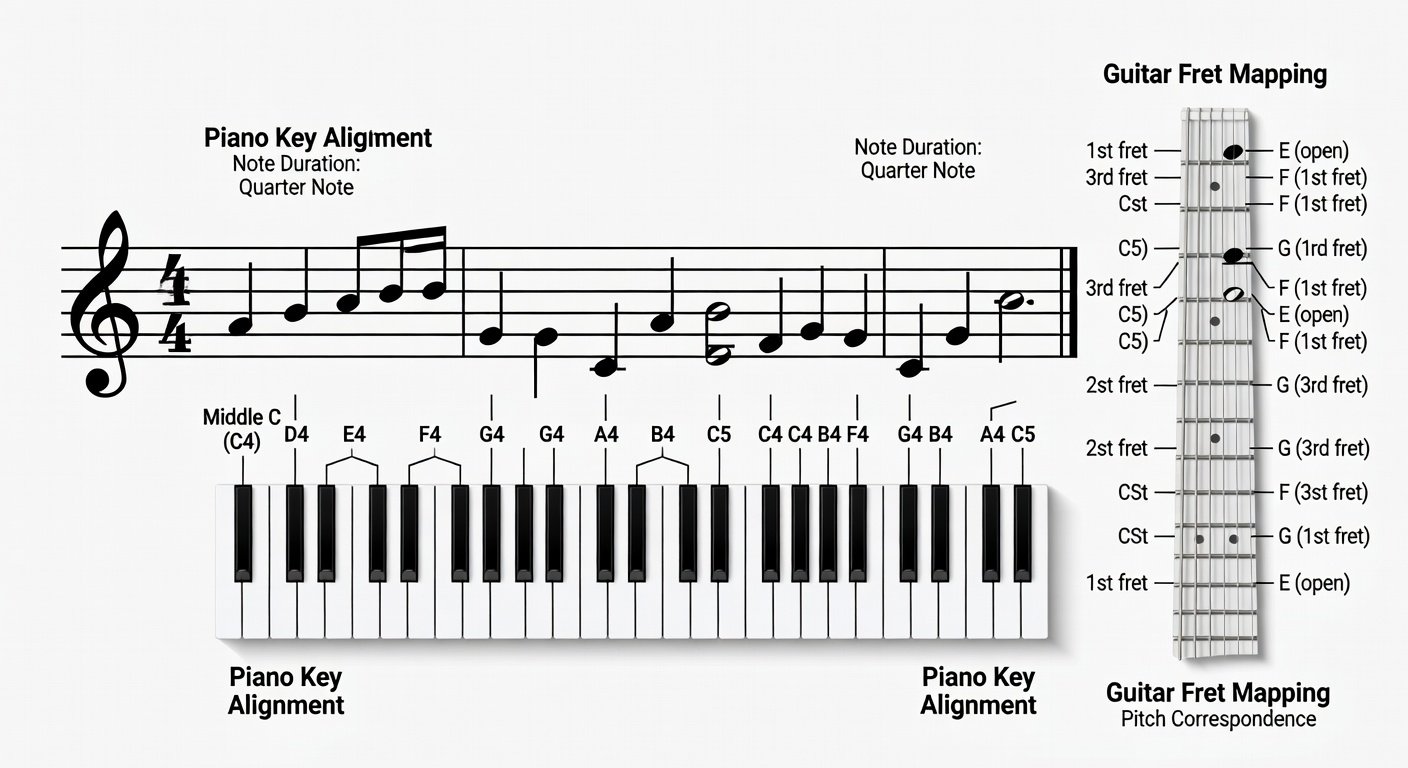
Each line and space on the staff corresponds to a specific note. Ledger lines extend the staff for higher or lower pitches beyond the five main lines. A common beginner mistake is miscounting ledger lines or confusing their spacing with the regular staff. Always count from the clef’s reference note outward. For instance, in treble clef the note on the bottom line is E. Adding one ledger line below gives middle C, which sits exactly between the treble and bass clefs. Practice drawing the staff and placing notes like C, D, E, F, and G in different positions to reinforce this skill. Real examples from simple songs such as “Mary Had a Little Lamb” show how these positions translate directly into melodies you already know.
Locating Notes on the Piano Keyboard Step by Step
The piano layout repeats groups of seven white keys and five black keys across the entire instrument. White keys are natural notes A through G. Black keys represent sharps and flats. Middle C sits roughly in the center of the keyboard and serves as the reference point for both clefs. To find any note, start at middle C and count up or down using the musical alphabet while pressing each key. The right hand usually plays notes above middle C while the left hand plays below. For example, the white key immediately to the right of middle C is D, followed by E, then the black key F#. Spend five minutes daily locating random notes called out by a friend or app to build speed and accuracy.
Locating Notes on the Guitar Fretboard with String-by-String Detail
The guitar fretboard has six strings tuned E-A-D-G-B-E from lowest to highest pitch. Each fret raises the pitch by a half step. Open strings give the starting notes, and the 12th fret returns to the same notes one octave higher. Memorize the first five frets thoroughly because most beginner songs stay within this range. For example, the low E string open is E, first fret is F, second fret is F#, third fret is G. The A string follows the same pattern starting from A. Unlike piano, guitar notes can appear in multiple locations across different strings, offering different tonal colors and fingerings. Trace scales slowly while naming every note aloud to internalize these positions permanently.
Step-by-Step Practice Exercises for Retention
- Write the musical alphabet five times forward and backward daily while speaking each letter clearly.
- Draw a treble clef staff and label every line and space using the FACE and Every Good Boy mnemonics until you can do it from memory.
- On piano, locate and play middle C, then all notes up one octave while naming each aloud and listening to the pitch change.
- On guitar, play each open string followed by the notes on frets one through five, naming every pitch before moving to the next string.
- Read simple melodies from beginner sheet music and find the corresponding keys or frets before attempting to play them.
- Practice identifying sharps and flats by playing C, C#, D, D#, E on your instrument and noting the half-step sound.
Common Beginner Mistakes to Avoid and How to Fix Them
- Confusing ledger lines with regular staff lines, leading to wrong octaves. Fix by always counting outward from the clef reference point.
- Ignoring sharps and flats when first learning the alphabet. Fix by drilling half-step examples such as E to F daily.
- Assuming guitar and piano notation are identical without accounting for guitar’s multiple positions for the same note. Fix by comparing the same melody on both instruments side by side.
- Skipping daily naming drills, which slows reading speed later. Fix by setting a phone reminder for ten minutes of note naming each morning.
- Rushing through exercises without listening to the actual pitches produced. Fix by playing each note slowly and matching it to a reference tone.
Comparing Guitar and Piano Notation in Detail
Piano music uses both treble and bass clefs simultaneously, showing the full range around middle C with clear visual separation of hands. Guitar music is written one octave higher than it sounds and primarily uses treble clef only. This transposition can confuse players switching between instruments. Piano offers immediate visual mapping of notes to keys while guitar requires understanding of string-specific positions and movable shapes. Theory learned on one instrument transfers well to the other once you adjust for these differences. Many players find starting on piano helps with reading skills before tackling guitar fretboard navigation.
Why Music Theory Matters: FAQ
Does learning theory slow down my playing progress?
No. Theory actually speeds up learning by helping you recognize patterns instead of memorizing every song note by note. Players who skip theory often hit plateaus when songs become more complex.
How long until I can read music fluently?
With consistent 15-minute daily practice most beginners read simple pieces within four to six weeks and begin tackling intermediate material shortly after.
Should I learn guitar or piano notation first?
Start with the instrument you enjoy most. The core alphabet and staff rules transfer easily between both once you master one system.
What free resources complement this guide?
Visit MusicTheory.net for interactive drills and Piano Keyboard Guide for additional piano-specific explanations.
Quick Retention Quiz
Name the notes on the treble clef lines from bottom to top. Locate middle C on your instrument and play it. Identify the open strings of the guitar in order. Write out the first five notes of the C major scale on staff paper. Review any missed answers and repeat the exercises above until every question feels automatic.
Mastering these basics in 2026 sets a strong foundation for years of enjoyable music making on guitar or piano. Practice consistently and you will notice rapid improvement in both reading and playing skills that lasts a lifetime.


No comments yet. Be the first!