 Instrumentiverse

Introduction to Essential Scales for Beginners
Mastering scales forms the bedrock of musical proficiency for any aspiring guitarist or pianist. In 2026, beginners continue to benefit from structured approaches that combine theory with hands-on practice. This guide covers major and minor scales on both instruments, offering clear instructions, proper fingerings, and real-world applications to accelerate your progress. Scales teach note relationships, improve technique, and prepare you for melodies and improvisation. Whether you play guitar or piano, consistent scale work builds muscle memory and ear training that lasts a lifetime. Many professional musicians credit early scale practice as the foundation that allowed them to learn songs faster and develop their unique style. Understanding scales also helps with reading music notation and understanding chord progressions that appear in virtually every genre from pop to classical.
Understanding Scale Construction
Major scales follow the interval pattern whole-whole-half-whole-whole-whole-half steps. Minor scales use whole-half-whole-whole-half-whole-whole for the natural minor form. These patterns apply universally across instruments, creating a shared language for musicians. The C major scale contains no sharps or flats, making it the perfect starting point. Each scale degree has a name and function: the first note is the tonic, the fifth is the dominant, and so on. Learning these relationships helps when you later explore chords and harmony. For example, the major scale produces bright, happy sounds while the minor scale creates a more somber mood. Practicing both forms side by side trains your ear to recognize these emotional differences immediately.
C Major Scale on Guitar
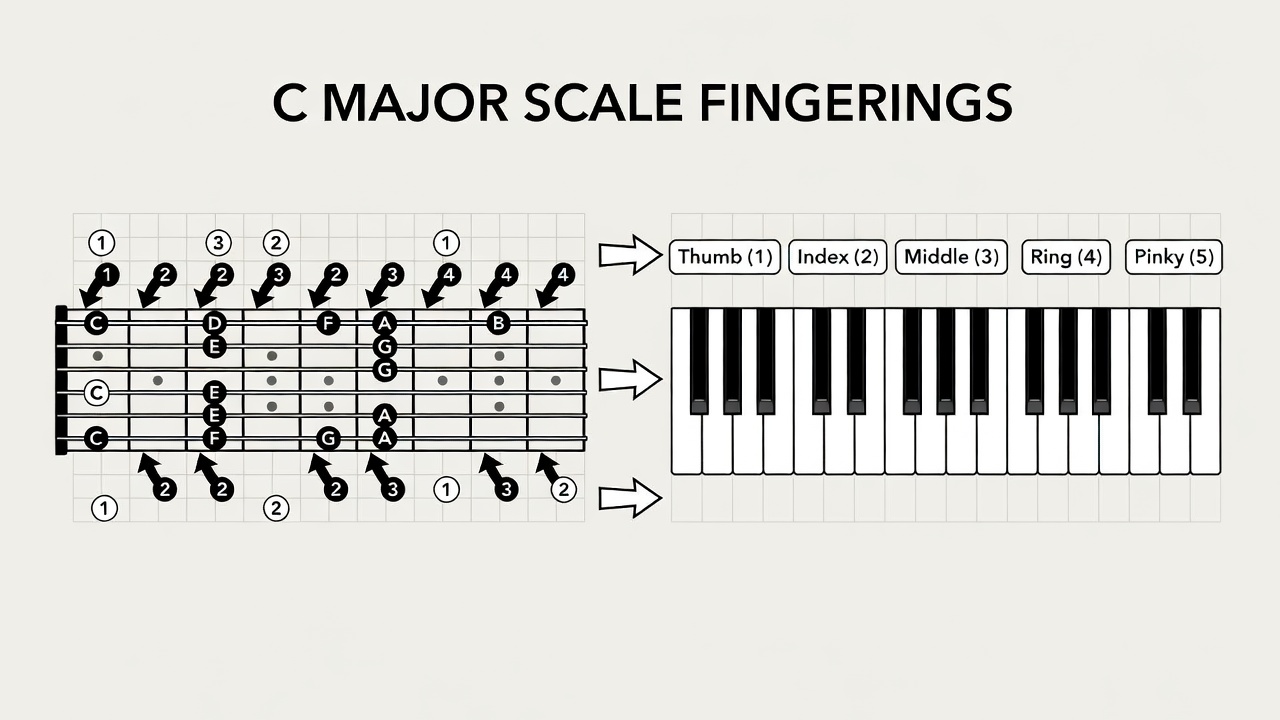
Play the C major scale starting on the 3rd fret of the A string. Use fingers 2-4 on the A string, then shift to the D string with fingers 1-3, and continue the pattern across strings. Practice ascending and descending slowly at first. The open position version begins with the open G string for some players, but the movable shape starting at the 3rd fret allows easy transposition later. Focus on keeping your fretting hand relaxed and your thumb behind the neck for support. Strum each note cleanly before moving to the next, and use a metronome to maintain steady rhythm. Once comfortable, try alternate picking patterns or add hammer-ons to develop speed and fluidity.
C Major Scale on Piano
Position your right hand with thumb on C, index on D, middle on E, thumb under to F, then index on G, middle on A, ring on B, and pinky on C. Left hand mirrors this with opposite finger order. Focus on even tempo and relaxed wrists. Keep your fingers curved and strike the keys from the fingertips rather than the pads. Practice hands separately before combining them. Pay attention to the thumb tuck motion, which often causes beginners to rush or hesitate. Play the scale in both directions multiple times, aiming for consistent volume across all notes.
Expanding to G Major and Other Keys
After mastering C major, move to G major which introduces one sharp (F#). On guitar this shifts the pattern up one string or fret position. On piano the right hand thumb now passes under after E to reach F#. These small changes help build familiarity with key signatures. Try D major next to introduce two sharps. Each new scale reinforces the interval pattern while expanding your comfort zone across the instrument.
Minor Scales: A Natural Minor Example
The A minor scale shares the same notes as C major but starts on A. Guitarists use similar fretboard patterns shifted down. Pianists begin with the pinky or thumb accordingly, maintaining the same finger independence drills. Practice both major and minor forms daily to internalize the sound difference. The relative minor relationship between C major and A minor is one of the most useful concepts for beginners because the fingerings remain nearly identical. This connection appears frequently in songs, making it practical knowledge right away.
Daily Exercises and Practice Routines
- Warm up with slow scales at 60 BPM, focusing on clean notes and relaxed posture.
- Gradually increase speed while keeping rhythm steady using a metronome app.
- Alternate between hands or picking patterns on guitar for coordination.
- Transpose C major to G major or F major for variety and key familiarity.
- Practice in different octaves and with varying articulations such as staccato or legato.
- Combine scales with simple chord progressions to hear how they function together.
Commit to 15-20 minutes of scale work each session before tackling songs. Track your progress in a practice journal noting tempo achieved and any trouble spots.
Connecting Scales to Songs
Many beginner pieces use scale fragments. "Happy Birthday" draws from major scale notes, while folk tunes often incorporate minor scales. Identify scale degrees in sheet music to recognize patterns quickly. For instance, the melody of "Twinkle Twinkle Little Star" follows the first five notes of the major scale repeatedly. On guitar this maps directly to open strings and frets; on piano it uses the first five fingers in sequence. Learning to spot these connections turns scale practice into a direct pathway for learning new music faster.
Comparing Guitar and Piano Techniques
Guitar requires precise fretting and picking coordination, while piano emphasizes independent finger movement and hand position. Both benefit from relaxed posture to avoid tension. Guitarists can visualize scales on the fretboard as repeating patterns, whereas pianists rely on keyboard geography and muscle memory across black and white keys. Transferable skills include ear training and rhythmic accuracy, yet each instrument demands unique physical adjustments. Guitar players often struggle with string muting, while pianists focus on even key pressure. Understanding these differences helps dual-instrument learners avoid frustration.
Common Mistakes to Avoid
- Rushing through notes instead of maintaining even timing and tone quality.
- Using incorrect fingerings that lead to poor habits and limited speed later.
- Ignoring dynamics and articulation that bring scales to life musically.
- Skipping minor scales in favor of only major ones, limiting musical versatility.
- Neglecting left-hand or right-hand coordination drills on either instrument.
Frequently Asked Questions
How long should beginners practice scales daily?
Aim for 15-30 minutes, integrated into a broader routine that includes songs and technique drills. Consistency matters more than marathon sessions.
Which scales should I learn first after C major?
Move to G major and A minor next, as they introduce one sharp or none, keeping things manageable while expanding your range.
Can I use apps or online resources?
Yes, supplement with trusted platforms like MusicTheory.net for interactive lessons and Britannica for historical context on scales and their development across cultures.
What if my fingers hurt during practice?
Stop immediately, check your posture, and ensure you are not pressing harder than necessary. Gentle stretching before and after sessions helps prevent strain.
Actionable Tips for Long-Term Success
Record your practice sessions weekly to track improvement and identify areas needing extra attention. Join online communities for feedback and motivation from fellow beginners. Combine scales with ear training by singing notes as you play them. Over time, these habits turn scales into intuitive tools rather than chores. Experiment with different rhythms and groupings such as playing in triplets or adding syncopation. Eventually incorporate scales into improvisation over backing tracks to experience their creative potential. Stay consistent, and you will notice faster learning of new music and greater confidence in performance settings.
Review this guide periodically as your skills advance. Revisit earlier sections with fresh ears and try applying the same principles to more complex scales like harmonic minor or modes. The foundation you build today supports every musical goal you pursue in the future.


No comments yet. Be the first!