 Instrumentiverse

Introduction to Reading Sheet Music on the Violin
Many beginners start violin lessons focused on posture and bowing, but understanding notation opens the door to playing real music. This guide teaches the fundamentals of sheet music reading tailored for violinists, starting from the staff and progressing through key concepts with practical examples. Learning to read music allows you to access a vast library of classical, folk, and contemporary pieces without relying solely on memory or recordings. It builds independence so you can join ensembles or tackle new repertoire confidently. Unlike physical technique drills, notation study emphasizes visual recognition and rhythmic accuracy, forming the foundation for long-term musical growth.
The Musical Staff and Treble Clef
The staff consists of five lines and four spaces where notes are placed. For violin, the treble clef is standard, indicating higher pitches suited to the instrument’s range. The lines from bottom to top represent E, G, B, D, F, remembered by the mnemonic Every Good Boy Does Fine. Spaces spell FACE. Step-by-step, place your first open string note G on the second line from the bottom. The treble clef symbol itself curls around the second line, anchoring G as the reference point. As you advance, you will encounter ledger lines that extend the staff upward or downward for notes beyond the five lines, such as high A or low C. Practice identifying these positions by drawing the staff on paper and labeling each line and space repeatedly until recognition becomes automatic.
Identifying Notes on the Staff
Start with open strings: G on the second line, D on the third space, A on the second space above the staff, and E on the fourth space. Use flashcards or apps to quiz yourself daily. When a note sits on a line, trace upward or downward to confirm its letter name before playing. This visual mapping prevents hesitation during sight reading.
Note Values and Rhythms
Notes indicate both pitch and duration. A whole note lasts four beats, half note two beats, quarter note one beat, and eighth notes half a beat each. Practice counting aloud while tapping: start with quarter notes on open A string, then mix in halves. Rests follow the same hierarchy, requiring silence for the specified beats. To build rhythmic fluency, subdivide beats mentally—think “one-and-two-and” for eighth notes. 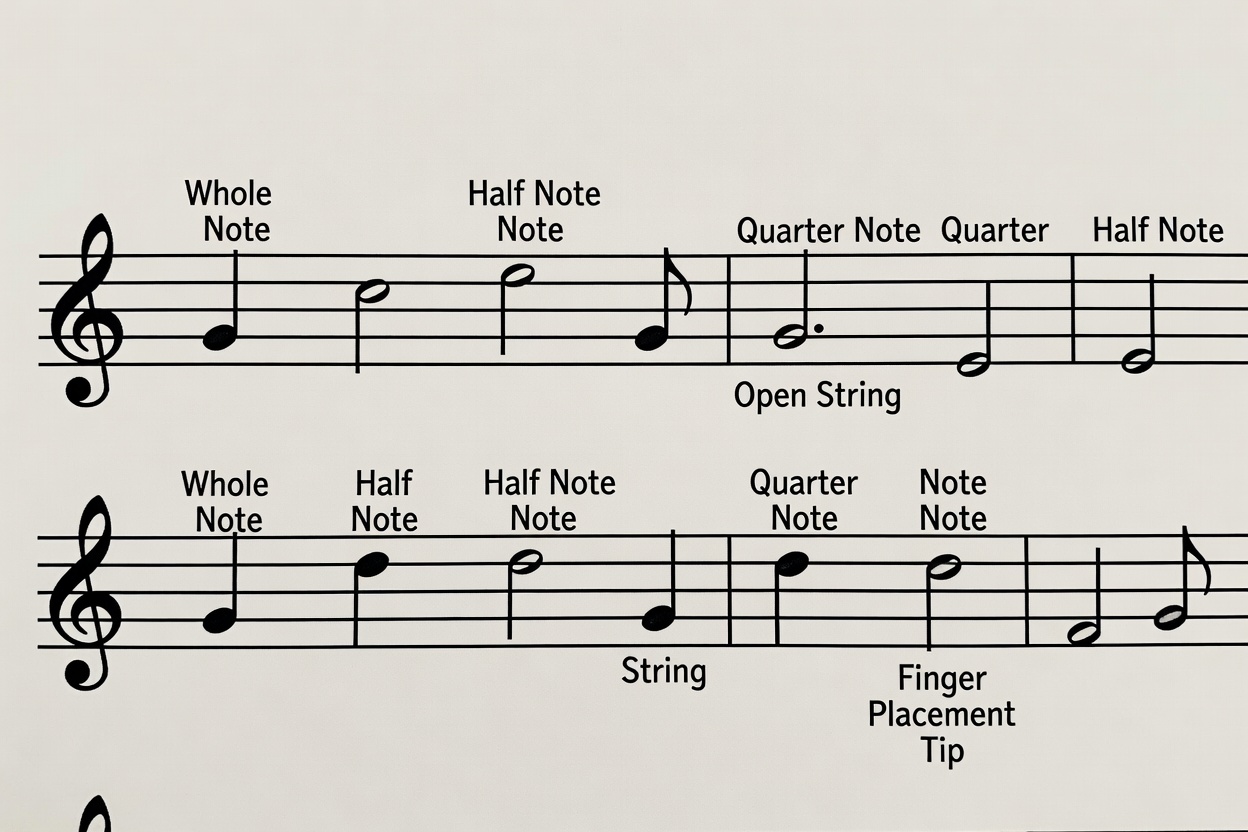
Applying Rhythms to Violin Playing
Once you recognize values, combine them with open strings. Play a measure of four quarter notes on G, then switch to two half notes on D. Record yourself to check timing accuracy. Over time, introduce dotted rhythms where a dot adds half the note’s value, creating a longer, lilting feel common in many beginner pieces.
Simple Practice Exercises
Consistent drills reinforce both pitch and rhythm recognition. Here are targeted exercises to incorporate into your routine:
- Exercise 1: Draw and name the first five notes on the staff, then play each on the corresponding open string.
- Exercise 2: Clap rhythms using only quarter and half notes for four measures, counting aloud before transferring to the violin.
- Exercise 3: Play open strings while reading their positions on the staff, varying the order randomly to simulate sight reading.
- Exercise 4: Write out a short four-bar melody using only quarter notes and perform it at a slow tempo.
Repeat each exercise three times daily, gradually increasing speed only after accuracy is achieved.
Understanding Key Signatures
Key signatures appear at the start of each line and show which notes are sharp or flat throughout the piece. For beginners, focus on C major (no sharps or flats) and G major (one sharp on F). Identify the key by counting sharps or flats and applying the order of sharps: F, C, G, D, A, E, B. Flats follow the reverse order. In G major, every F becomes F-sharp unless canceled by a natural sign. Practice scales in these keys on the violin while reading the signature, noticing how the raised note alters finger placement slightly on the fingerboard.
Common Beginner Mistakes to Avoid
New players often ignore the key signature, leading to wrong notes, or miscount rhythms by rushing eighth notes. Another frequent error is confusing ledger lines above or below the staff. Always double-check the clef and count beats slowly at first. Skipping rests or failing to observe dynamic markings also disrupts musical flow. To avoid these pitfalls, scan the entire page before playing and mark tricky spots with a pencil. Slow, deliberate practice outperforms fast but inaccurate attempts.
Violin Notation Compared to Guitar Tablature
Unlike guitar tabs that show fret numbers on strings, violin sheet music uses traditional notation for precise pitch and rhythm. Violinists benefit from learning standard notation early because it translates across instruments and ensembles, while tabs are instrument-specific and omit rhythmic detail. Notation also conveys articulation, dynamics, and phrasing that tabs rarely include. Guitarists transitioning to violin often find the staff initially slower but ultimately more versatile for orchestral or chamber music settings.
Practical Tips for 15-Minute Daily Sessions
Break sessions into focused segments: five minutes reviewing the staff and notes, five minutes on rhythm clapping, and five minutes playing simple open-string exercises. Consistency builds muscle memory faster than longer, infrequent practices. Track progress in a notebook to stay motivated. Use a metronome app set at 60 beats per minute to maintain steady tempo. If a concept feels overwhelming, isolate one element—such as only pitch identification—before combining with rhythm. Over several weeks these short sessions compound into noticeable improvement.
Additional Resources for Continued Learning
Supplement your study with free online tools and established references. Visit Library of Congress for public domain sheet music collections. Explore theory explanations at Britannica or browse educational archives at Smithsonian. These sources provide historical context and additional examples that reinforce daily practice.
FAQ: Progressing from Exercises to Real Pieces
How soon can I play actual songs? After mastering basic note reading and simple rhythms, try short melodies like “Hot Cross Buns” within two to three weeks of daily practice.
What resources help next? Explore method books or free online lessons from authoritative sites such as the Library of Congress music collections.
Should I learn by ear or notation first? Combine both, but notation provides accuracy for ensemble playing and complex pieces.
How do I handle accidentals that appear mid-piece? Treat each sharp, flat, or natural as an alteration lasting only for that measure unless tied across bars.
When should I add fingerings to the music? Pencil in finger numbers only after you can read the notes fluently, using standard violin fingering patterns for efficiency.
Conclusion
Reading sheet music transforms violin practice from mechanical drills into musical expression. With steady focus on the staff, clefs, rhythms, and key signatures, beginners quickly gain confidence. Apply these concepts daily and you will progress smoothly to enjoyable pieces that reward consistent effort.

No comments yet. Be the first!