 Instrumentiverse
What Are Barre Chords and Why Master Them in 2026?
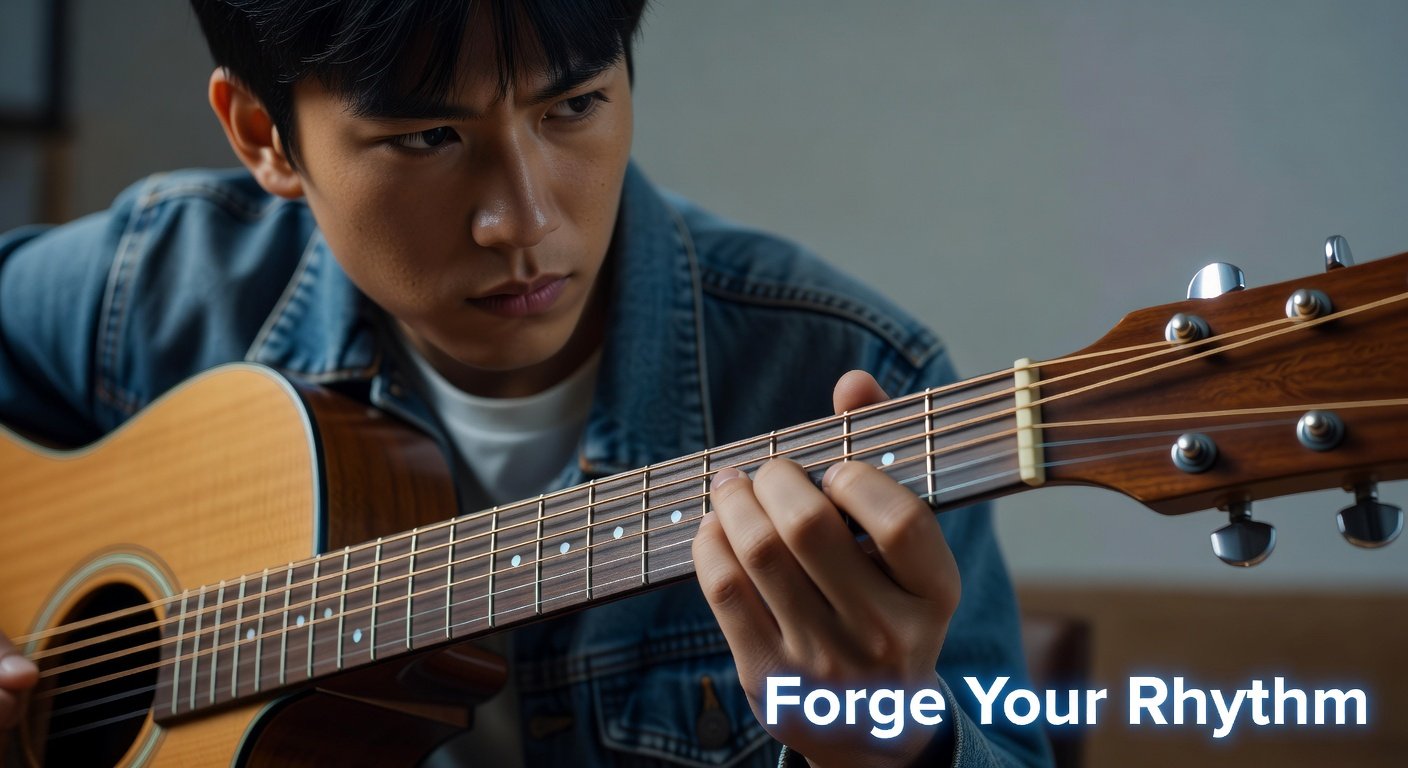
Barre chords are a game-changer for guitarists, allowing you to play any major or minor chord by moving a single shape up the fretboard. Unlike open chords that use unfretted strings, barre chords require barring multiple strings with one finger—typically your index finger—creating a 'bar' across the neck. This technique opens up endless possibilities for playing songs in different keys without learning dozens of unique chord shapes.
For beginners, barre chords like F major and B minor can feel intimidating due to the hand stretch and pressure needed. But with the right approach, you'll build the strength and dexterity to transition smoothly from open chords. In 2026, AI-powered apps make practice more efficient than ever, tracking your progress with real-time feedback. This guide covers everything: step-by-step fingerings, exercises, common pitfalls, song progressions, and app recommendations to get you strumming like a pro.
Whether you're switching from open chords like G or C, or starting fresh, mastering barre chords boosts your versatility. Popular artists from Ed Sheeran to classic rock legends rely on them. Let's dive in and transform your playing.
Building Hand Strength: The Foundation for Barre Chords
Before tackling shapes, strengthen your hands to avoid pain and fatigue. Weak fingers lead to buzzing strings and frustration. Start with these daily routines:
- Warm-ups: Squeeze a stress ball or use a grip trainer for 5 minutes. Focus on thumb opposition—your thumb should press against the neck's back for leverage.
- Finger stretches: Place your hand flat on a table, lift each finger one by one, holding for 10 seconds. Repeat 3x per hand.
- Spider exercises: On the fretboard, place fingers 1-2-3-4 sequentially on each string, moving up frets. Do this slowly for 10 minutes daily.
Pro tip: Use lighter gauge strings (e.g., .010-.046) for easier pressing. Check out Fender's guitar setup guide for optimal action adjustment—low action reduces the force needed.
Aim for 15-20 minutes of strength work before practice. In 2026, apps gamify this with haptic feedback vibrators in smart picks.
Step-by-Step: The F Major Barre Chord
F major (F) is the gateway barre chord, often the first full bar beginners conquer. It's based on the E major shape moved to the first fret.
- Index finger: Barre across all strings at fret 1. Roll slightly onto the side of your finger for better contact—don't flatten completely.
- Middle finger: Fret 2 on G string (3rd string).
- Ring finger: Fret 3 on A string (5th string).
- Pinky: Fret 3 on D string (4th string).
Strum slowly. Mute the high E if it buzzes initially. Practice arpeggiating: pluck each string individually to check clarity. Common issue: insufficient thumb pressure—position it behind the neck at the midpoint.
Once clean, hold for 30 seconds, release, repeat 10x. Gradually increase speed.
Mastering B Minor Barre Chord
B minor (Bm) uses the A minor shape at fret 2, ideal for rock and pop progressions.
- Index finger: Barre frets 2 across all strings (or just the top 5 for easier start).
- Middle finger: Fret 3 on D string.
- Ring finger: Fret 4 on G string.
- Pinky: Fret 4 on B string.
Anchor your elbow against your body for stability. Bm often appears in songs like "Horse with No Name" by America. If your ring finger muting the low E, angle it slightly.
Practice switching from Em (open) to Bm: Em (022000) → Bm. Time yourself—aim for under 2 seconds.
Movable Barre Chord Shapes: Unlock Every Key
Once F and Bm click, learn these "E-shape" and "A-shape" majors/minors for mobility.
E-Shape Major (root on low E):
- Barre index across all at root fret.
- Middle: +1 on A.
- Ring: +2 on D.
- Pinky: +2 on G.
A-Shape Major (root on A string): Barre partial (D-G-B-E), fingers stacked like open A but barred.
For minors, flatten the top note: E-minor shape lowers G string by one fret.
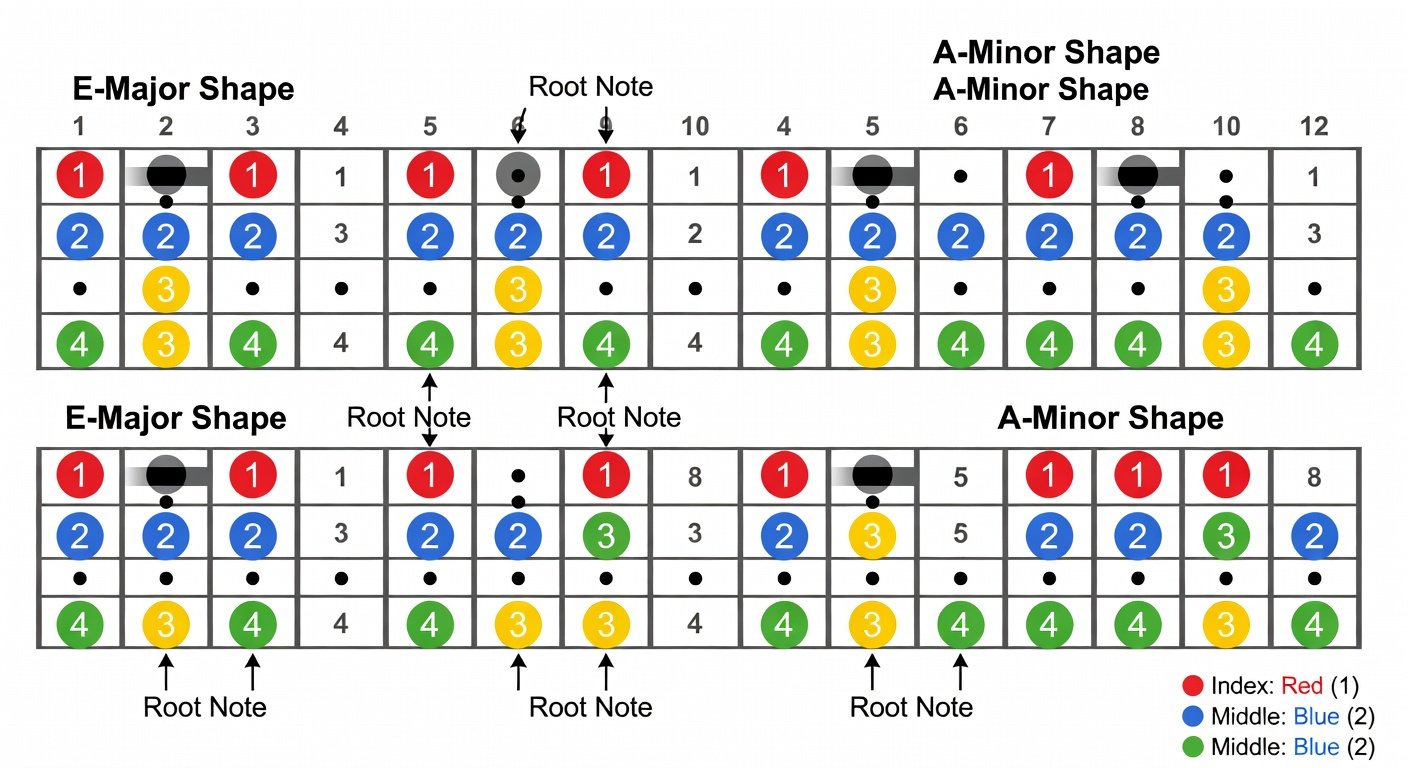
Visualize the fretboard: Practice C major (E-shape at 8th fret), then descend to B major (7th). This builds muscle memory across positions.
Common Mistakes to Avoid and Pro Tips
Even pros slip up. Here's what to watch:
- Mistake 1: Flat barre—roll your index finger toward the fret for curved pressure.
- Mistake 2: Lazy thumb—keep it firm, not wrapping over.
- Mistake 3: Tense shoulders—relax everything but fretting hand.
- Mistake 4: Ignoring muting—use fretting fingers or palm to silence extras.
Tips: Shorten nails, use classical posture (guitar on left thigh). Visit JustinGuitar.com for free video demos. Warm necks help in cold weather.
Practice Exercises for Smooth Transitions
Daily 30-minute sessions yield results in weeks.
- Hold and strum: F → rest → F (build endurance).
- Open to barre: G → Em → F → C (classic progression).
- Chromatic walk: F → F# → G (E-shapes up frets).
- 1-minute changes: Cycle Bm → G → D → A, metronome at 60bpm.
Record yourself—apps analyze intonation. Track weekly: Day 1 buzzes, Week 4 clean rings.
Chord Progressions and Popular Songs
Apply skills immediately:
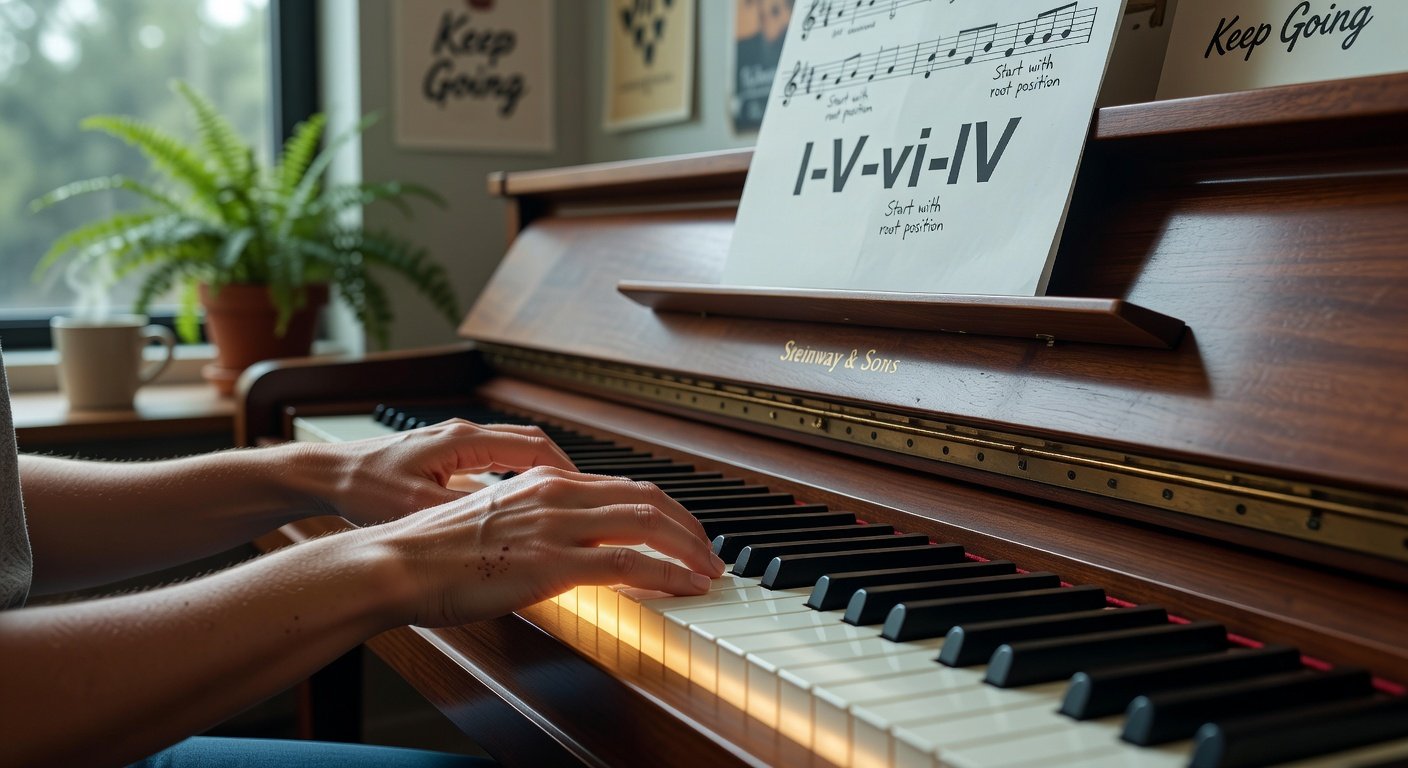
- I-IV-V in A: A - D - E (use A-shape D at 5th fret).
- Heartbreaker (Led Zeppelin): A - D - E - F.
- Wonderwall (Oasis): Em - G - D - A (barre D/A).
- Hey There Delilah: D - Bm - G - A.
Start slow, 50% tempo. Transpose to keys like Gb using capos. For full tabs, reference Ultimate-Guitar.com.
2026 App Recommendations for Tracking Progress
Leverage tech: These apps use AI for barre-specific feedback.
- Yousician: Real-time barre detection via camera/mic. Gamified missions, $10/month.
- Fender Play: 2026 AR overlays show finger pressure heatmaps. Beginner barre paths.
- Justin Guitar App: Free progress tracker, video sync practice.
- Guitar Pro 2026: AI transcription from audio, barre shape visualizer ($60/year).
Integrate with wearables for grip strength metrics. Set goals: "Clean F in 60s" → notifications.
Conclusion: Your Barre Chord Journey Starts Now
Barre chords demand patience but reward with freedom—play any song, any key. Dedicate 20-30 minutes daily, focus on strength and precision, and use 2026 apps for acceleration. From F's buzz to fluid progressions, you'll progress fast. Grab your guitar, barre up, and rock on. What's your first song? Share in comments!
No comments yet. Be the first!