 Instrumentiverse

Introduction to Blues Piano for Beginners in 2026
Blues piano provides an engaging pathway for players who have grasped basic scales and chords. This comprehensive 2026 piano tutorial guides beginners through the essential components of blues playing, helping you move beyond fundamentals into expressive, rhythmic performance. The blues genre highlights emotional feel, steady grooves, and creative improvisation, serving as an excellent vehicle for developing overall musicality and ear training.
Throughout this guide you will explore the iconic 12-bar blues form, core scales, left-hand accompaniment patterns, memorable riffs, and straightforward turnarounds. Each section features clear breakdowns, practice exercises, and comparisons with rock and jazz blues styles. By the end, you will possess practical tools to start playing authentic blues immediately while building coordination and timing skills.
The 12-Bar Blues Form Explained
The 12-bar blues structure forms the foundation of countless classic songs. It spans twelve measures divided into three four-bar sections and traditionally follows a I-IV-V chord progression. In the key of C, the sequence runs: four bars of C7, two bars of F7, two bars of C7, one bar of G7, one bar of F7, and two final bars of C7, frequently resolved by a turnaround phrase.
Mastering this progression allows seamless playing along with recordings and jam sessions. Begin by playing the chords in root position while counting steadily. Once comfortable, introduce simple inversions to create smoother voice leading between changes.
Essential Scales for Blues Piano
The blues scale supplies the characteristic sound of the genre. In C, the notes are C, Eb, F, Gb, G, and Bb. This scale derives from the minor pentatonic with an added flattened fifth, creating tension and resolution that defines blues expression.
Practice the scale in both ascending and descending directions at a slow tempo. Focus on even articulation and dynamic control. Next, apply the scale over the 12-bar progression by targeting chord tones on strong beats while using passing tones for melodic interest. For further scale theory resources, explore MusicTheory.net.
Left-Hand Bass Patterns
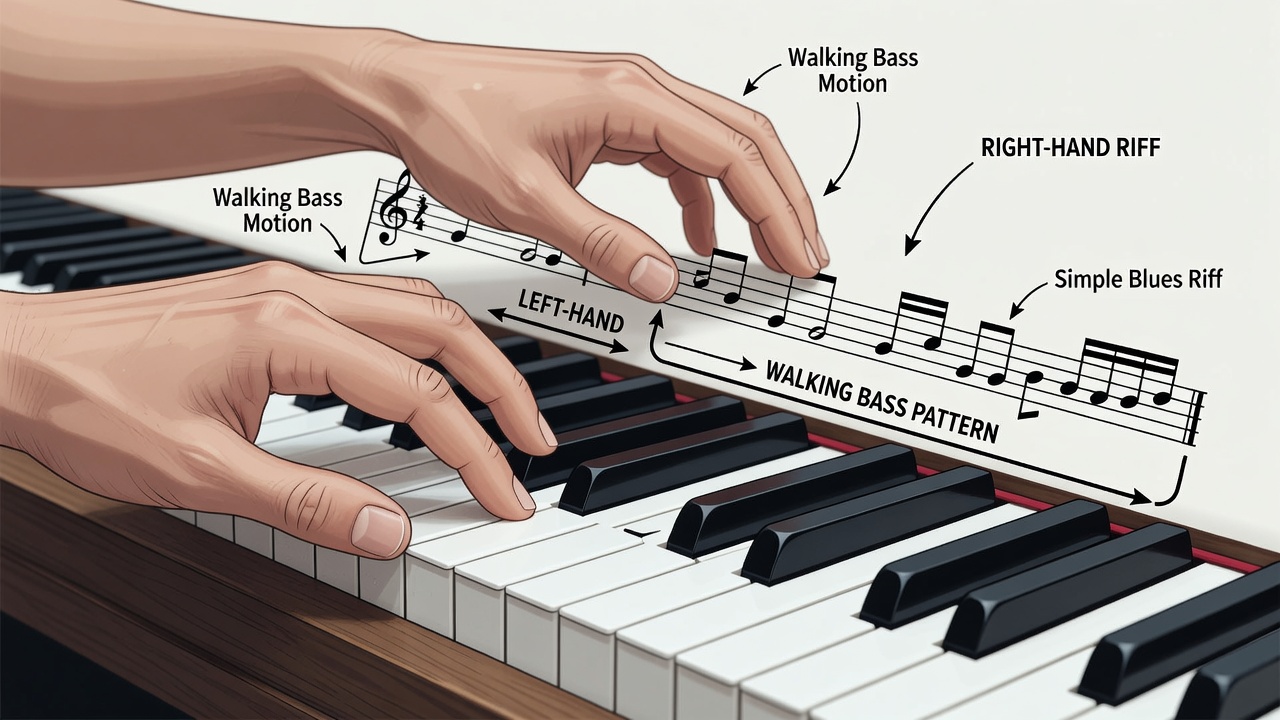
Strong left-hand patterns establish the driving pulse of blues piano. A foundational walking bass line alternates between the root and fifth of each chord, often incorporating chromatic passing notes. In C, a typical pattern might move C to G, then add A before returning, shifting appropriately when the harmony changes to F7.
Another popular option is the boogie-woogie shuffle, which uses a repeating eighth-note figure emphasizing the root, third, fifth, and sixth. Begin these patterns at 60 beats per minute with a metronome, ensuring each note receives equal weight and duration before gradually raising the tempo.
Signature Riffs and Simple Turnarounds
Signature riffs frequently employ slides, grace notes, and repeated motifs that echo vocal phrases. A basic right-hand riff over C7 could involve the notes G, Bb, C, and Eb played in a syncopated rhythm. Turnarounds close the 12-bar cycle and prepare the return to the top; a common example uses G7-F7-C7-G7.
Practice combining these riffs with your left-hand bass while maintaining steady time. Record short phrases and listen back to refine phrasing and dynamics.
Practical Exercises and Audio Examples
Exercise 1: Play the C blues scale ascending and descending over one full 12-bar chorus while keeping the left hand silent. Exercise 2: Layer a simple walking bass in the left hand beneath right-hand scale fragments. Exercise 3: Create a short call-and-response dialogue between hands using only three notes from the blues scale.
Work on these drills daily for five to ten minutes each. As you improve, transpose the material to other keys such as F and G to broaden your versatility.
Comparisons to Rock and Jazz Blues Styles
Rock blues tends toward straightforward energy, often featuring straight-eighth rhythms and amplified textures. Jazz blues, by contrast, incorporates swing feel, extended chords such as 9ths and 13ths, and more frequent harmonic substitutions. Listening to representative recordings of each style reveals these distinctions and helps you choose which direction to pursue first.
Tips for Improving Timing and Hand Coordination
Timing issues often arise when hands move at different speeds. Isolate each hand during initial practice, then combine them only after both parts feel secure. Use a metronome set to quarter notes, then progress to clicking on the off-beats to develop stronger internal pulse.
Hand coordination improves through slow, deliberate repetition. Start with short two-bar phrases and gradually extend them. Consistent daily practice yields faster results than occasional long sessions.
Common Mistakes to Avoid
- Rushing through chord changes instead of letting each harmony breathe for its full duration.
- Neglecting dynamics, which makes playing sound mechanical rather than expressive.
- Overusing the same riff without variation, limiting musical development.
- Ignoring proper posture and hand position, leading to tension and fatigue.
Conclusion
Consistent application of the 12-bar form, blues scale, bass patterns, and turnarounds will quickly build your confidence at the piano. Continue exploring different keys, tempos, and stylistic variations to keep your practice engaging and progressive. The blues offers endless room for personal expression and serves as a gateway to many other musical styles.
FAQ
- How do I improve timing? Practice with a metronome starting at very slow tempos and gradually increase speed while maintaining accuracy.
- What helps with hand coordination? Isolate each hand until the part is memorized, then combine them slowly before adding speed.
- Which key should beginners start in? C major offers the easiest visual layout on the keyboard for initial practice.
- How long before I can play along with recordings? Most beginners achieve basic competence within four to six weeks of focused daily practice.


No comments yet. Be the first!