 Instrumentiverse
Getting Started with Drum Basics
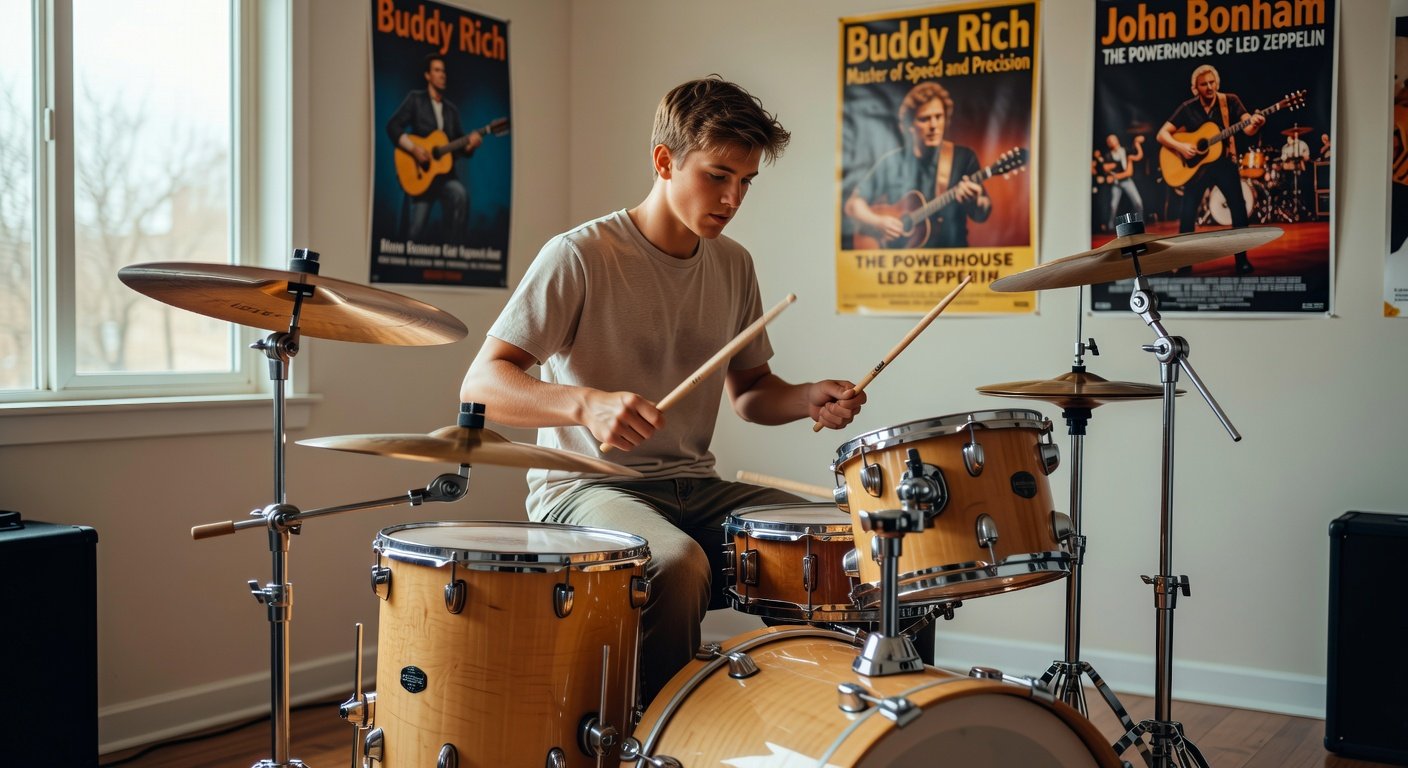
Before diving into rhythms, set up your practice space correctly. A basic drum kit includes a snare drum, bass drum, hi-hat, and one or two tom-toms. Position the snare between your legs, hi-hat to the left, bass pedal at your right foot, and toms within easy reach. Adjust throne height so thighs are parallel to the floor for comfort and power.
Master the matched grip, where both hands hold sticks similarly: thumb and index finger form a fulcrum, middle finger wraps around, ring and pinky support loosely. For details, check Vic Firth's grip resources. This grip suits beginners across genres.
Use a metronome to build rock-solid timing. Start at 60 BPM. Apps or devices click steady beats—align your hits precisely. Essential for transitioning rudiments to full grooves.
The 10 Fundamental Drum Rudiments
These rudiments form the backbone of drumming. Practice each on snare drum first, 5-10 minutes daily, increasing speed gradually. Notation uses 'R' for right hand, 'L' for left: e.g., R L R L.
1. Single Stroke Roll
The simplest: alternate sticks evenly. Notation: R L R L R L R L.
- Play quarter notes at 80 BPM: one stroke per beat.
- Speed to eighth notes: two per beat.
- Exercise: 4 bars singles, 4 bars rest. Repeat 10x.
Builds control and evenness.
2. Double Stroke Roll
Two bounces per hand. Notation: RR LL RR LL.
- Start slow: wrist bounce only.
- 60 BPM quarters, then eighths.
- Exercise: Pyramid—4 doubles, 2, 1; reverse up.
Great for rolls and fills.
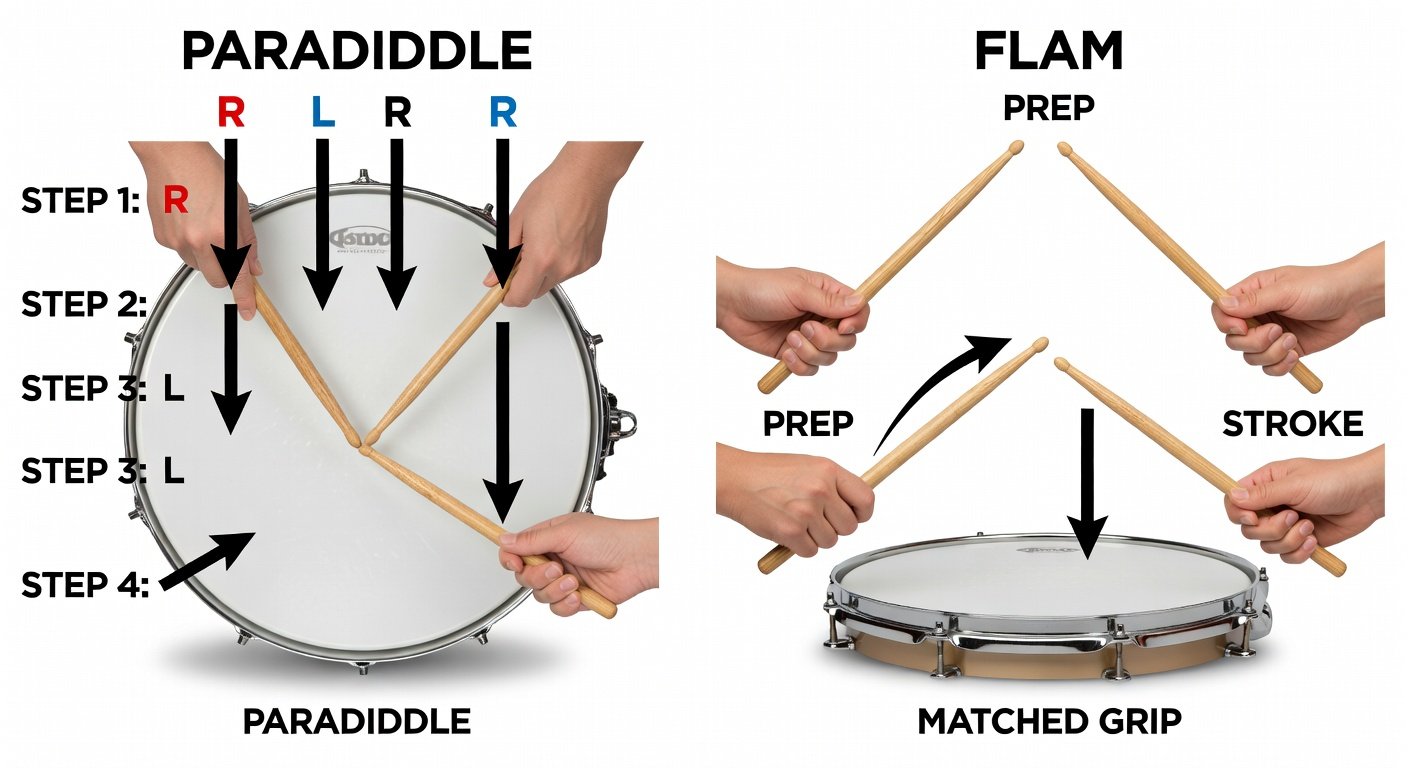
3. Paradiddle
Pattern: R L R R L R L L. Stick to it!
- Play as quarters, accent first R.
- Move around kit: snare to tom to crash.
- Exercise: 16 reps, feet tap quarters.
Improves hand independence.
4. Inverted Paradiddle
R L L R L R R L.
- Mirror the standard paradiddle.
- 80 BPM, focus on clean L doubles.
- Exercise: Alternate with standard paradiddle.
5. Triple Paradiddle
R L R L R R L L R L R.
- Slow motion: enunciate each note.
- Build to 16th notes.
- Exercise: Kit orbit—hi-hat, snare, tom.
6. Flam
Grace note before main: small 'f' before R or L (fr, fl).
- Wrist snap for grace.
- Pattern: flam on 1,3; singles 2,4.
- Exercise: Flam tap—4 flams, crescendo.
Adds flair to grooves.
7. Drag
Two grace notes: dR, dL (like mini double).
- Light graces, full main stroke.
- Combine with singles.
- Exercise: Drag singles around toms.
8. Ratamacue
Five-stroke roll into singles: RR L RR L.
- Keep roll tight.
- 70 BPM, open to closed.
- Exercise: End beats with ratas.
Classic fill rudiment.
9. Single Dragadiddle
dR L dR R L dR L.
- Blend drag and paradiddle.
- Slow for clarity.
- Exercise: 8 reps per hand leading.
10. Four-Stroke Ruff
Three graces + main: dddR.
- Finger control key.
- Pair with singles.
- Exercise: Ruff pyramid like doubles.
Visit the Percussive Arts Society for official 40 rudiments list.
Practice Routine for Mastery
- Warm-up: 5 min singles/doubles at 60 BPM.
- Rudiment block: 2 min each, rotate daily.
- Metronome challenge: +10 BPM when clean.
- Cool-down: Free play with rudiments.
Record yourself—check evenness, relaxation.
Transitioning to Full Beats
Apply rudiments to grooves: e.g., paradiddles on hi-hat for rock beat (R L R R on hats, bass on 1&3, snare 2&4). Start simple:
- Quarter note beat: Bass 1, snare 2, repeat.
- Add paradiddle fills: 8th note hi-hat, insert at end of phrase.
Layer gradually—feet first, then hands.
Genre-Specific Applications
Rock: Singles/doubles for power fills.
Jazz: Paradiddles, flams for swing.
Metal: Triple paradiddles, blasts.
Funk: Drags/ghosts (soft singles).
Practice with play-alongs at varying tempos.
Consistent practice turns rudiments into instinct. Start slow, stay relaxed, and groove on!

No comments yet. Be the first!