 Instrumentiverse
Introduction to Basic Piano Chords for Beginners
Are you a piano for beginners enthusiast ready to dive into the world of music? Mastering basic piano chords is the foundation of playing your favorite songs. This guide breaks it down simply: from proper hand positioning to finger exercises, simple progressions, and practice tips. No prior experience needed—just a keyboard or piano and dedication. By the end, you'll play common chords like C, G, F, and Am confidently.
Chords are groups of three or more notes played together, creating harmony. Popular songs use just a handful of these. Let's start with the essentials.
Step 1: Proper Hand Positioning on the Piano
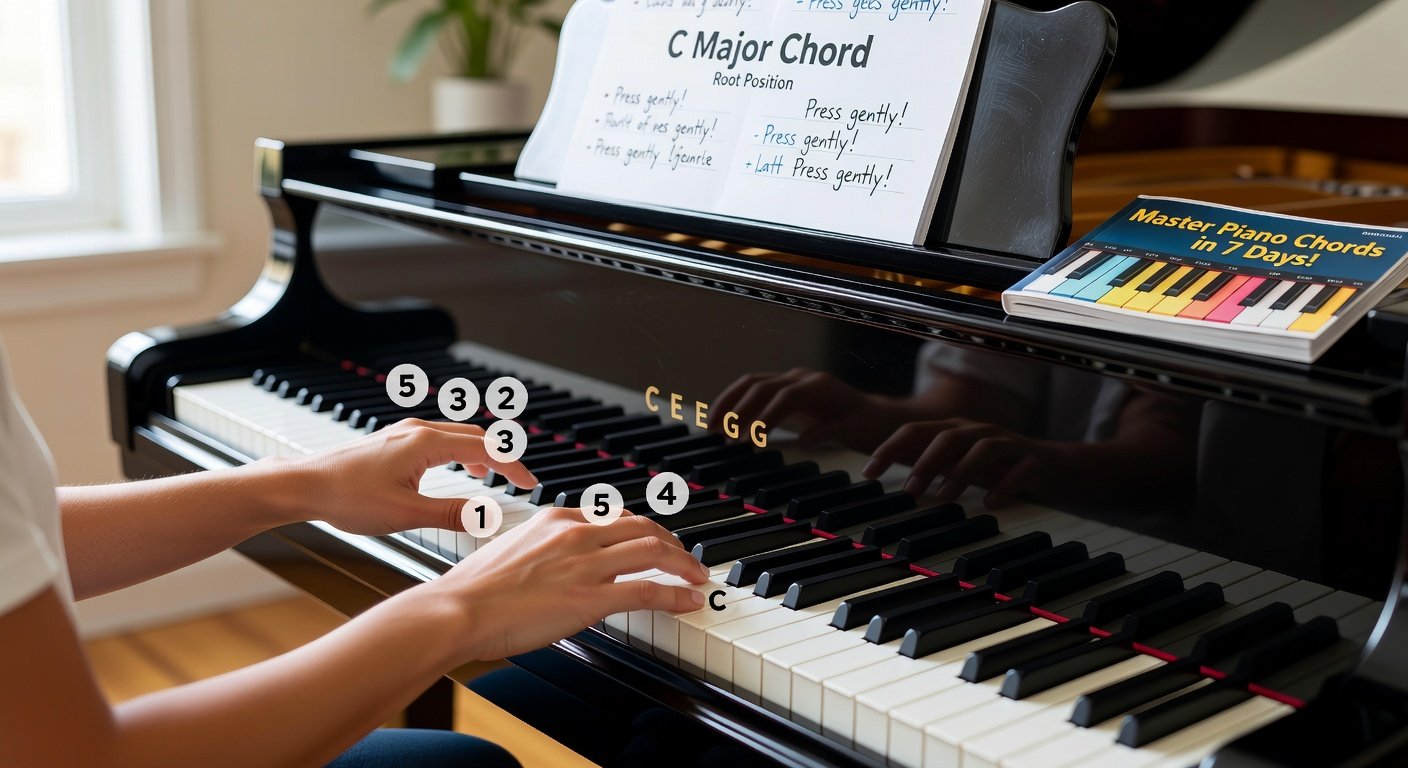
Hand positioning is crucial for piano for beginners to avoid strain and build good habits. Sit at the piano with your back straight, feet flat on the floor, and elbows at keyboard height.
- Curved Fingers: Imagine holding a bubble under each finger—keep them rounded, not flat.
- Relaxed Wrists: Wrists level with the keys, not dipping or rising.
- Thumbs and Pinkies: Point slightly up for reach.
Visualize the keyboard: white keys (naturals) and black keys (sharps/flats) in groups of twos and threes. Middle C is your anchor—find it as the white key left of two black keys in the center.
Step 2: Essential Finger Exercises for Piano Beginners
Before chords, warm up with exercises to build dexterity. Use all five fingers (numbered 1=thumb to 5=pinky).
- Five-Note Scale: On white keys starting at C: Play C(1)-D(2)-E(3)-F(4)-G(5), then back down. Slow tempo, even rhythm.
- Hanon Exercise #1: Ascend and descend slowly, focusing on finger independence.
- Trill Drill: Alternate fingers 2-3 and 3-4 on the same key for 10 seconds each.
Practice 10-15 minutes daily. This strengthens fingers for smooth chord transitions.
Step 3: Learning Your First Basic Piano Chords
Start with major and minor triads—three-note chords. Here's how to form them:
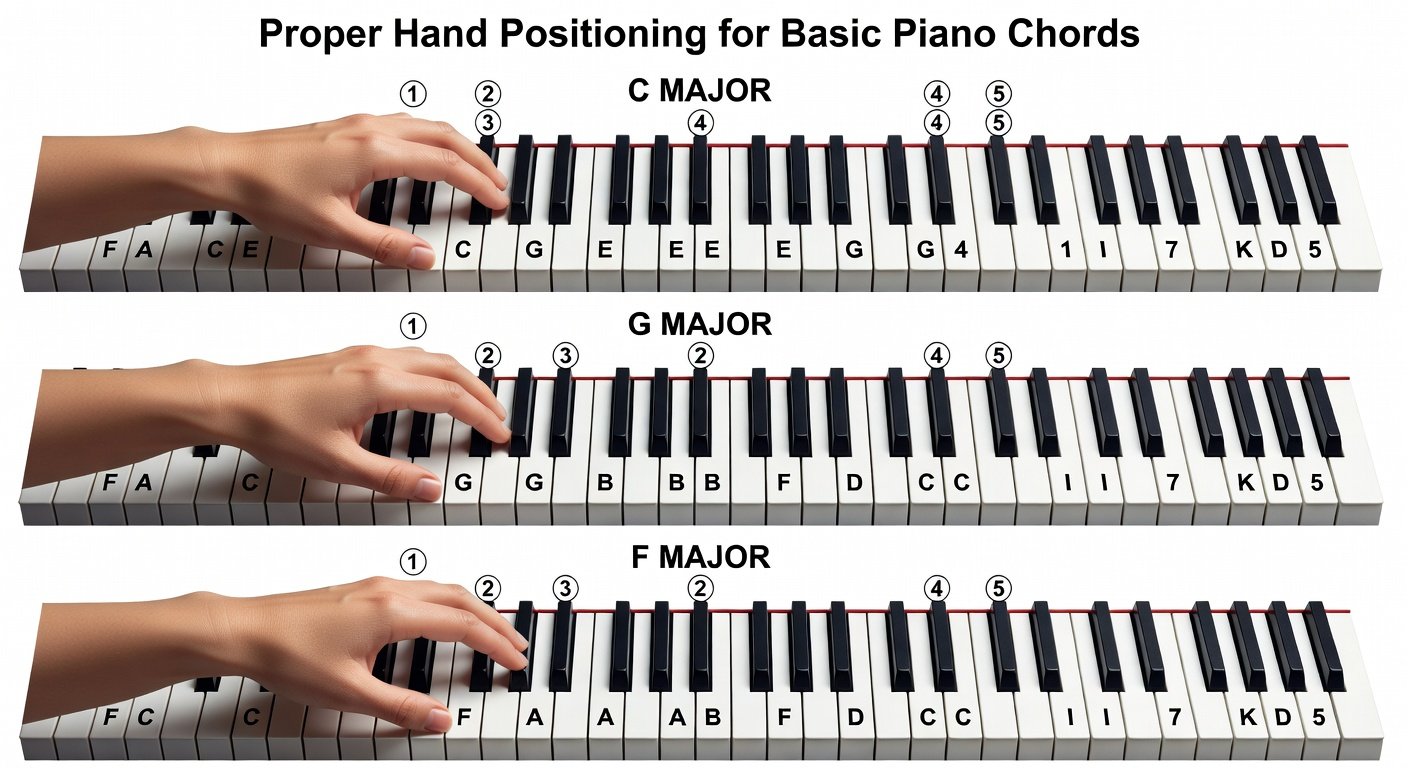
- C Major (C): Right hand: C-E-G (fingers 1-3-5). Left hand mirrors: G-C-E (5-1-3).
- G Major (G): Right: G-B-D (1-3-5). Thumb on G (white key right of two blacks).
- F Major (F): Right: F-A-C (1-3-5).
- A Minor (Am): Right: A-C-E (1-3-5). Easiest minor chord.
Press keys firmly but lightly. Strum from low to high for arpeggios, then block together. For visuals, refer to standard piano layouts like those on Wikipedia's Piano page.
Step 4: Simple Chord Progressions to Play Songs
Progressions are sequences of chords. The I-IV-V (C-F-G) is king for beginners.
- C-F-G (I-IV-V): Play each for 4 beats. Cycle: |C |C |F |F |G |G |C |C|.
- Am-F-C-G: Pop ballad staple: |Am |F |C |G| x2. Try "Let It Be" by The Beatles.
- Canon Progression: C-G-Am-Em-F-C-G-Am. Great for classical feel.
Practice hands separately, then together slowly (60 BPM). Use a metronome app.
Step 5: Applying Chords to Real Songs
Put it together with easy tunes:
- "Twinkle Twinkle Little Star": C-C-G-G-A-A-G, F-F-E-E-D-D-C. Chord under: Mostly C-G-F.
- "Happy Birthday": G-G-A-G-C-B, etc. Chords: G-D-C.
- "Wonderwall" Intro: Em-G-D-A, simplify to Em-G-D.
Search sheet music labeled "easy piano chords." Invert chords (e.g., C/E: E-G-C) for smoother voice leading.
Practice Tips for Consistent Improvement
Consistency beats intensity. Here's how piano for beginners succeed:
- Daily Routine: 20-30 mins: 5 warm-up, 10 chords, 10 songs.
- Slow is Fast: Perfect at half speed before speeding up.
- Record Yourself: Hear progress and errors.
- Metronome Mastery: Start at 50 BPM, increase gradually.
- Hands Together Trick: Play right hand melody, left chords offset by one beat.
Track in a journal: chords mastered, songs played. Join online communities for motivation.
Troubleshooting Common Beginner Issues
Hit snags? Fix them:
- Stiff Fingers: Relax shoulders, shake hands out. More stretches.
- Uneven Sound: Balance finger pressure—forte/piano dynamics.
- Missing Notes: Finger numbering tattoos or stickers on keys temporarily.
- Hand Crossing: Practice inversions or single-hand first.
- Fatigue: Short sessions, ergonomic bench height (knees under keyboard).
For deeper theory, explore chord construction on Wikipedia's Chord page. Check manufacturer guides like Yamaha's piano resources for keyboard specifics.
Next Steps: Beyond Basic Piano Chords
Congrats—you've got the basics! Add 7ths (e.g., G7: G-B-D-F), inversions, and scales. Apps like Simply Piano or Flowkey gamify learning. Soon, improvise over progressions. Keep practicing—musicality grows with time.
Master these fundamentals, and piano for beginners becomes a lifelong joy. Happy playing!

No comments yet. Be the first!